The business had started with a modest office and more uncertainty than money.
I had not planned to become the kind of woman who spent her days discussing contracts and payroll.
Life had moved in that direction one decision at a time.
At first, I worked because the bills needed to be paid.
Then the work grew.
More customers came.
More responsibilities followed.
Before long, people were depending on decisions I made.
I learned to read documents carefully.
I learned to ask questions when someone used language designed to confuse me.
I learned that a person could speak confidently and still be wrong.
Most importantly, I learned that silence during a negotiation could be useful.
You did not have to answer every demand immediately.
You did not have to agree simply because someone expected you to.
I became good at that.
Or so I thought.
The truth was more complicated.
At work, I could refuse an unfair offer.
In my personal life, I sometimes struggled to refuse an invitation that made me uncomfortable.
I could challenge a number in a financial report.
But I could spend hours worrying that a friend might think I was unkind.
I had developed confidence in some areas and left it unfinished in others.
For a long time, I did not see the contradiction.
I assumed that being capable meant I had overcome the insecurities of my youth.
The reunion showed me otherwise.
A few days after I found the school photograph, I went into my office to review some old business records.
I no longer managed every daily operation, but I still liked knowing where things stood.
A folder of early contracts lay near the bottom of a cabinet.
I opened it and found a document from one of the first major agreements I had negotiated.
The paper was thin.
My signature appeared near the bottom.
I remembered that meeting clearly.
The other party had expected me to accept their terms without much discussion.
They had spoken quickly and used unfamiliar technical language.
I had been nervous.
I had gone home the night before and read every page of the draft.
I had written questions in the margins.
I had called someone I trusted and asked for an explanation of a clause I did not understand.
Then I had returned to the meeting and asked for changes.
The other party had looked surprised.
I remembered that expression.
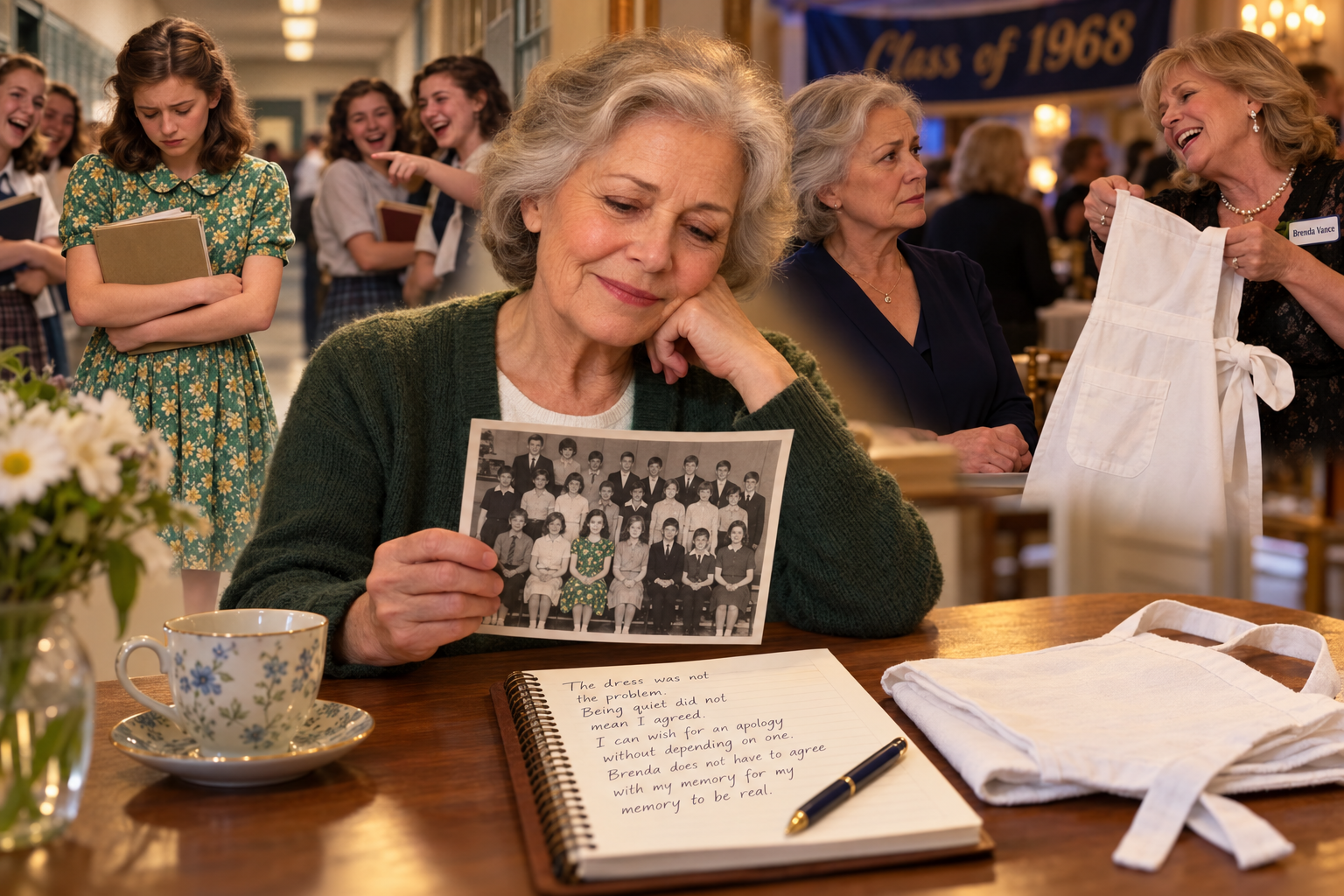
It was the same kind of surprise I had seen on Brenda's face when I refused the apron.
Someone had expected me to behave in a certain way.
I had done something else.
The agreement had not been easy to secure.
There had been disagreements and revisions.
Eventually, we reached terms I could accept.
I held the document and considered the young woman who had signed it.
She had been afraid of making a mistake.
She had been afraid of looking inexperienced.
She had been afraid that asking questions would reveal how much she still needed to learn.
But she had asked anyway.
That was courage.
Not the absence of fear.
The willingness to continue despite it.
I had known that lesson professionally for decades.
I had simply failed to apply it to the memories that mattered most to me.
I returned the contract to its folder.
Then I stood beside the cabinet for a moment, thinking about the difference between respect and approval.
I had spent a great deal of time trying to secure approval.
I wanted people to see me as competent, generous, fair, and reasonable.
Those were good things to want.
But I had sometimes treated another person's approval as proof that I had done the right thing.
That was dangerous.
People could approve of you for the wrong reasons.
They could dislike you for the right ones.
And some people would judge you regardless of what you did.
Brenda had demonstrated that when we were teenagers.
At the reunion, she had demonstrated it again.
I could not control her judgment.
I could control whether I continued to use it as a measure of my worth.
The next time I thought about the apron, I tried to remember the exact moment when I had refused it.
My voice had been quiet.
My hands had trembled slightly.
I had not delivered a speech.
I had not made Brenda admit anything.
I had simply declined.
For years, I had imagined that standing up for myself would require a dramatic confrontation.
Perhaps that was why I had postponed it so often.
I had been waiting to become someone who could deliver the perfect response.
But the perfect response was not necessary.
A clear one was enough.
That realization changed the way I thought about other moments in my life.
I remembered times when I had said yes because I did not want to disappoint someone.
I remembered times when I had stayed quiet because speaking would have created an awkward pause.
I remembered times when I had laughed at a joke I disliked because I wanted the conversation to continue smoothly.
None of those moments had destroyed my life.
But together, they had taught me to treat my discomfort as less important than everyone else's.
I no longer wanted to live that way.
I did not intend to become rude.
I did not intend to challenge every careless remark.
There was no point in turning ordinary life into a series of arguments.
I simply wanted to stop abandoning myself whenever someone else seemed displeased.
That afternoon, I called my son.
We spoke about ordinary things first.
He asked how I was feeling and whether I had been keeping busy.
I told him I had been sorting old papers.
Then I mentioned the reunion.
He knew that I had attended, but I had not told him much about what happened.
I explained the apron.
There was a pause.
“He really did that?”
“She did.”
“Why?”
“I don't know.”
He sounded angry on my behalf.
I found myself wanting to reassure him that it was nothing serious.
The words came automatically.
Then I stopped.
“It upset me more than I expected,” I admitted.
He was quiet for a moment.
“I'm sorry, Mom.”
I looked at the school photograph on the shelf.
“Thank you.”
I did not explain why it had affected me so deeply.
I did not need to turn the conversation into a lesson.
It was enough that I had told him the truth.
Before we hung up, he asked whether I was all right now.
“I think I'm getting there.”
After the call, I sat quietly for a while.
I felt lighter.
Not because my son had solved anything.
He had not.
But I had allowed someone who loved me to know that I had been hurt.
That was different from pretending I was untouched.
For years, I had believed that hiding pain protected the people around me.
Sometimes it had only protected my pride.
I could not change the past.
I could stop making the same choice every time it became uncomfortable to speak honestly.
I went into the kitchen and washed the cup I had used earlier.
The water ran over my fingers.
I watched it disappear down the drain.
Then I dried the cup and put it away.
It was a small, ordinary task.
I found myself smiling.
I had spent decades measuring my progress by what I had built, what I had earned, and what I had survived.
Perhaps another measure was whether I could finally treat myself with the fairness I had tried to show other people.
I did not know how long that would take.
I was willing to begin.
Click here to continue reading: PART 8: When I Thought About Seeing Brenda Again, I No Longer Wanted to Prove My Worth; I Wanted to Understand What I Could Leave Behind
The Woman Who Once Made Me Ashamed of My Clothes Had No Idea What My Life Had Become
Part 7 of 20