A few days later, I went through the closet in my spare room.
I had no particular reason for doing it.
The shelves had become crowded, and I wanted to make space.
There were old coats, folded blankets, and boxes of things I had kept because they seemed too useful to discard.
At the back sat a small cardboard box containing photographs and papers from my younger years.
I brought it to the bed.
Dust rose from the lid when I opened it.
Inside were photographs, old receipts, and a few cards I had saved for reasons I could no longer remember.
I sorted them slowly.
Some photographs showed places I recognized immediately.
Others took a moment.
I found one of myself standing outside a building in a dress I barely remembered.
I looked younger than I felt I had ever been.
My hair was carefully arranged.
My shoes were plain.
My hands rested at my sides.
I wondered what I had thought when the photograph was taken.
Had I been pleased with the dress?
Had I worried about how it looked?
Had somebody complimented me?
Had somebody made a remark I carried home?
I could not remember.
For years, I had allowed Brenda's laughter to stand in for an entire period of my life.
Now I was beginning to understand how unfair that was.
There had been other days.
There had been ordinary afternoons when I had sat with friends.
There had been lessons I enjoyed and people whose names I still remembered with affection.
There had been small victories that had nothing to do with Brenda.
I had forgotten some of them because embarrassment was easier to recall.
Pain had a way of making itself seem more important than everything around it.
I placed the photograph in a pile I wanted to keep.
Then I found an old school paper.
The handwriting was mine.
The letters leaned slightly to the right, and I had pressed hard enough that the marks showed through the page.
I smiled.
I had always written that way.
The paper was unimportant, but seeing it made me feel close to the girl I had been.
She had wanted to do well.
She had worried about ordinary things.
She had probably spent more time thinking about the next school day than about the insult that later came to define her memory of that year.
I had made her life smaller by remembering only the worst part.
I sat on the edge of the bed and let that thought settle.
Then I continued sorting.
I kept what mattered to me.
I discarded a few things I had been carrying from one house to another for no reason beyond habit.
By the time I finished, the box was lighter.
I felt lighter, too.
That afternoon, I went out to buy groceries.
The weather was mild, and I took my time walking through the store.
I chose vegetables, bread, and a few things I needed for the week.
Near the clothing display, a woman stood holding two sweaters against her coat.
She checked the price tags, then returned one to the rack.
There was nothing remarkable about the scene.
People made choices like that every day.
I had done it myself more times than I could count.
Yet I remembered the way I had once felt when I had to make every purchase carefully.
I remembered standing in a store and calculating whether something could be repaired rather than replaced.
I remembered stretching the life of a garment by turning a collar, replacing a button, or mending a seam.
Those decisions had required patience and effort.
They had not made me less deserving of respect.
I wished I had understood that when I was young.
I wished I had known that money could change what a person owned without changing the person's value.
Brenda had grown up with more than I had.
That was a fact.
She had been able to buy clothes without calculating every small expense.
I had not.
That was another fact.
Neither fact gave her the right to humiliate me.
I paid for my groceries and carried them to the car.
On the drive home, I thought about how easily people used appearances to tell themselves stories about others.
A polished shoe became evidence of success.
A worn coat became evidence of failure.
A repeated dress became a reason to laugh.
We looked at what someone could afford and imagined we knew what they deserved.
I had been guilty of making judgments, too.
I had judged people for being unkind, and sometimes I had judged them before giving them a chance.
I could not pretend I had always been fair.
But there was a difference between forming an opinion and deliberately trying to make another person feel small.
That difference mattered to me.
When I got home, I put away the groceries and washed my hands.
Then I sat down with the notebook.
I wrote about the woman choosing sweaters.
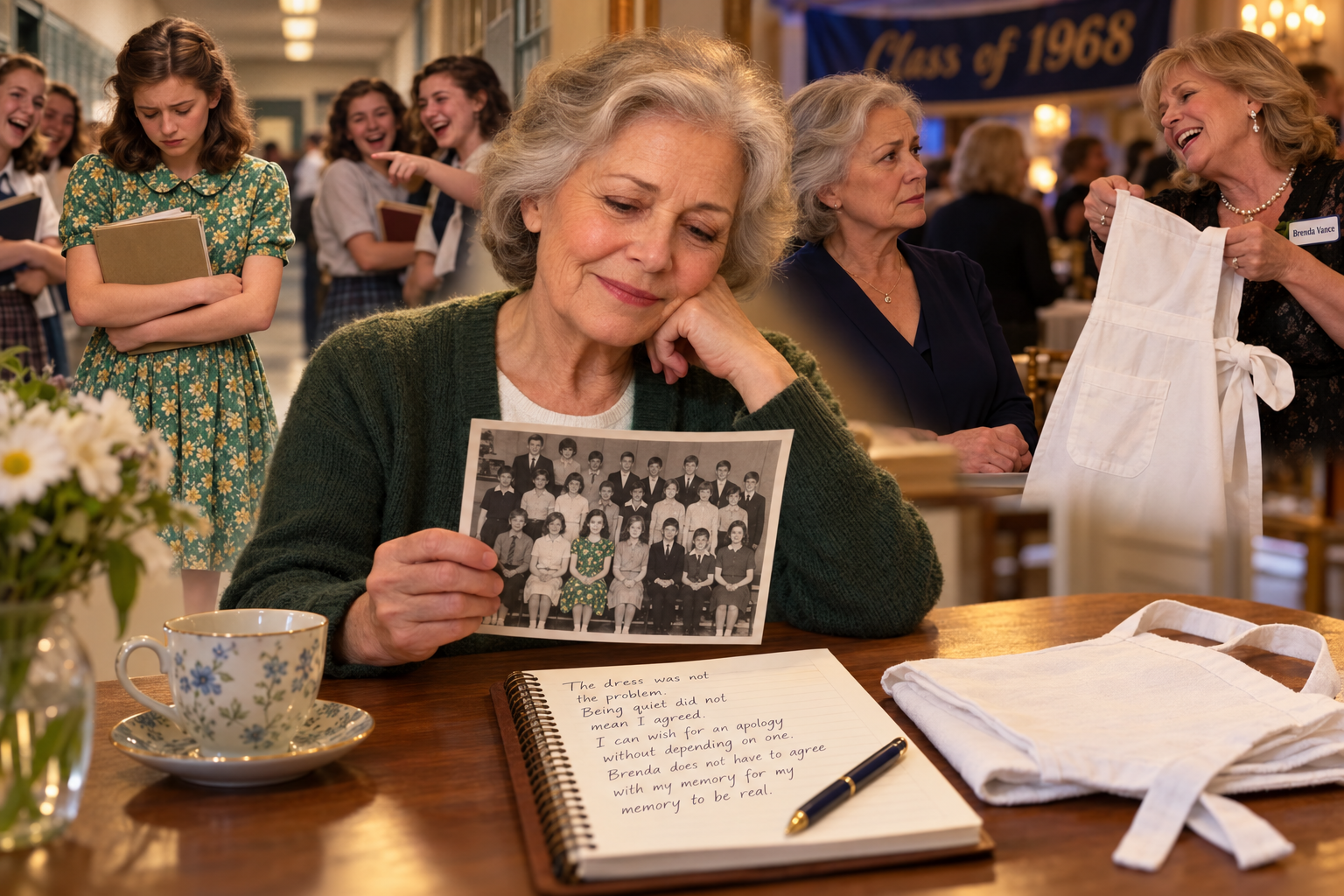
I wrote about the girl in the green dress.
I wrote that a person's circumstances were not an invitation for strangers to measure their worth.
I paused before adding another sentence.
I am allowed to remember what happened without being ashamed that it happened to me.
That sentence felt more difficult than the others.
I had spent decades feeling embarrassed about the way Brenda treated me.
As though her behavior reflected something about my judgment.
As though I should have been cleverer, better dressed, or less sensitive.
I had taken responsibility for an insult I had not created.
I had carried it as if it were a private failure.
The truth was much simpler.
I had been a teenager.
I had owned four school dresses.
I had worn one of them more than once.
Brenda had chosen to make fun of me.
I had been hurt.
There was no secret flaw in that account.
I could stop looking for one.
That evening, I placed the notebook beside the school photograph.
I studied the girl in the back row again.
This time, I did not focus on her dress.
I looked at her face.
She seemed serious.
Perhaps she was tired.
Perhaps she was simply waiting for the photographer to finish.
I could not know.
I had no right to invent feelings for her any more than Brenda had had the right to decide what her clothes meant.
I let the photograph rest on the table.
Later, as I prepared for bed, I thought about the white apron again.
I understood why it had unsettled me.
Brenda had not known what I had carried from the past.
Or perhaps she had known enough and simply hadn't cared.
I could not be certain.
I didn't need to be.
Her intention did not erase the effect.
And the effect did not mean I had to spend the rest of my life trying to understand her.
I could acknowledge the hurt and still move forward.
I could even remember the parts of my school years that had been good.
For the first time, that possibility seemed real.
The next morning, I made a small change.
I moved the school photograph from the kitchen table to a shelf where I kept pictures of people and places that mattered to me.
I did not put it in the back of a drawer.
I did not hide it behind another frame.
I placed it where I could see it.
The photograph was not a celebration of what Brenda had done.
It was a reminder that I had lived a life far larger than one cruel moment.
I had been that girl.
I was also the woman who had grown beyond the hallway.
Both things were true.
And neither one needed to be ashamed of the other.
Click here to continue reading: PART 12: When Brenda’s Name Came Up Again, I Let Myself Answer Without Pretending Nothing Had Happened
The Woman Who Once Made Me Ashamed of My Clothes Had No Idea What My Life Had Become
Part 11 of 20