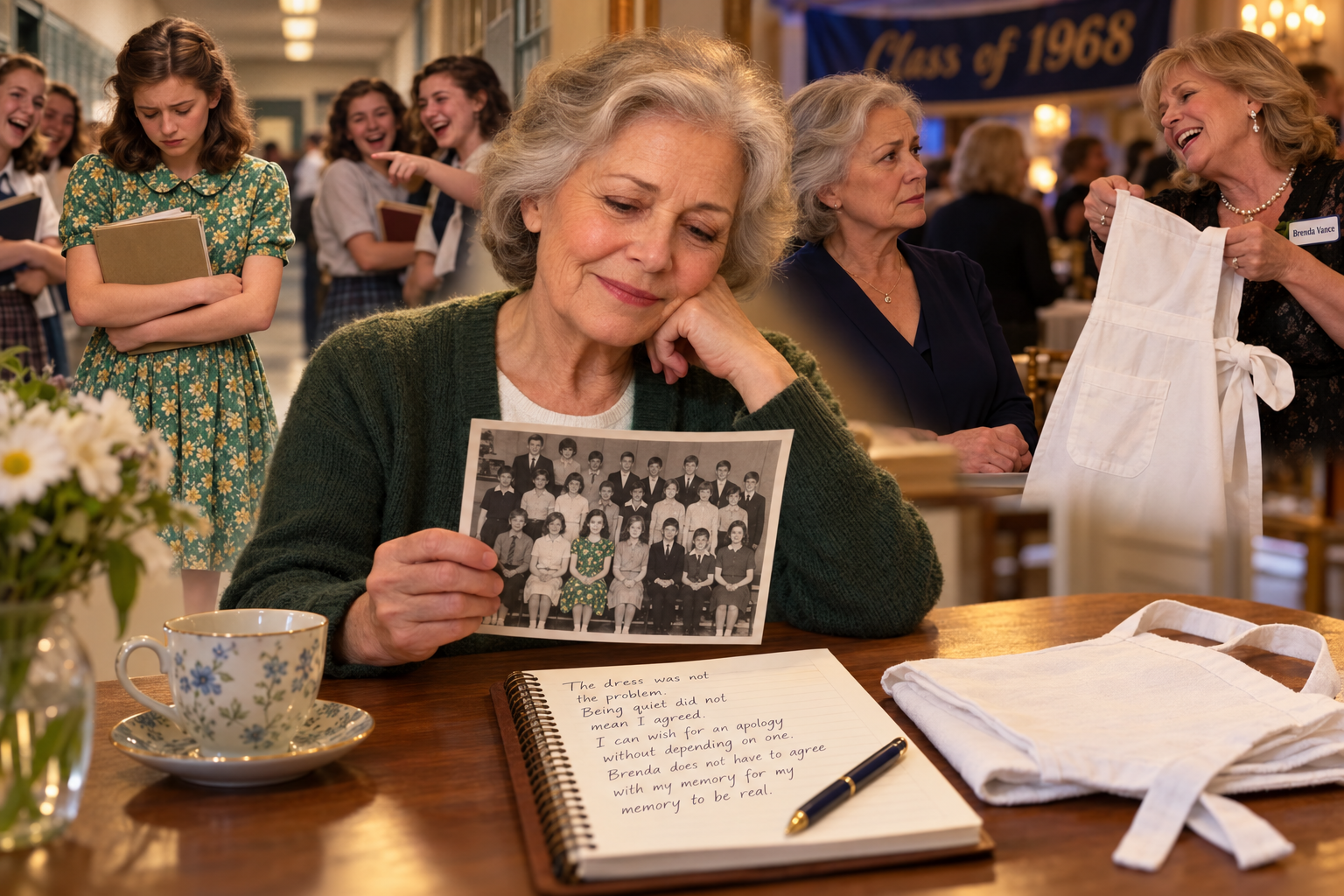
The following day, I took the school photograph from the shelf and placed it on the kitchen table.
I wanted to look at it without rushing.
For years, I had glanced at old photographs as if they were windows into rooms I no longer belonged in.
I would recognize a face, remember a place, and move on.
This time, I stayed with the picture.
I looked at the students standing in rows.
Some seemed confident.
Others looked uncomfortable in front of the camera.
A few were smiling at something beyond the photographer's view.
They were ordinary teenagers, each with a private life I knew very little about.
I had spent so much time remembering Brenda as the person who hurt me that I had allowed her to become the center of the photograph in my mind.
But she was only one person in a crowded group.
I was there, too.
So were people who might have remembered the day differently.
I could not know what each of them had been thinking.
I could only stop treating my own humiliation as the only truth the photograph contained.
I took my notebook from the drawer.
On a clean page, I wrote the date and then described the photograph.
I wrote about the rows, the stiff collars, the careful hairstyles, and the way my hands were folded.
Then I wrote about the green floral dress.
I did not call it ugly.
I did not call it embarrassing.
I wrote that it was one of four dresses I had for school.
I wrote that I had worn it more than once because that was what I could afford.
I wrote that I had liked it before Brenda made it a subject of ridicule.
That last detail mattered most.
I had almost forgotten that I had liked the dress.
Somewhere along the way, Brenda's laughter had replaced my own memory of it.
I had remembered the dress through her eyes.
I had remembered myself through the judgment of a girl who had no right to define me.
I put the pen down.
The room was quiet except for the refrigerator humming in the corner.
I sat with the photograph until the light shifted across the table.
Then I put it back on the shelf.
I did not feel triumphant.
I felt sad for the time I had spent carrying the memory incorrectly.
But sadness was different from shame.
Sadness allowed me to acknowledge what had happened.
Shame told me I should have been different.
I no longer wanted to confuse the two.
That afternoon, I went for a walk by myself.
I followed a familiar route, moving slowly and watching the pavement ahead of me.
A couple passed with a dog that kept stopping to sniff the same patch of grass.
The woman laughed and gently tugged the leash.
I smiled as they went by.
I thought about how many small moments I had missed when I was busy rehearsing old arguments in my head.
The world had not been waiting for me to resolve my feelings about Brenda.
It had continued to offer ordinary days.
I wanted to be present for more of them.
When I returned home, I made a cup of tea and sat beside the window.
I thought about what I would say if Brenda contacted me.
The idea still made me uncomfortable.
I did not know whether she would ever reach out.
I did not know whether she remembered the school incident as clearly as I did.
Perhaps she remembered it only as an unimportant joke.
Perhaps she had forgotten it completely.
I could not answer those questions from my kitchen.
I could not enter her mind and search for an explanation.
What I could do was decide how I would respond if our paths crossed again.
I would not pretend the apron had amused me.
I would not exaggerate what had happened.
I would not use the old memory as a weapon.
I would tell the truth.
If Brenda listened, I would speak to her.
If she dismissed me, I would not spend hours trying to persuade her that my feelings were real.
I had spent enough time waiting for the person who hurt me to become the person who understood.
Understanding would be welcome.
It was no longer a condition I needed to meet before I could move forward.
The thought brought a quiet relief.
I had imagined that healing required some final conversation in which every question was answered.
Perhaps that could happen.
But perhaps it would not.
I did not want my remaining years to depend on a conversation I could not arrange.
I wanted to live without needing Brenda to confirm that I had been treated unfairly.
The next morning, Eleanor sent a short message asking whether I was free later in the week.
I replied that I was.
She suggested we meet for coffee again.
I agreed.
When I put down the telephone, I noticed how easily I had answered.
I had not studied my calendar for hidden reasons to refuse.
I had not worried that she might think I was too eager.
I wanted to see my friend, so I had said yes.
That was all.
Later, while putting away the dishes, I remembered the white apron folded on the service table at the reunion.
For a while, that image had bothered me almost as much as Brenda's gesture.
I had imagined it lying there, waiting for somebody else to pick it up.
I had wondered whether leaving it behind had made me look offended.
Now I understood that I had no obligation to manage the appearance of my refusal.
I had not taken the apron.
That was the end of it.
Brenda could interpret my decision however she wished.
The other guests could think what they liked.
I did not need to explain myself to an imaginary audience.
I finished washing the dishes and dried my hands.
Then I opened the notebook.
Under the description of the photograph, I wrote:
I liked that dress before anyone laughed at it.
The sentence made me smile.
It was such a small thing to reclaim.
But it belonged to me.
I had liked the dress.
I had worn it because it was mine and because I needed something to wear.
There was no reason to be ashamed of that.
I could not recover every feeling I had experienced at seventeen.
I could not remember the exact color of every flower or how the fabric felt against my skin.
But I could stop allowing Brenda's laughter to erase the simple fact that I had once been a girl who liked what she wore.
That evening, I left the photograph on the shelf and closed the notebook.
The memory remained.
It was not gone.
But it had become smaller in a different way.
Not because I had dismissed my pain.
Because I had stopped adding blame to it.
Click here to continue reading: PART 15: I Realized That I Could Remember the Past Without Asking It to Apologize for Me
The Woman Who Once Made Me Ashamed of My Clothes Had No Idea What My Life Had Become
Part 14 of 20