
I couldn't stop hearing the word safety.
Abigail had used it as though it settled everything.
She had spoken about Mom's condition with the confidence of someone who believed there was nothing left to discuss.
I had almost accepted that.
Not because I was convinced.
Because I had wanted to believe her.
That was difficult to admit.
I had been away on deployment.
I had not witnessed what had happened at home.
Abigail had been there.
It would have been easier to assume she understood the situation better than I did.
But I had seen enough to know that her explanation was incomplete.
And every time I looked toward the stairs, I felt the weight of that missing truth.
Abigail seemed to notice my distraction.
"You're quiet."
I looked at her.
"I'm thinking."
"About your mother?"
I didn't answer immediately.
There was no point denying it.
"Yes."
She sighed.
"I know this isn't what you expected to come home to."
I studied her face.
That was the first thing she had said that felt completely true to me.
I had expected a reunion.
I had expected ordinary problems.
I had expected to hear about the things I had missed while I was gone.
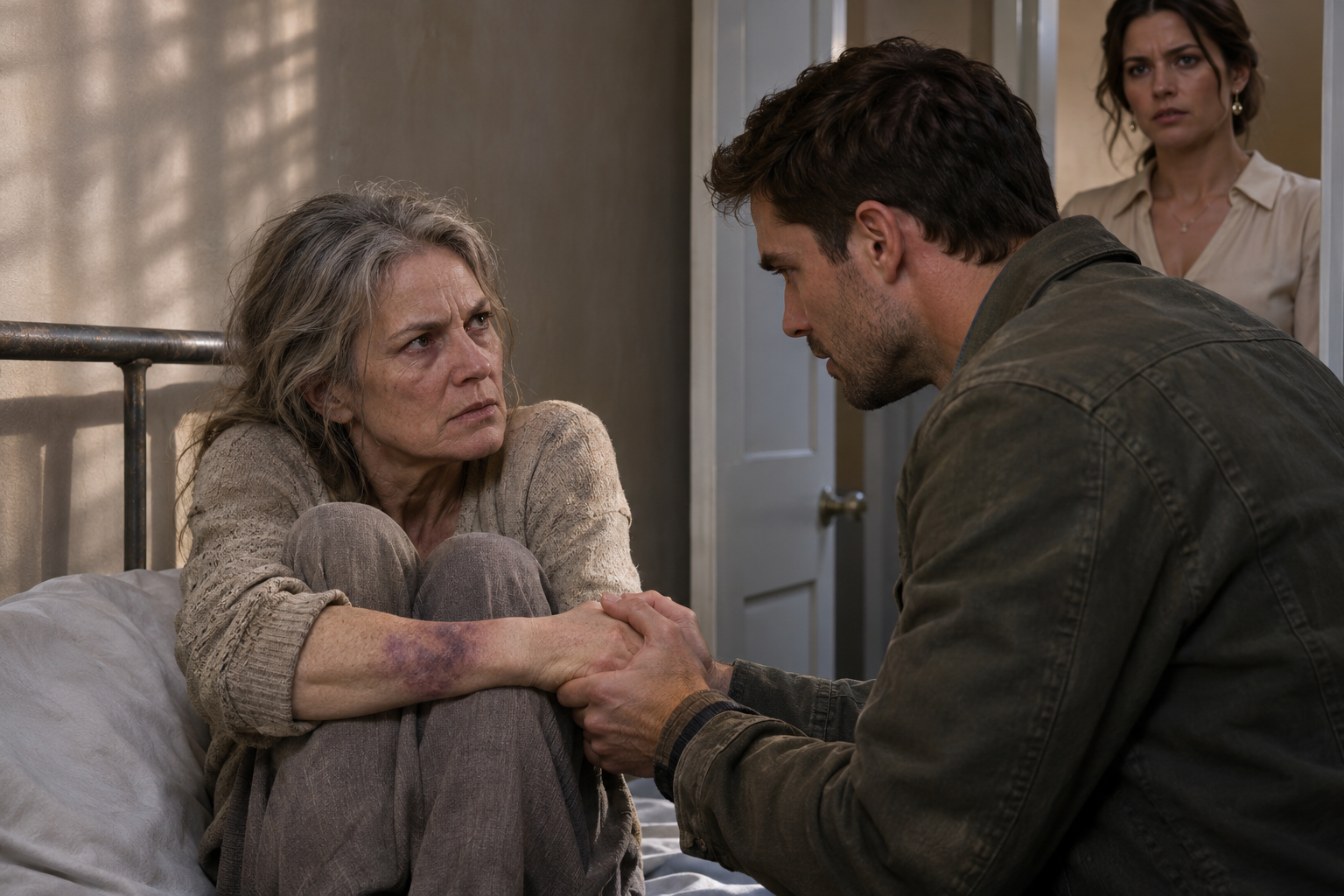
I hadn't expected my mother to be locked in a dark room.
I hadn't expected to find bruises.
I hadn't expected to wonder whether my wife was telling me the truth.
"No," I said. "It isn't."
Abigail lowered her eyes.
For a moment, she looked genuinely tired.
I reminded myself that exhaustion could be real even when an explanation was incomplete.
A person could be overwhelmed.
A person could make poor decisions while trying to help someone.
I understood that.
I wasn't interested in finding reasons to condemn Abigail before hearing the facts.
But there was one thing I couldn't accept.
The conditions in Mom's room were not something I could overlook.
A bare bed.
Old clothes.
Water left in a plastic cup.
An absent phone.
Those things required answers.
Even if Mom had been seriously confused, she still deserved comfort.
Even if she had behaved unpredictably, she still deserved to be treated with dignity.
Even if Abigail had struggled, Mom still needed care.
I kept returning to those simple facts.
They weren't complicated.
They didn't depend on knowing whether Abigail had meant well.
They didn't require me to understand every medical possibility.
My mother was a person.
And I had seen her living in conditions I would never willingly have chosen for her.
"Abigail," I said.
She looked up.
"Can you tell me what happened before I came home?"
She frowned slightly.
"What do you mean?"
"With Mom."
"I've already told you."
I waited.
She didn't continue.
I felt the familiar pull of frustration.
I could have argued.
Instead, I tried to make the question smaller.
"When did you start worrying about her?"
Abigail leaned back.
"It's been difficult."
I watched her.
That wasn't an answer.
I wondered whether she realized it.
Or whether she had become accustomed to using broad explanations instead of describing particular events.
"Was there something that happened?" I asked.
She looked toward the stairs.
"Samuel, she's not herself."
Those words stayed with me.
Not herself.
I thought about the woman behind the door.
The way she had recognized me.
The way she had spoken with certainty.
The way she had held my hand.
She had seemed very much herself to me.
Not happy.
Not comfortable.
But herself.
I looked at Abigail.
"What does that mean?"
She appeared frustrated.
"She's been confused."
I waited again.
I wanted an example.
A moment.
Something concrete that would help me understand why she believed a locked bedroom was necessary.
But Abigail did not give me one.
Instead, she returned to the same explanation.
"She needs someone who knows how to take care of her."
I nodded slowly.
"Professional care."
"Yes."
I remembered hearing her say that to the neighbor.
She had spoken as though plans were already underway.
As though the decision had nearly been made.
I wondered whether Mom knew what was being discussed.
I wondered whether anyone had asked her what she wanted.
I knew I had not.
I had barely spoken to her before being forced to leave the room.
That made me feel worse.
I had told her I believed her.
But I had not asked the questions that might have helped me understand what she had experienced.
I had seen her injuries.
I had seen how she was living.
And I had been so afraid of Abigail finding us together that I had walked away before learning much more.
The regret was immediate.
I knew I needed another chance to speak with Mom.
I also knew I could not allow Abigail's account to be the only one I heard.
"Does Mom agree with the plan?" I asked.
Abigail looked at me.
"She's not in a position to make those decisions."
The answer came easily.
Too easily for my comfort.
I thought about Mom insisting that she understood what was happening.
I thought about the anger in her eyes.
I had no reason to believe she would agree with Abigail's description.
But I didn't know what she would say about professional care.
I hadn't asked her.
That was another question I needed to bring upstairs.
"Has anyone explained it to her?" I asked.
"Samuel."
Abigail said my name as though I was being unreasonable.
I looked at her.
"I'm asking."
"I know."
"Then help me understand."
She was quiet.
For a moment, I thought she might finally tell me something specific.
Something that would explain why the situation had reached this point.
But she only shook her head.
"It's been hard."
I felt disappointed.
Not surprised.
Disappointed.
I had wanted her to give me something I could hold alongside what I had witnessed.
An explanation that would account for the locked door.
The missing phone.
The bruises.
The bare mattress.
But she was still speaking in general terms.
And I was still left with the same questions.
I looked down at my hands.
I remembered Mom's grip.
Her fingers had closed around mine with purpose.
It had lasted only a moment.
But it told me more about how she felt than Abigail's careful explanations had told me all afternoon.
I was trying to be patient.
I was trying not to decide the worst before I knew the facts.
But every conversation with Abigail made that patience harder to maintain.
I asked myself what I would think if someone else had described finding an older relative in that room.
I knew the answer.
I would have been concerned.
Deeply concerned.
I would have wanted to know why the person was locked inside.
I would have wanted an explanation for the bruises.
I would have wanted to make sure they could communicate with someone outside the house.
I would not have accepted that everything was fine because someone said the word safety.
Yet here I was.
Sitting in the same house.
Listening to those explanations.
Trying to convince myself that I should not react too quickly.
I realized how much my relationship with Abigail affected my judgment.
I had trusted her.
I had loved being able to come home to someone familiar.
I had wanted to believe she was doing the right thing.
Those feelings were real.
But they did not erase what I had found upstairs.
I looked at her again.
She had become quiet.
I wondered what she was thinking.
Did she believe Mom was truly confused?
Did she think keeping her locked away was necessary?
Did she understand how that room would look to anyone who opened the door?
I couldn't answer any of those questions.
I didn't know what was inside Abigail's mind.
And I had to stop pretending I could read it.
What I knew came from what I had seen and heard.
Mom had been isolated.
Her room was dark.
Her bed lacked sheets.
She had no phone within sight.
Her wrists were bruised.
And she had plainly denied being confused.
Those were facts I could return to.
They were enough.
I didn't need to imagine a hidden motive to recognize that something was wrong.
I didn't need to invent an explanation for the injuries.
I needed to learn what had happened.
That was different.
It was the difference between suspecting and knowing.
I wanted to preserve that difference.
Because if I allowed my anger to fill the gaps, I might miss something important.
But I also understood that waiting for perfect certainty could become another kind of failure.
Mom was still upstairs.
She was not an abstract problem.
She was not a medical description.
She was not a burden being discussed by other people.
She was my mother.
And she was waiting behind a locked door.
I stood.
Abigail looked up.
"Where are you going?"
I hesitated.
I could feel myself being pulled between the same choices again.
Tell her what I knew.
Demand answers.
Or keep the conversation calm until I could speak to Mom privately.
I chose not to accuse her.
Not yet.
"I need a minute," I said.
Abigail studied me.
Then she nodded.
I stepped away.
I didn't feel relieved.
I felt exhausted.
I had spent so much effort hiding my concern that I had barely made progress toward understanding what happened.
But one thing had become clear.
Abigail's explanation was no longer enough for me.
It didn't matter how gently she repeated it.
It didn't matter how worried she appeared.
The room upstairs existed.
The bruises existed.
My mother's words existed.
And I could not pretend those things were less important than keeping the peace between Abigail and me.
I looked toward the stairs.
The second floor was quiet.
I thought about the key.
I thought about opening that bedroom door again.
And I understood that the next conversation I needed was not another conversation about Mom.
It had to be a conversation with her.
Click here to continue reading: PART 7: I Had Returned Home Ready to Trust Abigail, but My Mother’s Quiet Words Made Me Examine Every Excuse I Had Accepted
I Came Home From Deployment Expecting to See My Mother, but One Locked Bedroom Door Made Me Question Everything Abigail Said
Part 6 of 10

One Comment on “PART 6 – Every Time Abigail Said My Mother Needed Protection, I Remembered the Empty Bed and the Bruises She Had Not Explained”