Eric read Melinda's message three times.
He did not reply.
His thumb hovered over the screen, then dropped to his knee.
I watched him carefully.
“Has she sent messages like that before?”
“No.”
“Are you sure?”
He rubbed both hands over his face.
“She has been pressuring me.”
“About what?”
“Money.”
I looked at Mr. Dawson.
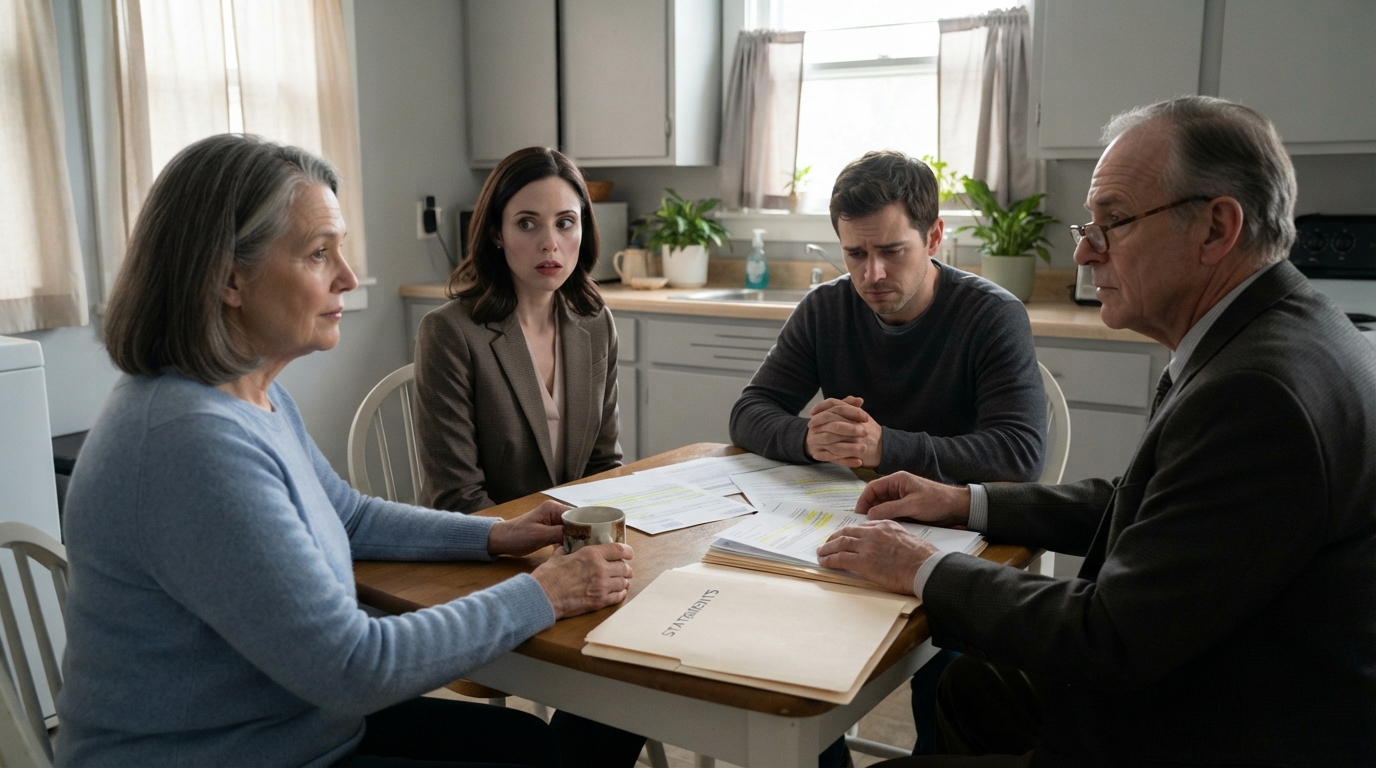
He had opened his briefcase and was arranging documents across the table.
“Then let's stop guessing,” he said. “We need the complete account history.”
Eric looked at him.
“You think Melinda took money?”
“I think we have evidence that someone accessed your mother's account without proper authorization.”
“That doesn't mean she did it.”
“No,” Mr. Dawson said. “It doesn't.”
He tapped the statement.
“But her name appearing as an authorized user is not something we should ignore.”
Eric stared at the paper.
“I didn't know she had access.”
I believed him.
But belief had become a dangerous thing in my house.
For years, I had believed that Eric would tell me if something was wrong.
I had believed Melinda's questions were harmless.
I had believed Dale's warnings were merely the caution of a man who worried too much.
Now every assumption seemed to have a crack running through it.
Mr. Dawson pulled another document from his briefcase.
“This is the original authorization on file.”
I leaned closer.
There was a signature at the bottom.
Dale's name.
My heart stopped.
“That isn't possible.”
Mr. Dawson nodded.
“I know.”
Eric looked from the document to me.
“Dad signed it?”
“Dale died before this authorization was supposedly submitted.”
The kitchen went silent.
Eric stood.
“Then someone forged it.”
Mr. Dawson didn't disagree.
He picked up another page.
“This is the date the bank says the authorization was entered.”
I looked at the calendar.
“Three months after Dale died.”
Eric stared at the paper.
“Who submitted it?”
“The bank doesn't have a clear record yet.”
“Can they tell who logged in?”
“I'm asking them to retrieve the access history.”
Eric paced toward the window.
“Mom, I swear I didn't do this.”
“I know.”
He turned.
“You believe me?”
“Yes.”
His shoulders dropped.
For a moment he looked like the boy who used to come home from school with a scraped knee and pretend it didn't hurt until he reached me.
Then he said, “I think Melinda is in trouble.”
I waited.
“What kind of trouble?”
“I don't know.”
“Eric.”
He swallowed.
“She borrowed money.”
“How much?”
“I don't know.”
“You just told me she was pressuring you about money.”
“She said the business needed it.”
“What business?”
He looked embarrassed.
“M&M Family Development.”
I frowned.
“That sounds like a construction company.”
“It is.”
“You never told me you and Melinda had a development company.”
“It started small.”
“How small?”
“Renovations. A few properties.”
“And now?”
He looked away.
“Now it's bigger.”
Mr. Dawson folded his hands.
“Bigger in what way?”
Eric didn't answer.
I stood.
“Eric.”
He finally looked at me.
“We're behind.”
“How far behind?”
“I don't know.”
“That isn't good enough.”
He lowered his voice.
“About two hundred thousand.”
The number seemed absurd.
Two hundred thousand dollars.
I had never heard my son mention a debt remotely close to that amount.
“How?”
“Loans.”
“From whom?”
“Banks. Private lenders.”
“Why?”
He shook his head.
“We bought two properties.”
“And they didn't sell?”
“They haven't sold.”
“So you borrowed against them.”
“Yes.”
“How much did Melinda borrow?”
“I don't know.”
I looked at Mr. Dawson.
He had stopped taking notes.
“That's what we need to find out.”
Eric's phone vibrated again.
This time he looked at it immediately.
His expression changed.
“It's the bank.”
“Answer it,” I said.
He did.
“Hello?”
He listened.
“Yes.”
A pause.
“No, I didn't authorize that.”
Another pause.
“I'm sorry, what account?”
His face tightened.
“What amount?”
He looked at me.
“Five thousand?”
He listened again.
“No. No, I don't know that company.”
He hung up.
“What was it?” I asked.
He sat down.
“Someone tried to open a business credit account using my name.”
The room seemed colder.
“When?”
“Yesterday.”
“Did they succeed?”
“The bank stopped it because they flagged the application.”
“Why would they use your name?”
He looked at me.
“I don't know.”
But I did.
At least I knew what question needed to be asked.
“Has Melinda ever taken copies of your identification?”
He went still.
“Yes.”
“When?”
“Last year.”
“Why?”
“She said we needed them for taxes.”
Mr. Dawson exchanged a look with me.
“Did she keep the copies?”
“I assumed she did.”
“Do you know where?”
“No.”
I walked to the cabinet where Dale's old paperwork was stored.
The cabinet had always been his territory.
Even after his death, I had avoided opening it unless necessary.
I unlocked it.
Inside were folders arranged by year.
Tax records.
Property documents.
Insurance.
Investment statements.
Estate paperwork.
And one folder labeled FAMILY.
I pulled it out.
Eric came to stand beside me.
“What are you looking for?”
“I don't know yet.”
I opened the folder.
The first pages were ordinary.
Copies of birth certificates.
Insurance information.
Old tax forms.
Then I found a photocopy of Eric's driver's license.
I looked at him.
“Did you put this here?”
“No.”
I turned the page.
There was another copy.
Then another.
All from different dates.
My hands began to shake.
“Why would Dad keep copies of your license?”
Eric stared.
“I don't know.”
Mr. Dawson reached for the folder.
He examined the dates.
“These copies were made after Dale's death.”
That stopped all three of us.
“How?” I asked.
“Someone added them.”
I looked toward the doorway.
Nothing moved.
But suddenly my house felt unfamiliar.
The same walls.
The same furniture.
The same family photographs.
Yet someone had been moving through our private records while I was grieving.
Eric sat at the kitchen table again.
“I should have told you.”
I closed the cabinet.
“Told me what?”
He stared at his hands.
“Melinda asked me to sign something.”
“What?”
“A property document.”
“What property?”
He hesitated.
“Your house.”
I felt the blood leave my face.
“My house?”
“She said it was only a temporary guarantee.”
“For what?”
“The business.”
“You were going to use my house as collateral?”
“No.”
His voice broke.
“I refused.”
“When?”
“About two months ago.”
“Why didn't you tell me?”
“I thought it was handled.”
“How?”
“She got angry.”
“Of course she did.”
“She said I wasn't supporting my family.”
“And what did you do?”
“I walked away.”
I looked at him.
“Then why didn't you tell me?”
He looked ashamed.
“Because I was embarrassed.”
That answer hurt.
Not because I wanted to punish him.
Because I suddenly understood how much silence had protected Melinda.
Every time Eric decided not to tell me something, she gained another place to hide.
Mr. Dawson closed the folder.
“I want to ask Eric something.”
I nodded.
“Has Melinda ever mentioned the Hawthorne property?”
Eric frowned.
“No.”
Mr. Dawson's expression didn't change.
“Are you sure?”
“Yes.”
“Never?”
“Never.”
I looked at him.
“What is Hawthorne?”
Mr. Dawson glanced at me.
Then at the clock.
“Dale owned land outside the city.”
“How much land?”
“Forty acres.”
I stared.
“I've never heard of it.”
“I know.”
“Why?”
“Dale asked me to keep it separate from the rest of the estate.”
“Separate how?”
“Through a long-term holding structure.”
Eric looked confused.
“Why would Dad do that?”
Mr. Dawson didn't answer.
I felt an old memory stir.
Years ago, Dale had driven somewhere alone on a Saturday morning. When he returned, he had been unusually quiet.
I had asked where he had gone.
He had kissed my forehead and said, “Just taking care of something for our future.”
I had never asked again.
Now I wondered whether that land had been what he meant.
“How much is it worth?” I asked.
Mr. Dawson hesitated.
“Several million.”
Eric stared at him.
“What?”
“Approximately four-point-eight million at the last appraisal.”
The room went silent.
I sat down.
Melinda had asked for twenty thousand.
She had accessed my account.
Someone had forged Dale's authorization.
Eric's identity had apparently been used to open credit.
And Dale owned an asset worth nearly five million dollars that I had never known existed.
I looked at Mr. Dawson.
“Who knows about the property?”
He answered carefully.
“Dale.”
“Obviously.”
“You.”
“Apparently not.”
“Me.”
“Anyone else?”
He shook his head.
“I don't know.”
Eric looked uneasy.
“Mom, why would Dad hide a property from you?”
“I don't know.”
Mr. Dawson gathered the papers.
“I think we should meet tomorrow.”
“Why not today?”
“Because I want the bank records first.”
“What records?”
“Everything.”
He looked directly at me.
“Every withdrawal. Every login. Every authorized user. Every transfer.”
I nodded.
That night, Eric stayed for dinner.
Neither of us ate much.
He sat at the table where Dale had always sat on Sunday mornings, newspaper folded beside his plate.
After dinner, Eric washed the dishes.
I watched him from the doorway.
“You don't have to do that.”
“I know.”
He rinsed a glass.
“Mom?”
“Yes?”
“Do you think Dad knew something?”
I looked at the empty chair.
“I think your father knew more than he told me.”
Eric dried the glass slowly.
“Why?”
“I don't know.”
He nodded.
Then he said something that stayed with me long after he left.
“Dad always told me that if something seemed too complicated, I should ask who benefited from keeping it complicated.”
I stood alone in the kitchen after he drove away.
I thought about Melinda.
I thought about the account.
I thought about the property.
And I thought about Dale.
The next afternoon, Mr. Dawson arrived with a thick binder.
He placed it on my table.
“This is the preliminary account history.”
I opened it.
There were dozens of transactions.
Most were ordinary.
Then I saw the withdrawals.
$2,400.
$3,100.
$1,850.
$4,800.
$6,500.
All over several months.
I turned the page.
Another set.
The amounts were smaller.
Some were labeled household expenses.
Others were online transfers.
One had been used to pay a credit card.
Another had gone to a company I didn't recognize.
“Who owns this company?”
Mr. Dawson looked at the statement.
“We're checking.”
I kept reading.
The total grew.
My hands became cold.
“How much?”
He didn't answer.
“How much was taken?”
He finally said it.
“$18,740.”
Eric, who had arrived ten minutes earlier, stared at him.
“What?”
“That's only the amount we can currently trace.”
Melinda walked through the front door.
She had a key.
I had given it to her years ago.
She stopped when she saw the papers.
Her eyes moved from me to Eric, then to Mr. Dawson.
“What is this?”
I looked at her.
“You tell me.”
She took one step forward.
“I don't understand.”
I turned the binder toward her.
“This is my account.”
She looked at the first page.
Then the second.
Her face changed.
Not dramatically.
Just enough.
A small tightening around the eyes.
A pause before she breathed.
I had seen that expression before.
It was the face of someone searching for the safest lie.
She looked at Eric.
“What did you tell your mother?”
Eric didn't answer.
I did.
“We're past what he told me.”
I pointed to the statements.
“I want to know why your name appears beside these transactions.”
Melinda swallowed.
“That isn't what you think.”
“Then tell me what it is.”
“It was temporary.”
“What was?”
“The money.”
I stared at her.
“You took money from my account?”
“I borrowed it.”
“Without asking?”
“I was going to replace it.”
“When?”
“When the business recovered.”
“You have no idea whether it will recover.”
“We were close.”
“Close to what?”
She looked at Eric.
He said nothing.
Melinda's voice hardened.
“You don't understand what we've been dealing with.”
“Then explain it.”
She folded her arms.
“It was a temporary cash-flow problem.”
“You said that before.”
“And it was true.”
“Then why did you use my account?”
She looked toward Mr. Dawson.
“I had authorization.”
Mr. Dawson spoke quietly.
“No, you didn't.”
She turned.
“Dale gave me permission.”
“No.”
“He did.”
Mr. Dawson opened another document.
“You're mistaken.”
She stared at him.
“What are you talking about?”
“The authorization you're relying on is not financial.”
Her expression shifted.
I watched Eric look at her.
“What authorization?” he asked.
Melinda said nothing.
Mr. Dawson slid the document across the table.
“You have been using this to claim access to Margaret's financial information.”
Melinda looked down.
Then back up.
“Dale signed it.”
“He did.”
“Then I had permission.”
“No,” Mr. Dawson said. “He signed a medical authorization.”
The silence that followed was so complete I could hear the refrigerator motor start.
Melinda's mouth opened.
Then closed.
I looked at her.
And suddenly the twenty thousand dollars made sense.
She wasn't asking me for help.
She was asking me to give her permission to keep doing what she had already started.
Click here to continue reading: PART 3: The Amount Missing From My Account Was Only the First Shock, Until Dale’s Letter Revealed Why He Had Been Preparing to Protect Me
My Daughter-in-Law Arrived With a Demand I Never Expected, and One Question Made Me Realize She Knew More About Dale’s Money Than I Did
Part 2 of 20