
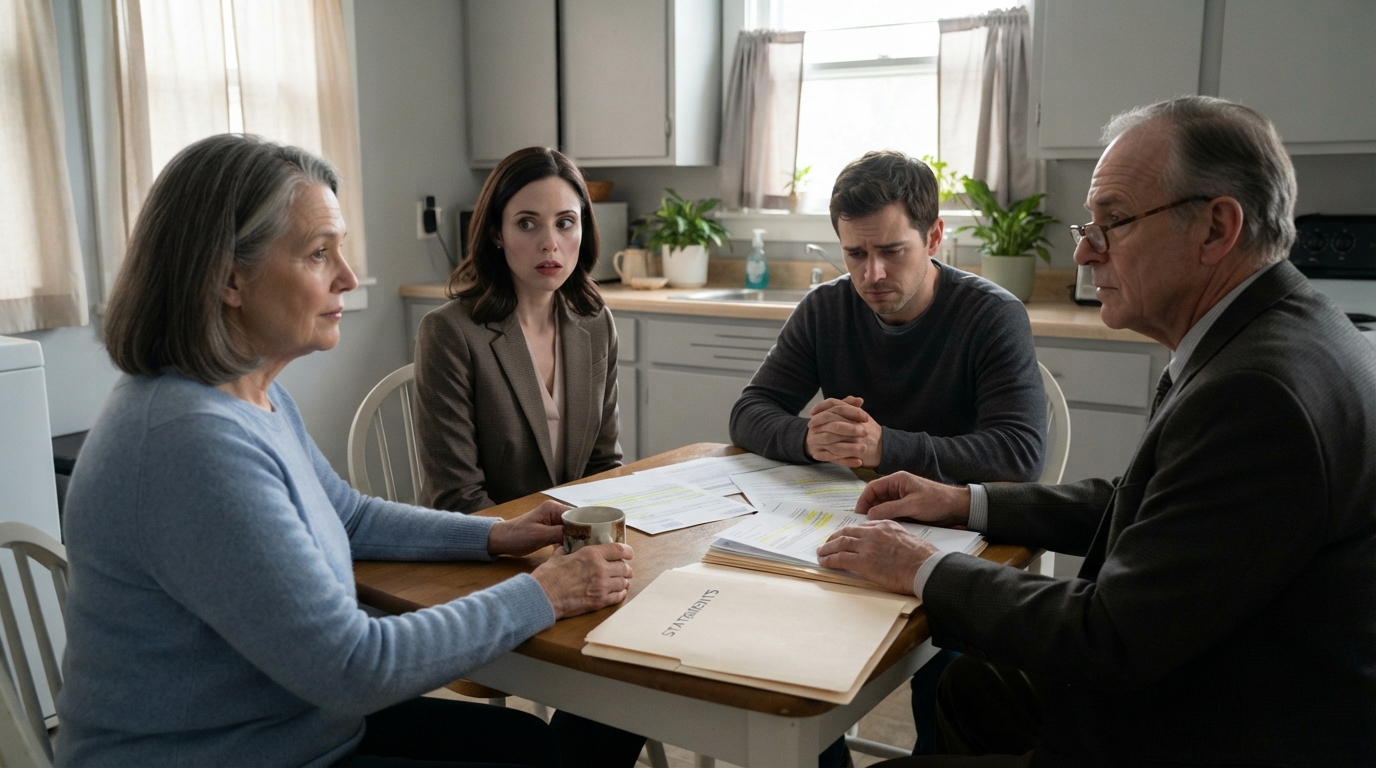
The first letter arrived three months after the conservation agreement was signed.
There was no return address.
I almost threw it away.
Instead, I opened it at the kitchen counter while the kettle clicked softly behind me.
Inside was a photocopy of a single page.
At the top was a date from twenty-three years earlier.
At the bottom was Dale's signature.
The middle contained one sentence I had never seen.
The water is not the only thing beneath Hawthorne.
I read it twice.
Then a third time.
My hands went cold.
I called Robert.
He arrived less than an hour later.
He read the page without speaking.
“What does it mean?” I asked.
“I don't know.”
“You've said that before.”
“And every time we thought we knew the whole story, something else appeared.”
I looked toward the fields.
Hawthorne had finally become quiet.
I didn't want another secret.
Robert examined the photocopy beneath a magnifying glass.
“This isn't the original.”
“I know.”
“Someone wants you to see it.”
“Who?”
“That is the question.”
There was a second sheet inside the envelope.
A hand-drawn map.
It showed the northern section of Hawthorne.
A red circle marked a point beyond the old barn.
Robert recognized the handwriting immediately.
“Dale.”
I stared at the map.
“Could he have left something there?”
“Possibly.”
We waited until morning.
Eric insisted on coming.
So did Rebecca.
We walked toward the northern field after breakfast.
The grass was wet against our shoes.
At the edge of the property stood the old barn, unused for years.
Dale had rarely mentioned it.
Inside, dust covered the beams.
A broken wagon wheel leaned against the wall.
Rebecca studied the map.
“The mark is behind this.”
We moved a stack of old timber.
Beneath it was a narrow trapdoor.
Eric looked at me.
“Did you know this existed?”
“No.”
He lifted it.
A stale breath of earth rose from below.
There was a ladder.
Robert went first.
The chamber beneath the barn was small.
It contained shelves.
Most were empty.
One wasn't.
A wooden crate sat against the far wall.
Inside were geological reports.
Not about the aquifer.
About something deeper.
A survey dated twenty-four years earlier described a natural underground cavity beneath the northern field.
The report referred to it as a limestone chamber.
There were measurements.
Depth.
Width.
Stability.
And a warning.
Unauthorized excavation could destabilize the surrounding groundwater system.
Eric looked at me.
“So that's what Dad meant.”
“Maybe.”
Rebecca picked up another document.
“This isn't geological.”
She handed it to Robert.
It was a contract.
A mining company had attempted to purchase access to the northern field.
Dale had rejected the offer.
The date was the same year he ended his partnership with Martin.
Robert's face tightened.
“They knew about the chamber.”
“Who?”
“Martin.”
The next document answered another question.
A private survey had been commissioned by Martin.
The company had paid for drilling rights.
Dale had stopped the project.
He had apparently realized that drilling into the chamber could damage the aquifer.
I sat on the wooden crate.
For years, I had thought Dale was protecting water.
He had been protecting the entire system beneath the land.
Then Rebecca found a photograph.
It showed Dale standing beside two geological engineers.
Behind them was the barn.
On the back, Dale had written:
This must never become a commodity.
I felt tears rise unexpectedly.
“Why didn't he tell me?”
Robert answered softly.
“Because he knew what people would do with the information.”
The chamber had one final shelf.
On it was a metal box.
Inside were letters.
Most were from environmental scientists.
One was from Martin.
You cannot keep hiding this forever.
Dale's response was underneath.
I can keep it out of your hands.
That was the whole argument.
Two men had wanted the same thing for completely different reasons.
Dale wanted protection.
Martin wanted control.
I folded the letters.
Then Eric noticed something scratched into the wall.
Three letters.
E.C.
Rebecca stared at them.
“Elena.”
We looked at her.
“My mother came here.”
“How do you know?”
“She told me once that Dale had shown her somewhere beneath the property.”
She touched the initials.
“He wanted her to know there was proof.”
We searched the chamber again.
Behind a loose stone was a small envelope.
Rebecca opened it.
Inside was a letter from Elena.
Dale,
If Martin comes back, don't let him convince Margaret that keeping secrets was wrong.
Sometimes silence is the only shelter left.
Rebecca's eyes filled with tears.
“He knew.”
“Yes.”
She looked at me.
“My mother always said he saved her twice.”
“How?”
“First from Martin. Then from herself.”
I didn't understand.
Rebecca explained that Elena had once considered returning to Martin because she believed she could protect her children by negotiating with him.
Dale stopped her.
He told her that people like Martin did not negotiate.
They collected leverage.
Elena had listened.
She had disappeared.
She had lived.
And now, finally, she was free.
That evening, I called her.
She came to Hawthorne the next morning.
When I showed her the chamber, she closed her eyes.
“I hoped you'd never need to find this.”
“Why?”
“Because finding it means someone wanted you to.”
“Who?”
“I don't know.”
She looked at the letter.
Then at the map.
“I thought Martin had destroyed every copy.”
“Every copy of what?”
She hesitated.
“The original geological survey.”
We searched the crate.
It wasn't there.
Elena's expression changed.
“Then someone took it.”
“Who?”
She shook her head.
“There was one person Dale didn't trust.”
I waited.
“Not Martin?”
“No.”
“Richard?”
“No.”
She looked toward the northern field.
“An engineer named Peter Voss.”
The name was unfamiliar.
“What did he do?”
“He conducted the first survey.”
“Why would Dale distrust him?”
“Because Peter believed the chamber could be exploited safely.”
Robert immediately searched the old records.
Peter Voss had died six years earlier.
But his company had not.
It had been sold.
To a corporation we recognized.
The same corporation that had recently challenged the conservation agreement.
I felt the old pattern returning.
Different names.
Same hunger.
Robert closed the file.
“They've been waiting.”
“For what?”
“For the restrictions to weaken.”
I looked at Hawthorne.
The land was protected.
The water was protected.
But apparently someone still believed there was another way in.
Then my phone rang.
An unfamiliar number.
I answered.
No one spoke.
I heard only breathing.
Then a man's voice said:
“You should never have opened the barn.”
The call ended.
I looked at Robert.
He was already standing.
“Lock the property.”
I nodded.
For the first time since Martin's arrest, I realized something uncomfortable.
We had won the legal battle.
But someone else had been watching the entire time.
And unlike Martin, they had never needed to reveal themselves.
Click here to continue reading: PART 18: The Hidden Chamber Became the Center of a New Threat When Someone Tried to Use Dale’s Own Protection Against the Land He Had Died Defending
My Daughter-in-Law Arrived With a Demand I Never Expected, and One Question Made Me Realize She Knew More About Dale’s Money Than I Did
Part 17 of 20

