
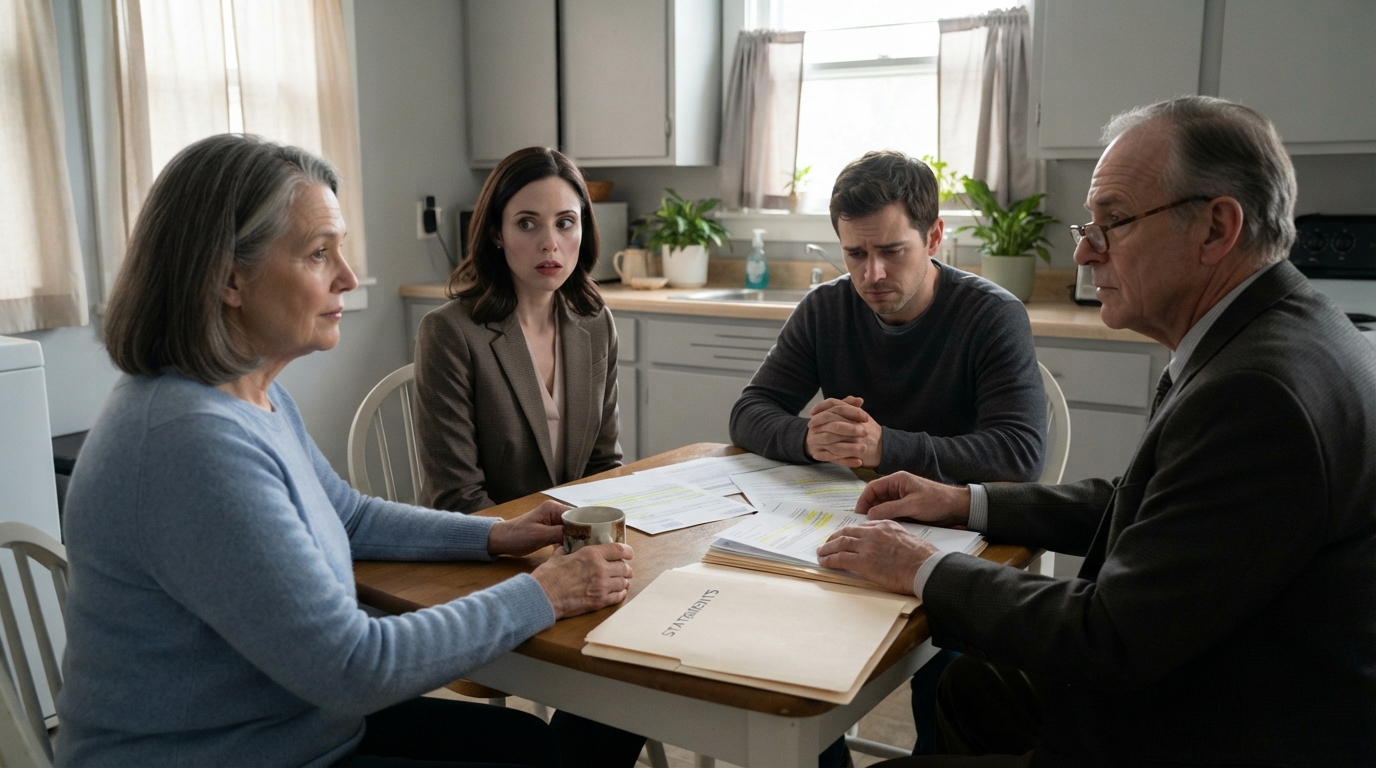
Martin was waiting in the interview room when I arrived.
He looked older than he had at the hearing.
Less certain.
I sat across from him.
For a moment, neither of us spoke.
Then he smiled faintly.
“You won.”
“No.”
He raised an eyebrow.
“Then who did?”
“Dale.”
His expression tightened.
“You still think this was about him.”
“It was.”
“You don't know what he did.”
“Tell me.”
Martin leaned back.
“He could have destroyed me twenty years ago.”
“Why didn't he?”
“Because he made a deal.”
I stared at him.
“What deal?”
“He gave me the fifty thousand dollars.”
“That was the settlement.”
“No.”
Martin looked at me.
“That was payment for my silence.”
“About Elena?”
“Yes.”
My chest tightened.
“What did you know?”
“Everything.”
“Then why did you leave her alone?”
“Because Dale threatened to expose me.”
“So he controlled you.”
“For a while.”
Martin laughed quietly.
“Your husband was clever.”
“He protected her.”
“He protected everyone.”
Martin's voice softened.
“That was his weakness.”
“No.”
I looked directly at him.
“That was his choice.”
Martin looked away.
Then he admitted something I had never expected.
Dale had known about the aquifer before he bought Hawthorne.
He had also known that development would eventually make the land extraordinarily valuable.
But he had purchased it anyway.
Not to become rich.
To keep it from people like Martin.
“He could have sold it years ago,” Martin said.
“Yes.”
“He refused millions.”
“Yes.”
“Why?”
“Because he understood what you didn't.”
Martin frowned.
“What?”
“Not everything valuable belongs to whoever can pay the most.”
For the first time, he had no response.
He looked down at the table.
Then he said, “I thought he was wasting his life.”
“He was protecting it.”
Martin shook his head.
“He should have told you.”
“I wish he had.”
“He wanted to.”
I looked up.
“When?”
“Before he died.”
“What stopped him?”
“Fear.”
I felt my throat tighten.
“Fear of you?”
“No.”
Martin looked at me.
“Fear that if you knew everything, you'd become a target.”
That answer hurt more than I expected.
Because I finally understood the price Dale had paid.
He had carried the knowledge alone.
He had allowed me to believe he was simply secretive.
He had accepted my frustration.
My anger.
My confusion.
Because the alternative was putting me in Martin's line of sight.
Martin continued.
“Your husband knew Richard would come after Hawthorne eventually.”
“How?”
“Because Richard wanted the development rights.”
“And you wanted the water.”
“Yes.”
“Then why did you work together?”
“Because neither of us could get what we wanted alone.”
That was the final truth.
Richard needed Martin's network.
Martin needed Richard's companies.
Melinda became the bridge.
Thomas became the paperwork.
Andrew became the legal instrument.
And the Mercer family became the target.
The entire scheme had been built around one assumption.
That eventually I would surrender.
They had been wrong.
When I stood to leave, Martin called my name.
“Margaret.”
I turned.
“Your husband was right about one thing.”
“What?”
“You're stronger than he thought.”
I smiled sadly.
“No.”
“I think he knew exactly how strong I was.”
Martin looked away.
I left.
Outside, Eric was waiting.
“How was it?”
“Honest.”
“Did he apologize?”
“No.”
“I'm not surprised.”
“Neither am I.”
We drove home.
Hawthorne was quiet that evening.
The fields were green after the rain.
The pond reflected the fading sky.
I walked to the old tree where Dale had once buried a small tin box when Eric was a child.
Inside had been marbles, coins, and a note that said:
For later.
I smiled at the memory.
Life had become strangely full of things meant for later.
The truth had been waiting.
The land had been waiting.
The water had been waiting.
Even Dale's final words had been waiting.
Eric joined me beneath the tree.
“What are you thinking?”
“That your father spent years preparing us for a future he would never see.”
Eric was quiet.
“Do you think he'd be proud?”
I looked toward the farmhouse.
“Yes.”
We stood there without speaking.
A week later, the foundation board approved the final conservation plan.
Hawthorne remained in the family.
The aquifer became permanently protected.
The foundation established scholarships and legal assistance programs for families facing predatory property schemes.
It wasn't Dale's original plan.
But it was what his choices had made possible.
Rebecca became a member of the advisory board.
Daniel helped document the financial network.
Andrew testified in the remaining cases.
Elena moved into a small house nearby.
She spent her mornings walking along the pond.
Sometimes I joined her.
She told stories about Dale that I had never heard.
He had once burned an entire batch of pancakes because he was too busy reading a survey report.
He hated cilantro.
He always carried two pens because he didn't trust one to work.
He once drove six hours to help Elena move a broken refrigerator.
Small things.
Human things.
I treasured them.
They filled the spaces left by all the secrets.
Months later, Martin's remaining assets were seized.
Richard's estate paid substantial restitution.
The fraudulent companies were dissolved.
The water initiative was permanently shut down.
Melinda continued serving her sentence, but her cooperation helped investigators recover additional money.
She sent Eric a letter.
He didn't show it to me.
I didn't ask.
Some things belonged to him.
That was another lesson Dale had left behind.
Protection did not mean control.
Love did not mean ownership.
And forgiveness did not require forgetting.
One spring morning, the first group of students arrived at Hawthorne for an environmental program.
They walked through the fields carrying notebooks.
Their teacher explained how the aquifer worked.
I stood near the porch and listened.
One child asked whether the land had always been protected.
I smiled.
“No.”
“What happened?”
“A lot of people wanted to own it.”
“Did they?”
“No.”
“Why?”
I looked toward the tree.
“Because someone decided some things were more important than money.”
The child considered that.
Then ran back to the group.
I watched them disappear toward the pond.
For the first time, Hawthorne felt less like a place we had defended.
It felt like a place we had entrusted to the future.
That evening, I returned to Dale's workshop.
The envelope was still on the bench.
I opened it once more.
There was one final line I had overlooked.
If you ever wonder whether I made the right choice, look outside.
I stepped onto the porch.
The fields stretched toward the horizon.
The pond caught the last light.
Children's voices drifted faintly from the education center.
I understood.
Dale's legacy wasn't the house.
It wasn't the land.
It wasn't the money.
It wasn't even the aquifer.
It was the choice to protect something when selling it would have been easier.
I stood there until the light disappeared.
Then I closed the workshop door.
Not because the story was over.
Because it finally belonged to us.
And this time, there were no secrets waiting behind it.
Click here to continue reading: PART 17: The Peace at Hawthorne Did Not Last Long When an Old Record Surfaced and Forced Me to Reconsider What Dale Had Meant by His Final Warning
My Daughter-in-Law Arrived With a Demand I Never Expected, and One Question Made Me Realize She Knew More About Dale’s Money Than I Did
Part 16 of 20

