
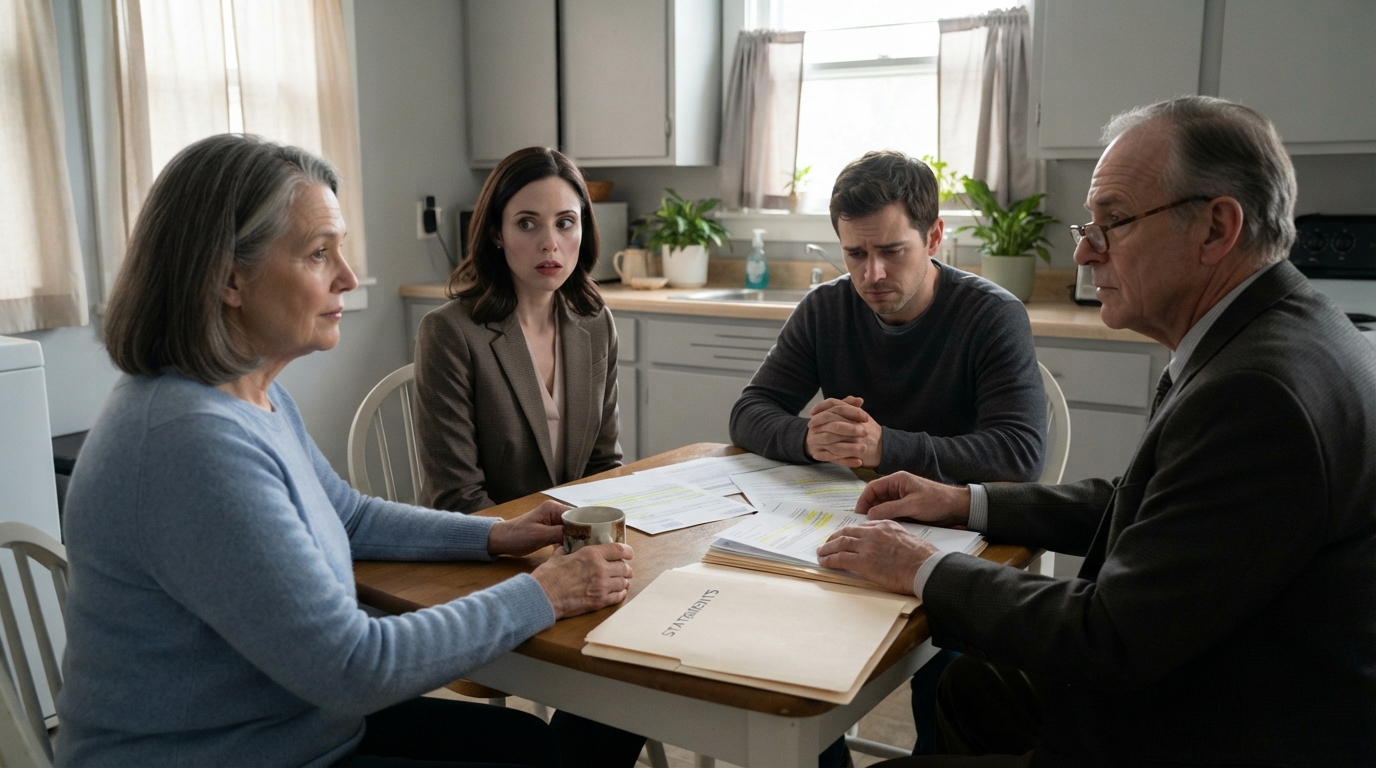
The first thing Melinda said after my husband’s funeral was not that she missed him.
She did not ask whether I had eaten, whether I had slept, or whether I wanted someone to stay with me through the night.
She stood in my kitchen, still wearing the black dress she had worn to the cemetery, and said, “We need to talk about Dad’s money.”
For several seconds, I honestly thought I had misunderstood her.
The refrigerator hummed behind me. A faucet dripped once into the stainless-steel sink. On the counter sat two untouched cups of coffee I had made that morning because I was still moving through the motions of being a person who had a morning routine.
Dale had been dead for nine days.
Nine days since I had watched the earth close over the man I had loved for forty-one years.
Nine days since I had come home to a house that seemed too large for one person.
And now my daughter-in-law was discussing his money as though we were sitting across from each other at a business meeting.
I turned slowly toward her.
“What money?”
Melinda gave me a look I would later recognize as the first of many expressions she used when she believed I was being deliberately difficult.
“The money Dale left.”
My fingers tightened around the edge of the counter.
“Dale left me several things.”
“I mean the investment account.”
The words landed differently.
Not because I had forgotten about the account.
Because I had never told Melinda the amount.
Dale had maintained several investments over the years. Some were ordinary retirement holdings. Others were accounts he had managed privately with the help of his financial adviser, Mr. Dawson. I knew enough to understand that we were comfortable, but I had never discussed exact figures with our son or his wife.
Dale had always been private about money.
Not secretive.
Private.
There was a difference.
Melinda pulled out a chair and sat without asking.
“We're having some serious financial problems,” she said.
I remained standing.
“What does that have to do with my husband's estate?”
Her mouth tightened.
“Eric is his son.”
“I know who Eric is.”
“And we're his family.”
“So am I.”
She looked away for a moment.
Then she lowered her voice.
“Margaret, this isn't the time to be stubborn.”
Something inside me went quiet.
I had known Melinda for twelve years. She had never been openly cruel to me. In public, she was pleasant. She remembered birthdays. She sent photographs of the children. She brought a pie at Thanksgiving and once mailed me flowers after I had surgery.
But there had always been a calculation underneath her kindness.
She noticed what people owned.
She noticed what they drove.
She noticed when someone remodeled a kitchen or mentioned a vacation.
And since Dale died, she had started asking questions I hadn't expected.
How much did the house cost when we bought it?
Was the mortgage paid off?
Had Dale changed his will?
Did I know what his investment accounts were worth?
At the time, I had told myself she was simply curious.
Standing there in my kitchen, I wondered whether I had been naive.
“What exactly are you asking me for?” I said.
Melinda sighed.
“We need temporary help.”
“How much?”
She hesitated.
“Enough to get us through the next few months.”
“That isn't a number.”
“Twenty thousand.”
I stared at her.
“Twenty thousand dollars?”
“Yes.”
“You want me to give you twenty thousand dollars nine days after your father-in-law's funeral?”
“It wouldn't be a gift.”
“What would it be?”
“A loan.”
“To you?”
“To Eric and me.”
I pulled out the chair opposite her but did not sit.
“Why?”
“Our business is having a cash-flow problem.”
“You have a business?”
Her eyes flickered.
“We've talked about it.”
“No, Melinda. You have mentioned that you were working on something. You never told me you were borrowing money.”
“We didn't think we needed to.”
“And now you need twenty thousand dollars from me.”
She folded her hands on the table.
“We need it from the family.”
I looked at her hands.
Her nails were perfectly manicured.
A thin gold bracelet circled her wrist.
I remembered seeing that bracelet before.
Dale had bought it for her at Christmas.
He had always been generous with Eric's family.
Too generous, perhaps.
He never wanted his son to feel that he was being judged for needing help.
But he had also warned me more than once that generosity could become a habit in other people's minds.
At the time, I had laughed.
“You worry too much,” I had told him.
He had looked at me over his glasses.
“Maybe. But if I ever die first, Margaret, don't let guilt make financial decisions for you.”
I hadn't understood why he said it.
Now I remembered the exact tone of his voice.
Not joking.
Not casual.
Serious.
“What would the twenty thousand be used for?” I asked.
Melinda's expression hardened.
“I just told you. The business.”
“I'd like to know what kind of business expense requires twenty thousand immediately.”
She leaned back.
“Payroll.”
“Then show me the numbers.”
Her eyebrows rose.
“Excuse me?”
“If this is a loan, I need to know what I'm lending against.”
“You're not a bank.”
“No.”
I looked at her.
“I'm the person you're asking.”
She stood abruptly.
“I shouldn't have come.”
“Maybe not.”
She stared at me.
Then her voice became colder.
“You have no idea what Eric is dealing with.”
“Then tell me.”
“I don't owe you an explanation.”
“No,” I said. “But you do owe me the truth if you're asking me for twenty thousand dollars.”
She picked up her purse.
“We'll handle it ourselves.”
I watched her walk toward the door.
Before she reached it, she stopped.
“You know Dad would have helped us.”
That sentence hurt more than I wanted it to.
Because Dale would have helped.
He had helped everyone.
He had helped Eric through college. He had covered a business loss once without telling me until months later. He had paid for repairs on Melinda's first car. He had helped with the grandchildren's medical bills.
But he had also taught me that helping someone did not mean allowing them to make decisions with your money.
I said nothing.
Melinda opened the door.
Then she turned back.
“You should talk to Eric.”
“I will.”
“He's under a lot of pressure.”
“I know.”
“And if something happens to our business because you refused to help, don't blame him.”
The door closed.
I stood there for a long time.
The house became quiet again.
I walked to the kitchen window and watched Melinda cross the driveway. She climbed into her SUV, sat behind the wheel, and remained there for almost a minute.
Then she drove away.
I should have felt relieved.
Instead, I felt watched.
That evening, I called Eric.
He answered on the fourth ring.
“Mom?”
“Did Melinda talk to you?”
A pause.
“Yes.”
“About money?”
Another pause.
“Yes.”
I sat down.
“She asked me for twenty thousand dollars.”
“I know.”
“Did you know she was going to ask?”
“I knew we were having problems.”
“What kind of problems?”
“Business problems.”
I closed my eyes.
“That isn't an answer.”
“I don't know what you want me to say.”
“The truth would be a good start.”
His voice softened.
“Mom, I'm sorry.”
“Why?”
“Because she shouldn't have put you in that position.”
That answer caught me off guard.
“Then you agree I shouldn't give her the money?”
“I didn't say that.”
“Eric.”
“I don't know.”
There was something wrong in his voice.
Not anger.
Fear.
“Are you in trouble?”
“No.”
“Are you sure?”
“Yes.”
“Then why do you sound frightened?”
He didn't answer.
I heard movement on his end.
Then Melinda's voice, faintly in the background.
“Who is it?”
Eric lowered his voice.
“I have to go.”
“Eric—”
“I'll call you tomorrow.”
He hung up.
I stared at the phone.
For years, I had known my son as someone who talked through problems. Even as a teenager, he had been incapable of keeping a secret from me for long.
But now he had ended a conversation because his wife had asked who was calling.
I barely slept that night.
The next morning, I found an envelope on the kitchen table.
I had no memory of putting it there.
Inside was a photocopy of one of Dale's investment statements.
My name was printed at the top.
So was the account number.
I read the balance once.
Then again.
It was larger than I expected.
Much larger.
I sat down slowly.
Dale had never told me the exact amount.
But I remembered our conversations.
He had said we were secure.
He had said I would never have to depend on anyone.
He had said the account was intended to give me choices after he was gone.
I turned the paper over.
Nothing was written on the back.
My first thought was that I had somehow left the statement there.
My second thought was worse.
Someone else had put it there.
I called Mr. Dawson.
He answered immediately.
“Margaret?”
“Did you send me a copy of Dale's investment statement?”
“No.”
My throat tightened.
“Did anyone request one?”
There was a pause.
“Why?”
“Because I found one in my kitchen.”
His voice changed.
“Don't touch anything else.”
“What?”
“Are you alone?”
“Yes.”
“Lock the doors.”
I stood.
“Mr. Dawson, what is happening?”
“I don't know yet.”
“You sound like you do.”
“I don't want to speculate over the phone.”
“Then come here.”
“I'll be there in thirty minutes.”
He arrived twenty-six minutes later.
The first thing he did was check the front door.
Then the back door.
Then the windows.
Only after that did he sit across from me.
“You said no one should have access to that statement?”
“Correct.”
“Dale kept his financial records in a locked cabinet.”
“Yes.”
“Did you open it?”
“Not since the funeral.”
He looked at the copy again.
“This is recent.”
“How can you tell?”
“The account balance shown here includes a transaction from last week.”
I felt the room tilt.
“Last week?”
He nodded.
“Someone accessed the account after Dale died.”
I looked toward the hallway.
“Can they take money?”
“If they have authorization.”
“Who has authorization?”
“You do.”
“Anyone else?”
He didn't answer immediately.
“Margaret?”
“Yes?”
“I need to ask you something difficult.”
I waited.
“Has Melinda ever had access to your financial records?”
“No.”
“Think carefully.”
I thought about the years of holidays, family dinners, visits.
Then I remembered something.
“Last winter, she helped me set up online banking.”
Mr. Dawson's face became still.
“What exactly did she do?”
“She showed me how to use the app.”
“Did she ever handle your phone?”
“Yes.”
“For how long?”
“Maybe twenty minutes.”
He leaned forward.
“Did she set up the security questions?”
“I don't remember.”
“Did she know your password?”
“No.”
“Are you certain?”
I opened my mouth.
Then closed it.
Because suddenly I wasn't certain about anything.
Mr. Dawson reached for his phone.
“I want the bank to freeze online transfers immediately.”
My heart began pounding.
“Do it.”
He made the call.
While he was speaking, I looked again at the statement.
There was one transaction circled in blue ink.
$4,800.
The recipient was an account I didn't recognize.
But beneath the transaction was a notation.
AUTHORIZED USER: MELINDA MERCER.
I stared at the words.
When Mr. Dawson ended the call, I pushed the paper toward him.
“Why does it say she's an authorized user?”
He read it.
His expression changed.
“She shouldn't be.”
“Then how is her name there?”
He looked at me.
“I think that's the question we need to answer first.”
The front door opened.
I froze.
Mr. Dawson stood.
A voice came from the hallway.
“Mom?”
Eric.
I let out a breath.
He entered the kitchen alone.
His face was pale.
He looked at Mr. Dawson.
Then at the statement.
Then at me.
“What happened?”
I held up the paper.
“Your wife has access to my account.”
Eric stared at it.
“No.”
“Yes.”
“I didn't know.”
“Did you know she asked me for twenty thousand dollars?”
He looked down.
“Yes.”
“Did you know why?”
He hesitated.
“No.”
I believed him.
And that frightened me more than if he had lied.
Because somewhere between his father's death and that morning, my son had stopped knowing what was happening inside his own marriage.
Eric pulled out a chair.
He sat heavily.
“Mom,” he said, “I think we need to talk.”
Before he could continue, his phone rang.
He looked at the screen.
Melinda.
He didn't answer.
The phone stopped.
A second later, a message appeared.
He read it.
His face drained of color.
“What does it say?” I asked.
He turned the phone toward me.
It contained only one sentence.
Tell your mother to give us the money before she makes this worse.
I looked at my son.
Then at Mr. Dawson.
And for the first time since Dale died, I understood that the twenty thousand dollars had never been the real problem.
Someone already knew exactly how much money I had.
And someone was running out of time.
Click here to continue reading: PART 2: The Records Revealed a Pattern I Could No Longer Explain Away, and My Son Finally Admitted What He Had Been Afraid to Tell Me
My Daughter-in-Law Arrived With a Demand I Never Expected, and One Question Made Me Realize She Knew More About Dale’s Money Than I Did
Part 1 of 20

