
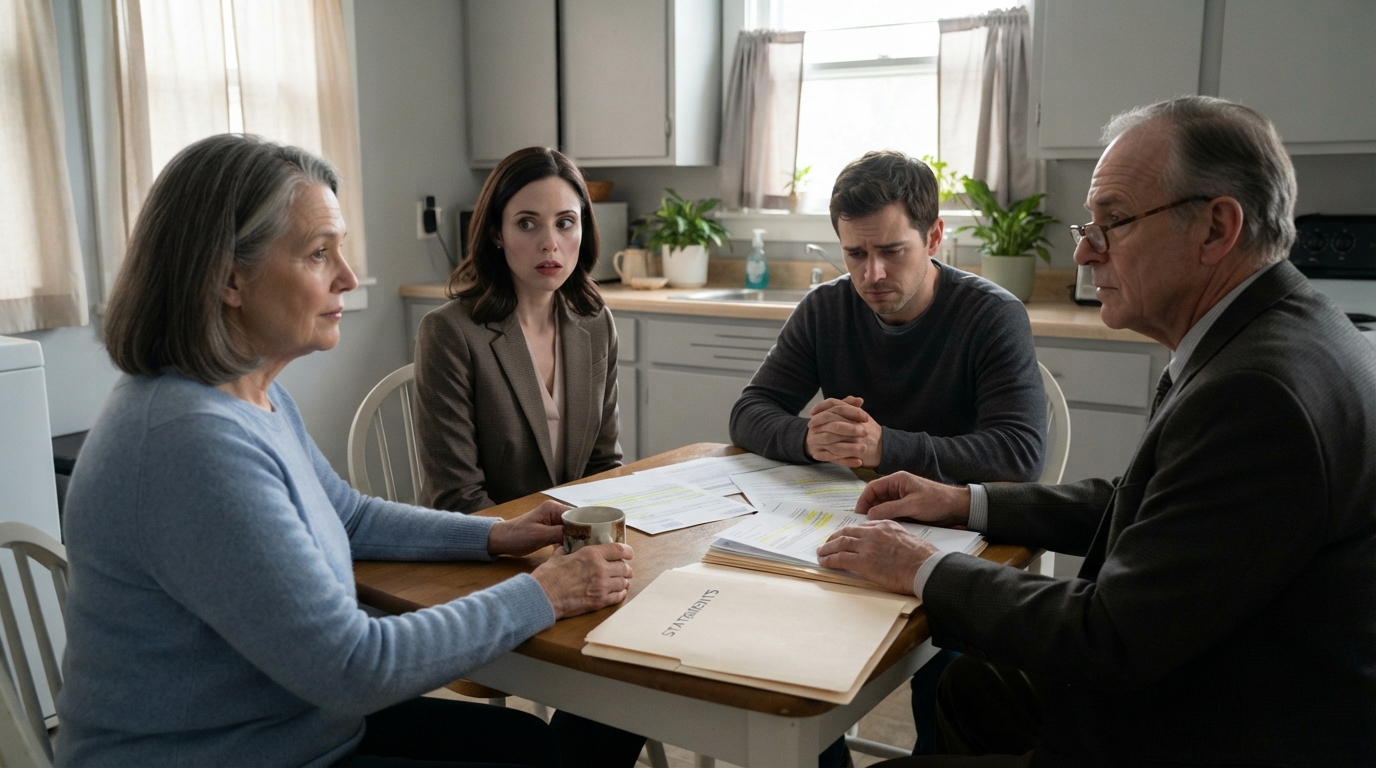
One year after the arrests, Eric came to my kitchen carrying a small wooden box.
He set it carefully on the table.
The same table where Melinda had once demanded twenty thousand dollars.
The same table where Mr. Dawson had spread out bank statements.
The same table where I had first realized that someone had been taking pieces of the life Dale left me.
“What is this?” I asked.
Eric pulled out a chair.
“I found it in Dad's old workshop.”
I touched the lid.
The wood was scratched along one corner.
I recognized the box.
I had seen it years earlier.
Dale used to keep small tools inside it.
I opened it.
His watch was inside.
The one I thought had disappeared after his funeral.
My fingers closed around it.
Underneath was a folded piece of paper.
I knew the handwriting immediately.
Dale.
I unfolded it.
Margaret,
If you're reading this, then I was right to worry.
I stopped.
Eric looked away.
I continued.
I wish I could have protected you myself.
But sometimes loving someone means preparing them for the day you can't stand beside them.
My eyes blurred.
Dale had always hated sentimental speeches.
Yet there it was.
In his own handwriting.
He continued.
Don't let anyone convince you that protecting yourself makes you selfish.
And don't let money become the reason you stop loving your son.
People make mistakes.
What matters is whether they learn from them.
I lowered the page.
Eric was crying.
So was I.
For a long moment, neither of us spoke.
Then he reached across the table.
“Mom?”
“Yes?”
“Can I ask you something?”
I nodded.
“Do you forgive me?”
I looked at him.
Really looked at him.
He wasn't the frightened young man who had once stayed silent because he didn't want to admit his marriage was failing.
He wasn't the son who had accepted his wife's explanation that my money was available because I had enough.
He was older.
More careful.
More honest.
“I already did.”
He closed his eyes.
A tear rolled down his cheek.
“But I don't want you to forget,” I said.
He nodded.
“I won't.”
“Neither will I.”
We sat there quietly.
Dale's watch rested between us.
I wound it once.
The second hand began moving.
It made a faint ticking sound.
For years, that sound had been part of our mornings.
Now it filled the kitchen again.
Eric smiled.
“Still works.”
“Your father took care of everything.”
“He really did.”
I looked at the note.
“He tried.”
That was the truth.
No one could protect everyone from every mistake.
Dale couldn't have prevented Melinda from becoming desperate.
He couldn't have stopped Richard from committing fraud.
He couldn't have guaranteed Eric would make the right decision.
He could only prepare.
He could only warn.
He could only build safeguards.
The rest had been left to us.
Five years passed.
The Dale Mercer Foundation grew.
The old farmhouse became a place people came when they didn't know whom to trust.
We helped with wills.
Estate planning.
Debt.
Bank statements.
Insurance policies.
Trusts.
Financial abuse.
Some visitors came angry.
Some embarrassed.
Some convinced they were foolish because they hadn't understood what they had signed.
I always told them the same thing.
“Read everything.”
“Ask questions.”
“And if someone becomes angry because you want to understand a document before signing it, pay attention to that.”
People sometimes laughed.
Others nodded.
A few cried.
But almost everyone left with something useful.
The affordable housing section of Hawthorne filled gradually.
Families moved into homes that were simple but safe.
The community garden produced vegetables.
Children played near the old farmhouse.
The property that Richard had wanted to control became something he could never have imagined.
A place where people had choices.
A place where nobody had to surrender those choices to receive help.
Eric continued working there.
He had a different relationship with money now.
He no longer avoided financial statements.
He read everything.
He asked questions.
He taught others.
Sometimes I caught him using phrases that sounded exactly like Dale.
It made me smile.
Not because I wanted my son to become his father.
Because I knew Dale had left something good inside him too.
The legal process eventually ended.
Richard's network collapsed.
The shell companies were dissolved.
The fraudulent loans were challenged.
The banks recovered much of the stolen money.
I never received every dollar.
At first, that bothered me.
Then it didn't.
Money could be replaced.
Time couldn't.
Trust could be rebuilt, but never by pretending nothing happened.
And life could continue without being exactly the same.
Melinda remained in prison.
Years after her conviction, another letter arrived.
I recognized the return address.
For a moment, I considered throwing it away.
Instead, I opened it.
She had started teaching financial literacy classes inside the prison.
She wrote about women who had made choices out of fear.
She wrote about women who had been manipulated.
She wrote about women who had believed that keeping control meant never admitting they were in trouble.
Then she wrote something that made me stop.
She said she had spent years believing money would make her safe.
Then she had spent years taking money because she was terrified of losing everything.
Only after losing nearly everything did she understand that safety could not be stolen from another person.
I folded the letter.
I didn't forgive her again.
There was nothing left to forgive.
I had forgiven her once.
That was enough.
Forgiveness didn't mean forgetting.
It didn't mean trust.
It didn't mean inviting someone back into my life.
Sometimes forgiveness simply meant refusing to carry anger every morning.
That was enough for me.
On Dale's birthday, Eric and I stood beneath the largest tree on the property.
The branches had spread wider over the years.
He carried two cups of coffee.
He handed one to me.
“Dad's mug?”
I smiled.
“Of course.”
We stood quietly.
The fields stretched beyond us.
The farmhouse roof was visible through the trees.
Children were laughing near the garden.
A truck moved slowly along the road.
It was an ordinary afternoon.
That was what made it beautiful.
Eric looked across the property.
“You know what I remember most about Dad?”
“What?”
“He always said money should make life easier, not control it.”
I smiled.
“He was right.”
Eric took a sip.
“Do you think he'd be proud of us?”
I looked at my son.
He wasn't asking about the foundation.
Or the property.
Or the money.
He was asking whether the years after Dale's death had meant something.
“Yes,” I said.
“Even after everything?”
“Especially after everything.”
He smiled.
We stood beneath the tree for a while longer.
Then he said, “I wish he could see this.”
“So do I.”
A breeze moved through the leaves.
For a moment, I imagined Dale beside us.
Not speaking.
Just standing there with his coffee.
He would have complained about the cost of the construction.
Then he would have secretly been proud.
I knew him well enough to imagine both.
That evening, I returned home.
Dale's old mug sat beside the sink.
The kitchen was quiet.
But it no longer felt empty.
I opened the drawer where I kept the important documents.
The old bank statements were still there.
So were the fraud reports.
The court orders.
The letters.
The estate documents.
Dale's final instructions.
I ran my finger along the edge of the folder.
For a long time, I had thought those papers represented the end of my life with him.
Now I understood they represented something else.
The beginning of the life he had tried to protect.
I closed the drawer.
Then I turned off the kitchen light.
Before going upstairs, I stopped beside Dale's photograph.
He was smiling in it.
Not the formal smile he used for family pictures.
The real one.
The one that reached his eyes.
“I finally understand,” I whispered.
“You weren't trying to protect the money.”
I smiled through the tears.
“You were trying to protect me.”
I stood there for another moment.
Then I walked away.
The money had never been the most valuable thing Dale left behind.
It was the warning.
The courage.
The reminder that love should never require surrendering your voice.
I had spent years believing being a good mother meant giving.
Giving money.
Giving chances.
Giving explanations.
Giving until there was nothing left.
Dale taught me something different.
Sometimes love means saying no.
Sometimes family means drawing a boundary.
And sometimes the strongest thing a woman can do is sit at her own kitchen table, look someone she loves in the eyes, and say, “This belongs to me.”
Not because she doesn't love them.
Because she finally understands that she is allowed to protect herself.
I took one last sip of coffee.
For the first time since Dale died, tomorrow didn't frighten me.
I didn't know what it would bring.
None of us ever do.
But I knew who I was.
I knew what mattered.
And I knew that loving my family did not require me to disappear inside their needs.
That was Dale's final gift.
Not the account.
Not the land.
Not the money.
The freedom to remain myself.
And nobody could take that from me.
Click here to continue reading: PART 9: A Quiet Morning at Hawthorne Was Interrupted by an Unexpected Visitor Carrying Evidence That Could Reopen Everything We Thought Was Finished
My Daughter-in-Law Arrived With a Demand I Never Expected, and One Question Made Me Realize She Knew More About Dale’s Money Than I Did
Part 8 of 20

