The cashier had already scanned the last carton of milk when the card reader flashed DECLINED.
I stared at the red message, waiting for it to disappear. It didn't. The cashier tried again, then looked at me with the careful sympathy people use when they don't know whether to pretend nothing happened.
The total was $120.47. Chicken, vegetables, coffee, cereal, toothpaste, laundry detergent, and milk. Nothing extravagant. Nothing I couldn't normally buy without thinking twice.
I pulled out my phone and called Mark.
He answered on the second ring.
“What's wrong?”
“My card was declined.”
There was a pause.
Then he laughed softly.
Not nervously. Not with surprise.
As if he'd been expecting the call.
“I locked it,” he said.
For a second, I thought I'd misheard him over the noise of the grocery store.
“You locked my card?”
“Yes.”
“Why?”
“Because you've been spending too freely.”
I looked down at the groceries spread across the conveyor belt.
“Mark, it's groceries.”
“I know what it is.”
His voice had that patient tone he sometimes used when explaining something he had already decided I was too emotional to understand.
“From now on, Emily, you ask me before you spend anything.”
My fingers tightened around the phone.
“Anything?”
“Anything.”
Someone behind me shifted impatiently. The cashier began moving the groceries aside, giving me room to step away from the register.
Then another voice came through the phone.
Evelyn.
Mark's mother.
“It’s about time somebody taught you that,” she said.
I closed my eyes.
“You're with him?”
“We're having lunch together. And honestly, Emily, Mark has been far too generous with you.”
I looked at the groceries again.
For eight years, I'd been married to Mark Carter. We lived in Baltimore in a house that had always felt comfortable rather than extravagant. Mark ran NorthStar Logistics, the company my father had helped finance years before.
I had never considered myself wealthy.
I had never thought of the money connected to my father as something I could casually spend.
That was partly because Dad had taught me to be careful, and partly because Mark had gradually taken over nearly every financial decision in our marriage.
At first, it had seemed harmless.
He handled business.
I handled the house.
He paid bills.
I bought groceries.
He managed investments.
I trusted him.
Somewhere along the way, though, “handling things” had become “deciding things,” and I hadn't noticed when the line moved.
Now he was standing somewhere with his mother, laughing about a $120 grocery bill as though I were a teenager who had taken his credit card without asking.
“Mark,” I said quietly, “you don't get to decide whether I can buy food.”
His voice hardened.
“Don't make this dramatic.”
“I’m not.”
“You are.”
Evelyn laughed in the background.
“Just come home, Emily. You’ve been indulged for too long.”
I hung up.
I didn't argue again.
I didn't cry.
I simply looked at the cashier and said, “Please put everything back.”
She gave me an apologetic nod.
I pushed the empty cart toward the exit.
The automatic doors opened, and warm Baltimore air met my face.
I sat in my car but didn't start it.
My hands were resting on the steering wheel.
For the first time in eight years, I wasn't thinking about whether Mark had overreacted.
I was thinking about why he had been so comfortable doing it.
My father had left me a trust when he died nine years earlier. It wasn't money sitting in a checking account. It was a complicated structure managed by a trustee, Mr. Vance, who had worked with Dad for decades.
The trust had helped finance NorthStar.
That much I knew.
What I didn't know was exactly how much of NorthStar was connected to it.
And suddenly, I needed to know.
I drove straight to Mr. Vance's office.
His receptionist recognized me immediately and stood when I walked in.
“Mrs. Carter?”
“I need to see Mr. Vance.”
“He's in a meeting.”
“Please tell him it's about my trust.”
Something in my face must have convinced her.
She picked up the phone.
Five minutes later, Mr. Vance opened his office door.
He was in his late sixties, silver-haired, precise, and rarely surprised by anything.
He looked at me once.
Then at the phone clenched in my hand.
“What happened?”
“My husband froze my card.”
His expression changed.
“Why?”
“He said I'm not allowed to spend money without his permission.”
Mr. Vance didn't respond immediately.
Instead, he closed the office door.
“Sit down.”
I did.
He took the chair across from me.
“Was this a personal card?”
“Yes.”
“Connected to the trust?”
“I don't know.”
He leaned forward.
“Then we should find out.”
He opened my file.
The familiar folder looked almost absurdly ordinary.
My father's name was typed across the tab.
Mr. Vance began reviewing the accounts.
His eyes moved slowly across the pages.
Then he stopped.
“Emily.”
“What?”
“When was the card frozen?”
“This morning.”
“Approximately what time?”
“Just before noon.”
He checked something on his computer.
“That's interesting.”
“What?”
“There was activity on your financial structure this morning.”
My stomach tightened.
“What kind of activity?”
“A request.”
“From whom?”
He looked at me.
“Mark.”
The room seemed to become quieter.
“What request?”
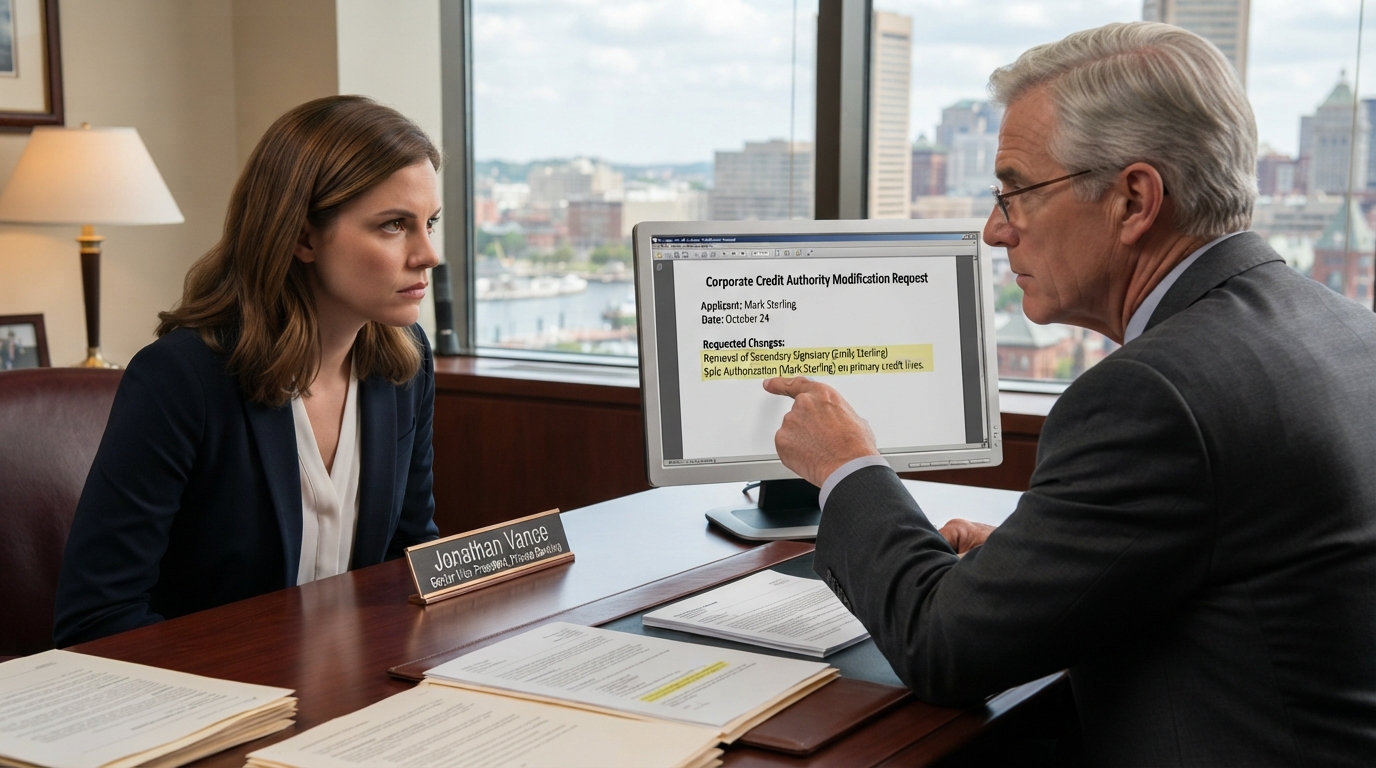
Mr. Vance rotated the screen toward me.
There was a bank submission dated two days earlier.
Mark's name appeared at the top.
Mine appeared beneath it.
I read the first page.
Then the second.
My name was listed as though I had approved a series of changes to accounts connected to my father's trust.
I frowned.
“I didn't sign this.”
Mr. Vance nodded.
“I know.”
I looked at him.
“How?”
“Because if you had, I would have been notified.”
He opened another document.
Mark had requested recognition as a controlling party for several financial instruments connected to the trust.
Another request asked that future distributions be redirected into a corporate reserve account.
I pointed at the page.
“What is this account?”
“I don't recognize it as part of NorthStar's normal operating structure.”
“Then who owns it?”
“We're still determining that.”
My mouth went dry.
“Why would Mark need to do this?”
Mr. Vance looked at the documents again.
“That is what concerns me.”
He pulled up the corporate resolution.
According to the document, I had supposedly agreed to transfer my beneficial interest in several assets to NorthStar Logistics.
I stared at the signature.
It looked like mine.
Not perfectly.
But close enough to make my stomach turn.
“I didn't sign that.”
“I know.”
“You keep saying that.”
“Because I have to.”
He folded his hands.
“Emily, your father designed your trust very carefully. A transfer of this size requires direct authorization and additional verification.”
“What happens if someone tries to bypass that?”
“They can't simply do it.”
“But they're trying.”
“Yes.”
The word landed heavily.
I looked down at my hands.
For eight years, I had shared nearly everything with Mark.
My home.
My schedule.
My worries.
My father's history.
The details of the trust.
I had told him about the restrictions because I trusted him.
Now I wondered whether I had handed him the blueprint to something he had always wanted to control.
Mr. Vance opened another file.
“There's something else.”
I looked up.
“Your father left instructions.”
“For me?”
“Yes.”
He stood and crossed to a locked cabinet.
He removed a sealed envelope.
My name was written across the front.
Emily.
Just that.
The handwriting was unmistakable.
I hadn't seen it in years.
My throat tightened.
“Why do you have that?”
“Your father instructed me to give it to you only if there was evidence that someone was attempting to interfere with your control of the trust.”
I stared at him.
“And now there is.”
“Yes.”
He placed the envelope on the desk.
I didn't touch it immediately.
“What did he know?”
“I don't know.”
“You never opened it?”
“No.”
“Why not?”
“Because it wasn't mine to open.”
I picked it up.
The paper felt strangely heavy.
My father's handwriting was only one word, but it pulled nine years backward in an instant.
I remembered him sitting beside my hospital bed after I'd broken my wrist as a child.
I remembered him teaching me how to balance a checkbook.
I remembered the last summer before he died.
He had been quieter then.
More deliberate.
He'd told me, “People don't always show you who they are when everything is easy.”
I'd laughed.
I hadn't understood.
Now I opened the envelope.
Inside was a single folded letter.
My hands trembled as I unfolded it.
Emily,
If you are reading this, something has happened that I hoped would never happen.
I stopped.
Mr. Vance said nothing.
I continued.
You may be angry that I prepared for a situation you never thought possible. Do not spend that anger defending someone who has already chosen secrecy over honesty.
My eyes blurred.
The next paragraph was worse.
The person who seems to need you most may one day decide that your generosity makes you controllable.
I looked at Mr. Vance.
He remained silent.
I kept reading.
If anyone attempts to gain control of your trust, company interests, or protected assets without your direct authorization, do not confront that person immediately.
Let them continue.
People reveal themselves when they believe they are winning.
My breathing became shallow.
Then I reached the line that made my fingers go numb.
If that person is your husband, do not tell him what you have discovered.
I lowered the letter.
“My father knew.”
Mr. Vance didn't answer.
“He knew something like this could happen.”
“He anticipated risks.”
“That's not the same thing.”
“No.”
I looked back at the page.
The final paragraph was shorter.
The greatest danger will not be losing money.
It will be allowing someone to convince you that protecting yourself makes you selfish.
Never confuse peace with surrender.
I folded the letter carefully.
For years, I had believed my father left me money.
Sitting in that office, I realized he'd left me something more useful.
A warning.
My phone began ringing.
Mark.
I watched his name appear on the screen.
Once.
Twice.
Three times.
I didn't answer.
A message appeared.
Where are you?
Then another.
Why aren't you answering?
Then:
The bank says you're making changes to the accounts.
I looked up at Mr. Vance.
“He knows.”
Mr. Vance reached for his keyboard.
“Then we move quickly.”
I placed my phone facedown.
For the first time that afternoon, I wasn't wondering whether I had misunderstood my husband.
I was wondering how much he had already done.
Click here to continue reading: PART 2: I Thought I Was Cutting My Husband Off From My Money Until the Trustee Showed Me How Deeply He Had Buried Himself Inside My Father’s Business
The Card Was Declined Over Groceries, But My Husband’s Calm Confession Made Me Realize Something Much Worse Was Already Happening
Part 1 of 20