The following Monday, I arrived at NorthStar at 8:15 in the morning.
For the first time, nobody stopped me at reception.
That small detail mattered.
For years, I had entered the building as Mark's wife.
People smiled.
People nodded.
People held doors.
But nobody had ever asked what authority I actually possessed.
Now they knew.
I walked into the boardroom and took the chair at the head of the table.
Mark wasn't there yet.
Mr. Vance sat to my right.
The company attorney sat across from us.
Three directors joined by video.
The room smelled faintly of coffee and printer paper.
No one spoke until the door opened.
Mark entered.
He stopped when he saw me.
His eyes moved from my face to the chair beneath me.
Then to Mr. Vance.
“You're serious.”
I kept my voice calm.
“Yes.”
He closed the door.
For a moment, neither of us moved.
Then he took his usual seat.
The meeting began.
We reviewed the company's finances.
The numbers were worse than I had expected.
The $4.8 million debt was real.
The Harbor Ridge transfers were real.
The trust-backed guarantees were real.
And several of the documents Mark had submitted contained signatures that were now being examined by forensic specialists.
Mark tried to explain.
“I was moving money temporarily.”
“Why?” the attorney asked.
“Cash flow.”
“Why wasn't the board informed?”
“I intended to explain.”
“When?”
Mark looked at him.
“When it was resolved.”
The attorney turned a page.
“Did you inform Emily?”
“No.”
“Why not?”
Mark's eyes moved toward me.
“She didn't need to be involved in day-to-day operations.”
I almost laughed.
The attorney didn't.
“She was the controlling beneficiary whose assets secured the company's debt.”
Mark said nothing.
I looked at him.
“You knew.”
He didn't answer.
“You knew I had an ownership interest.”
Still nothing.
“And you knew my trust was guaranteeing your debt.”
His jaw tightened.
“Emily, this isn't the place.”
“It became the place when you used my assets without telling me.”
The room went quiet.
Mark leaned back.
“I was trying to protect what your father built.”
I stared at him.
“You moved hundreds of thousands of dollars to your mother's company.”
“It was temporary.”
“You tried to redirect trust distributions.”
“For the company.”
“You requested control of my financial instruments.”
“To stabilize the business.”
“And you froze my grocery card.”
His face changed.
“That was personal.”
“No.”
I shook my head.
“That was the first thing I could see.”
Nobody spoke.
Mr. Vance opened a folder.
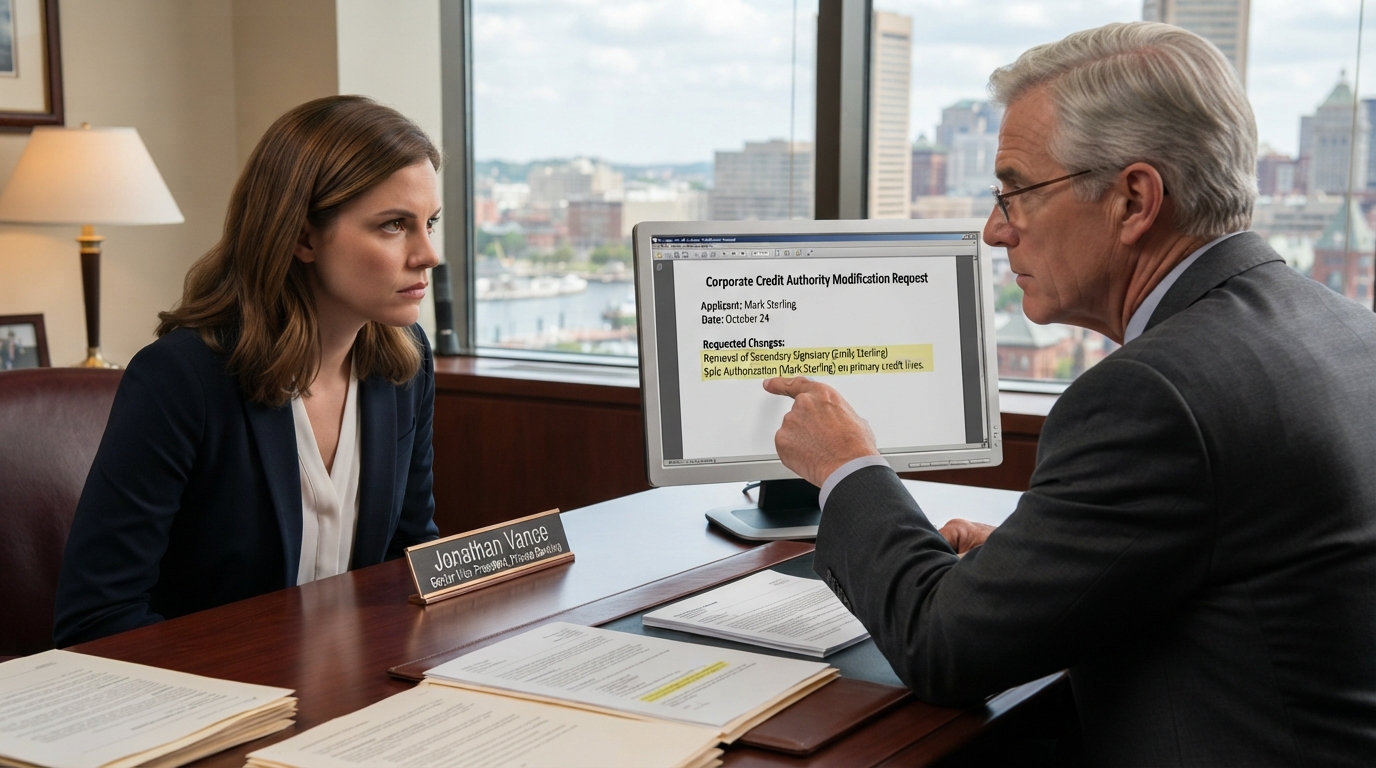
“We need to discuss another concern.”
He placed a document on the table.
Mark looked at it.
“What is that?”
“A request filed yesterday.”
His face tightened.
I read the page.
It involved another attempt to change the authorization structure.
Mark's name appeared.
My name appeared beneath it.
Again.
My signature was attached.
Again.
I looked at Mark.
“Did you submit this?”
He didn't answer.
The attorney spoke.
“Mr. Carter?”
Mark finally said, “I don't remember.”
I stared at him.
“You don't remember?”
“There have been hundreds of documents.”
“You don't remember asking to control my trust?”
“No.”
Mr. Vance quietly said, “That document was submitted from a computer registered to NorthStar.”
Mark looked at him.
“That doesn't prove I submitted it.”
“No,” Mr. Vance said. “It doesn't.”
Then he placed another document beside it.
“This one was submitted from your personal device.”
Mark stopped talking.
I felt a chill move through me.
He had been doing this much more deliberately than I had wanted to believe.
The board voted to suspend Mark's authority over trust-connected transactions.
His operational authority remained temporarily intact.
But the financial doors were closing.
When the meeting ended, Mark waited for me outside the conference room.
“We need to talk.”
I kept walking.
“We are talking.”
“No. Privately.”
I stopped.
“Why?”
“Because we're married.”
I turned.
“That's exactly why I don't trust you to handle this privately anymore.”
He flinched.
For the first time, I saw how deeply that sentence affected him.
“You're going to destroy everything.”
“I didn't build this situation.”
“You don't understand what will happen if NorthStar collapses.”
“I understand that you put it in danger.”
His voice dropped.
“I was trying to save it.”
“Then why did you hide the money?”
He didn't answer.
“Why Harbor Ridge?”
Silence.
“Why my life insurance?”
His face went completely still.
That was enough.
He knew about it.
And I'd never told him I had seen the filing.
I walked away.
That afternoon, I returned home and found my office door unlocked.
I knew I'd locked it.
I stepped inside.
Nothing looked disturbed.
The books were still on the shelf.
The desk was clean.
The framed photograph of my father was where I'd left it.
I opened the drawer containing my personal financial files.
The folder was gone.
My stomach dropped.
I checked another drawer.
Then another.
The external drive was missing.
So was the copy of my father's trust document.
I called Mr. Vance.
“Someone has been in my office.”
“Are you certain?”
“Yes.”
“What is missing?”
I told him.
He went silent.
Then he said, “Do not confront Mark.”
I looked toward the hallway.
“Why?”
“Because if he has the original trust documents, he may be preparing another filing.”
I locked the office door.
Then I checked the security system.
The camera feed showed my office hallway.
The previous evening was recorded.
I pressed play.
At 10:14 p.m., Mark entered.
He looked around.
He opened the filing cabinet.
Then he took a folder.
I watched the screen again.
He had used a key.
A key I didn't know he possessed.
I called Mr. Vance again.
“I have video.”
“Save it.”
“I am.”
“Make copies.”
“I will.”
There was a pause.
“Emily, there's something else.”
“What?”
“We found a company called EVC Management Holdings.”
I sat down.
“Who owns it?”
“Your mother-in-law.”
My heart began pounding.
“Evelyn?”
“Yes.”
“Does it have assets?”
“Very few.”
“Then why create it?”
“We're investigating.”
I thought of Harbor Ridge.
Then EVC.
Two different names.
Two companies connected to Evelyn.
I opened the folder of transaction records.
The pattern was becoming clearer.
Money moved from NorthStar.
Some of it went to Harbor Ridge.
Some went to EVC.
And some eventually returned through other accounts.
It wasn't random.
It was a system.
Mark had built a network around the company and my trust.
But why?
Mr. Vance called again.
“Emily.”
“Yes?”
“The bank found an attempted transfer for $1.8 million.”
I stood.
“What?”
“It was blocked.”
“Where was it going?”
“EVC Management Holdings.”
My hands went cold.
“Can they try again?”
“They already have.”
I stared at the wall.
“What do we do?”
“Freeze the trust-backed facilities.”
“Do it.”
“We also need legal counsel.”
“I have counsel.”
“You need litigation counsel.”
The next morning, I met Rebecca Shaw, an attorney recommended by Mr. Vance.
She was direct, practical, and unimpressed by Mark's reputation.
She listened while I explained everything.
When I finished, she asked one question.
“Where is the original trust binder?”
“I don't know.”
“Then that's our priority.”
“Why?”
“Because whoever controls the original documents may try to use them to support a false claim.”
I thought about the missing folder.
“I have copies.”
“Copies are useful.”
She leaned forward.
“Originals are leverage.”
That afternoon, Mark sent me a message.
We need to talk.
I didn't respond.
A second message appeared.
I'm not trying to hurt you.
Then:
You don't understand what I've had to do to keep this company alive.
Then:
If you keep listening to your father’s trustee, you will lose everything.
I saved the messages.
Rebecca told me to save everything.
That evening, another message arrived.
Please come home.
I stared at it for a long time.
I didn't go.
The next morning, Rebecca called.
“Emily, we found something.”
“What?”
“There are filings connected to EVC.”
“What kind?”
“A proposed asset transfer.”
My stomach tightened.
“From NorthStar?”
“Yes.”
“To EVC.”
“How much?”
“Nearly everything that generates revenue.”
I couldn't speak.
Rebecca continued.
“The debt remains with NorthStar.”
I sat down.
“So Mark is trying to move the profitable assets out while leaving the debt behind.”
“That appears to be the plan.”
I looked at my father's letter.
Never confuse peace with surrender.
For the first time, I understood exactly what my father had meant.
Mark wasn't trying to save NorthStar.
He was trying to save himself.
And if he couldn't control the company through me, he was preparing to move the company somewhere my trust couldn't reach.
Rebecca's voice became sharper.
“We need to move now.”
“How?”
“Emergency court protection.”
“Against Mark?”
“Against anyone attempting to transfer trust-backed assets.”
I stood.
“Then let's do it.”
But before I could leave, my phone rang.
Mr. Vance.
His voice was unusually tense.
“Emily, the bank just received another filing.”
“What filing?”
“A request to recognize a new controlling party over several assets.”
“Who?”
He hesitated.
“Evelyn Carter.”
I felt the room go cold.
“My mother-in-law?”
“Yes.”
“How?”
“We don't know yet.”
I looked at Rebecca.
She had heard enough from my expression.
“What happened?”
I put the phone on speaker.
Mr. Vance repeated the information.
Rebecca stood.
“Send us everything.”
“I already have.”
My phone chimed.
An email had arrived.
The subject line was simple.
CHANGE OF CONTROL NOTICE.
I opened it.
The attached document claimed that I was unable to manage my financial affairs and that a temporary guardian should be appointed to protect my assets.
The proposed guardian was Evelyn.
I stared at the screen.
Then at Rebecca.
“I'm not incapacitated.”
“I know.”
“The document says I authorized this.”
Rebecca took the phone.
She read it carefully.
Then looked at me.
“Did you?”
“No.”
“Good.”
She handed the phone back.
“Because this changes everything.”
I felt my heartbeat in my throat.
“What do you mean?”
Rebecca's expression hardened.
“They're not just trying to steal the company anymore.”
She pointed at the screen.
“They're trying to make the court believe you cannot stop them.”
My phone rang again.
This time, it was Mark.
I didn't answer.
A voicemail arrived seconds later.
I played it on speaker.
His voice was low.
“Emily, I need you to listen carefully. You can still fix this.”
There was a pause.
“If you cooperate, this can all remain private.”
Another pause.
“But if you fight me, you're going to make things much worse.”
The message ended.
Rebecca looked at me.
I looked at the screen.
For months, Mark had treated my trust as though it were his property.
Now he was trying to make my own judgment the reason he should control it.
I put the phone down.
“What's our next move?”
Rebecca picked up her briefcase.
“We go to court.”
And as we walked toward the door, I realized something I hadn't understood until that moment.
The grocery-store card had been the smallest part of Mark's plan.
The bank had exposed the money.
The board had exposed the company.
But the guardianship filing exposed what he was truly willing to do.
He wasn't merely trying to take what belonged to me.
He was preparing to convince everyone else that I had no right to stop him.
Click here to continue reading: PART 5: The Court Filing Claimed I Could Not Protect Myself, So I Let Mark Believe His Most Dangerous Lie Was Finally Working
The Card Was Declined Over Groceries, But My Husband’s Calm Confession Made Me Realize Something Much Worse Was Already Happening
Part 4 of 20