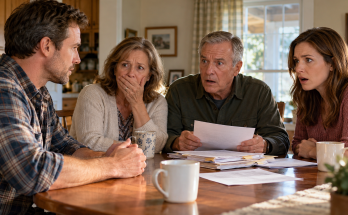
I had once believed that family problems should stay inside the family.
I didn't remember when I first learned that rule.
It had simply become part of how I lived.
If my mother was angry, I tried not to make things worse.
If my sister mocked me, I tried to ignore it.
If an argument became uncomfortable, I looked for a way to end it without involving anyone else.
I told myself that every family had problems.
I told myself that private disagreements were nobody else's business.
I told myself that keeping quiet was a form of loyalty.
Now I was beginning to see how those beliefs had worked against me.
They had made me reluctant to ask for help.
They had made me treat my own distress as something I needed to manage quietly.
And they had made me afraid of the consequences of telling the truth.
My family had not shown the same concern for protecting me.
They had left me outside.
Then they had gone to the police together and claimed I was mentally unstable.
Whatever reasons they gave themselves, the result was the same.
I was left trying to defend my account while they had already spoken.
I couldn't continue treating their reputation as more important than my safety.
That realization brought a strange kind of grief.
I had spent years trying to imagine what a healthy relationship with my mother might look like.
I had hoped we could disagree without cruelty.
I had hoped she might eventually listen when I told her something hurt me.
I had hoped that if I stayed patient, she would begin to understand how much damage her behavior caused.
Those hopes had been important to me.
They had helped me endure moments I didn't know how to handle.
But hope had also made me stay longer than I should have.
It had encouraged me to interpret every quiet period as evidence that things might improve.
It had made me forget how often the same problems returned.
I had mistaken the absence of an argument for the presence of peace.
Now I understood that peace could not mean one person remained silent while another did whatever they wanted.
I had to stop using that word to describe a situation in which I was afraid to speak.
The same was true of loyalty.
I had believed loyalty meant standing by my family, even when I disagreed with them.
I had believed it meant keeping their private problems away from other people.
I had believed it meant giving them the benefit of the doubt.
But loyalty could not require me to deny what had happened to me.
It could not require me to accept accusations that made me appear unreliable.
And it could not require me to return to a place where I had been hurt.
I could care about my family and still protect myself from them.
I could wish them well without pretending their choices had been harmless.
I could refuse to retaliate while still insisting that the truth be heard.
Those distinctions mattered because I didn't want my pain to turn me into someone who acted without thinking.
I was angry.
I had every reason to be.
But I didn't want anger to decide what I did with the evidence.
I wanted to handle it carefully.
I wanted the facts to speak for themselves as much as possible.
And I wanted to avoid making claims I couldn't support.
My family had already given people a reason to question me.
I couldn't control what they had said.
I could control whether I remained honest about what I knew.
That meant acknowledging the gaps in my memory.
It meant refusing to guess about what happened while I was unconscious.
It meant explaining what I had experienced without trying to make every unanswered question sound settled.
I knew some people might mistake that honesty for weakness.
I knew my family might use any uncertainty to challenge my account.
But I could not make uncertainty disappear by pretending it didn't exist.
I needed to keep the difference between what I knew and what I feared.
That was the only way I could remain grounded.
I also needed to remember why I had hidden the evidence in the first place.
I had not wanted to destroy my family.
I had wanted to protect something important from being taken out of my hands.
At the time, I hadn't known whether I would ever need it.
Now I knew I could not casually give it up.
I didn't know what the evidence would establish once someone examined it.
I didn't know whether it would answer every question I had.
But I knew my family did not know where it was.
For now, I needed to keep it that way.
I couldn't let a sudden demand or an emotional conversation persuade me to reveal it.
I couldn't let my mother make me feel guilty for protecting myself.
And I couldn't let my sister convince me that keeping evidence meant I was trying to hurt her.
Protecting evidence was not the same as seeking revenge.
It was a way to preserve the possibility of being heard.
I had to hold on to that distinction.
For a long time, I had measured my decisions by whether they would upset my family.
I would imagine my mother's anger before I considered my own needs.
I would think about how my sister might describe me before deciding whether I wanted to speak.
I had allowed their possible reactions to become part of every choice.
That habit had made me feel as though I needed permission to protect myself.
I didn't.
I could decide not to return to the house.
I could decide not to speak to my family alone.
I could decide to seek outside help.
I could decide to preserve the evidence until I had a safe way to present it.
None of those decisions required their agreement.
I repeated that to myself until it began to feel less like an idea and more like something I could act on.
I still wished things had been different.
I wished my mother had stopped.
I wished my sister had put her phone down and helped me.
I wished my family had chosen concern over accusation.
Those wishes remained.
I wasn't going to pretend I had stopped loving the people I had once depended on.
Feelings didn't disappear simply because someone had given me a reason to leave.
But love could no longer be the only thing I considered.
I had to consider the facts.
I had to consider the risk of going back.
And I had to consider what would happen if I allowed the story my family had told to go unanswered.
That last possibility frightened me most.
I imagined my family's account becoming the accepted version of events.
I imagined people hearing their accusations before they heard anything from me.
I imagined being treated as though my distress proved their claims.
I couldn't know whether those things would happen.
But I knew silence would give me no chance to correct them.
I had to speak eventually.
I had to find a way to explain what happened without allowing the conversation to become another argument about my character.
I had to protect the evidence and seek help from someone outside the family.
And I had to accept that telling the truth might change my relationships permanently.
That possibility hurt.
It also seemed unavoidable.
The relationships had already changed.
The night I woke outside had made that clear.
I could not return to the way things had been simply by refusing to acknowledge what had happened.
I could not make my mother safe by wishing she would become different.
I could not make my sister trustworthy by pretending her laughter had not mattered.
And I could not make my family honest by sacrificing my own account.
I had to begin from where I actually stood.
Alone, frightened, and uncertain about what came next.
But not without a way forward.
The evidence remained hidden.
My memories, however incomplete, were still mine.
And the decision to tell the truth was still available to me.
I had spent years trying to keep my family together.
Now I needed to make sure I didn't lose myself trying to do it again.
Click here to continue reading: PART 9: I Finally Admitted That Staying Silent Was Protecting the Wrong People, Even Though Speaking Up Meant Facing Everything I Feared
I Woke Up Freezing in an Alley, With No Shoes and No Memory of How My Own Family Had Left Me There
Part 8 of 20