By early evening, the kitchen table was covered with papers.
The notepad sat beside my phone.
My wallet was open near the edge of the table.
A few bank letters lay beside a cup of coffee I had forgotten to drink.
My father had moved the sugar bowl to make room.
It was an ordinary object, white ceramic with a small chip along the rim.
My mother had bought it years ago.
I used to tease her about keeping it after the chip appeared.
She said there was nothing wrong with something simply because it had been used.
I hadn't thought about that in a long time.
That afternoon, I kept looking at the chip while I tried to remember the dates of the unfamiliar transactions.
My father tapped the notepad.
"Let's put the dates in order."
I picked up the pen.
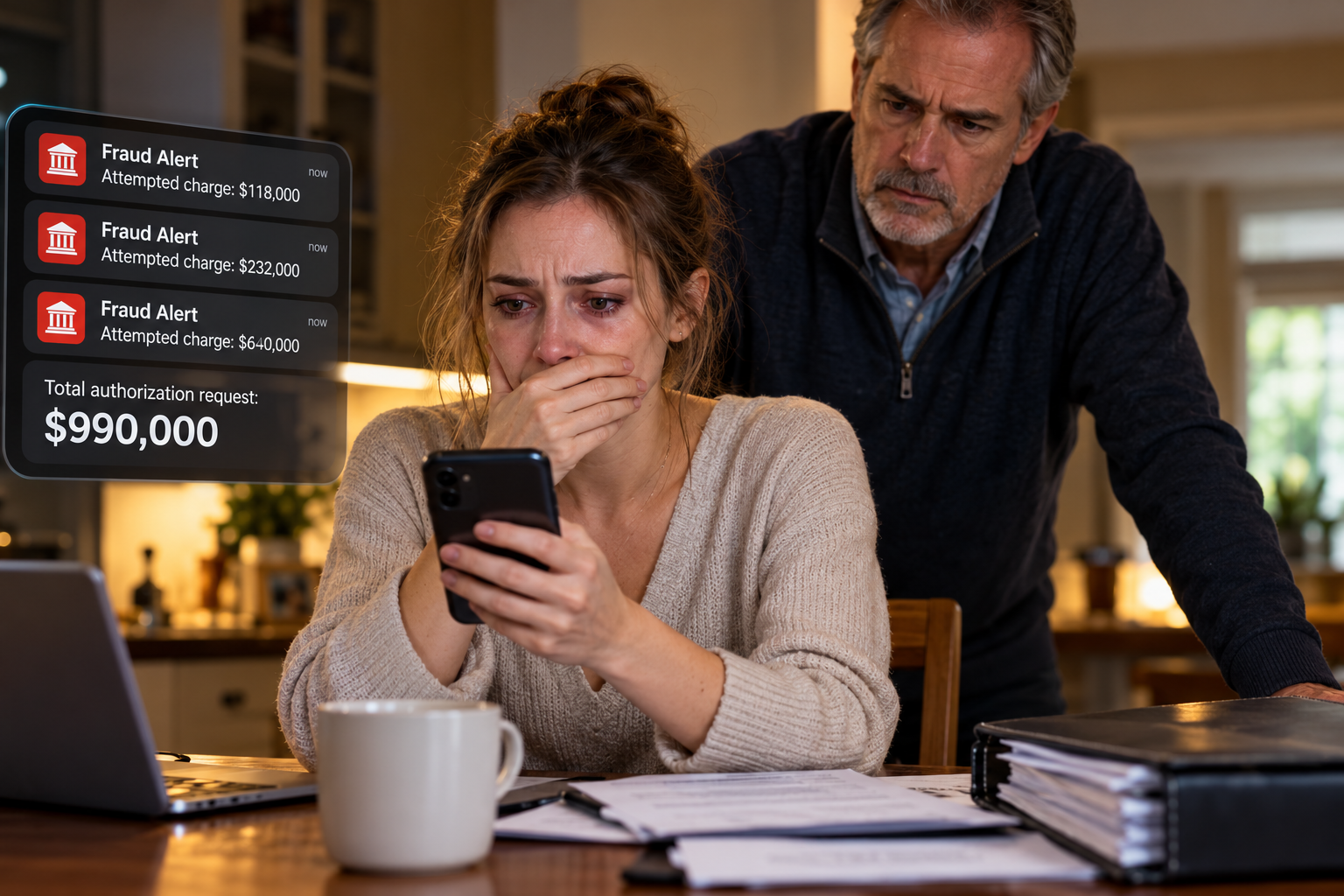
We started with the three attempted charges.
The first.
The second.
The third.
I wrote down the time of each alert and the bank associated with it.
Then I added the dates of the transactions I had questioned earlier.
They were not all on the same day.
They were spread across several weeks.
I looked at the list.
"That doesn't help much."
"It might."
My father pulled the paper closer.
"Look at the period before the divorce."
I knew the dates.
The divorce had been discussed for months before the hearing.
The final weeks had been particularly difficult.
My husband and I had argued about money, living arrangements, and what would happen after we separated.
Some conversations had ended quietly.
Others had left me sitting alone in another room, wondering how we had become two people who could barely speak without hurting each other.
I had blamed much of that on stress.
Divorce was stressful.
People became defensive.
People said things they didn't mean.
I had told myself that once the legal process was over, the tension would ease.
I had been wrong about that too.
I examined the dates again.
One unfamiliar transaction had occurred during the week my husband said he needed extra time to handle work matters.
Another had appeared shortly before we discussed the final financial arrangements.
The third had occurred after we had agreed to stop arguing about the accounts until the lawyers finished reviewing the paperwork.
I felt a cold pressure in my stomach.
"Dad."
He looked at me.
"What?"
"These dates are strange."
He didn't move closer.
"How?"
I pointed to the entries.
"They all happened around the same period."
He studied the page.
"Some of them did."
I wanted him to say more.
He didn't.
I was grateful for that, although I didn't like it.
He wasn't encouraging me to build a case against my ex-husband out of a handful of unexplained entries.
He was reminding me to pay attention.
I opened the transaction details again.
I compared the dates with the messages on my phone.
There were ordinary conversations between my husband and me.
Questions about dinner.
A reminder to pick up something from the store.
A message asking whether I had paid a bill.
One evening, I had sent him a photograph of a broken kitchen drawer because I wanted him to fix it.
He had replied with a joke.
I remembered smiling at the message.
Now I looked at the same conversation and wondered whether I had been ignoring something obvious.
I hated that feeling.
It made the past seem unstable.
If I could no longer trust my memory of those weeks, what else had I misunderstood?
My father noticed my expression.
"Don't do that."
"Do what?"
"Try to turn every memory into evidence."
I put the phone down.
He was right.
A joke was a joke.
A dinner invitation was a dinner invitation.
A strange transaction was a strange transaction.
I needed to keep those things separate until I had a reason to connect them.
I looked at the list again.
"What if I missed something?"
"You probably did."
I stared at him.
He shrugged.
"Everybody misses things. That's why you check."
I let out a short, tired laugh.
It was the first real laugh I had managed since the courthouse.
It didn't last long.
But it helped.
My father smiled faintly.
Then he returned to the dates.
We checked the records I had saved from the banks.
Some entries included reference numbers.
Others included merchant descriptions.
A few were incomplete.
I made notes beside each one so I could follow up later.
We did not discover a clear connection between the earlier transactions and the three attempted charges.
We did not discover who had tried to authorize the large amounts.
We did not even know whether the same person had been involved in every incident.
The uncertainty was difficult to live with.
But I was learning not to fill it with whatever explanation hurt the least.
At one point, I found myself staring at a photograph on my phone.
It showed my husband and me sitting at a restaurant.
We had taken it during a weekend away.
I remembered the restaurant.
I remembered the meal.
I remembered him telling me that we needed to do things like that more often.
I had believed him.
I still couldn't say whether he had meant it.
That was what hurt.
Not simply that our marriage had ended.
It was the possibility that I had spent years measuring our relationship by the moments that made me happy while ignoring the moments that should have made me ask harder questions.
I put the photograph away.
My father didn't comment.
After a while, he stood and began clearing the table.
I tried to help, but he told me to finish organizing the documents.
He stacked the bank letters neatly and placed them in a folder.
I kept the notepad.
The three large amounts were still written on the page.
I drew a small box beside each one and marked it with the word declined.
It was important to remember that.
The attempts had happened.
The money had not been taken through those transactions.
I needed to keep both facts in mind.
My father returned with a clean sheet of paper.
"Write down what you need to do tomorrow."
I looked at him.
"Tomorrow?"
"You're not going to solve everything tonight."
I didn't like hearing that.
I had spent the entire day trying to get ahead of the next problem.
The thought of stopping made me feel vulnerable.
But my eyes hurt.
My head ached.
I was so tired that I had read the same bank message three times without understanding it.
I took the paper.
I wrote down the accounts that still needed follow-up.
I added the questions I wanted to ask the banks.
I noted which cards needed replacement and which confirmations I needed to keep.
The list was not comforting.
It was manageable.
There was a difference.
When I finished, my father read it.
"That looks right."
I set the pen down.
For several seconds, neither of us spoke.
Then I asked the question I had been avoiding all afternoon.
"Do you think he did this?"
My father looked at me.
I waited for him to answer.
He could have told me that he suspected my husband.
He could have pointed to the unexplained transactions and the timing of the attempted charges.
He could have given me the certainty I wanted.
Instead, he said, "I think we need to find out who did it."
I lowered my eyes.
I had wanted him to choose a side.
I had wanted him to say the thing I was too frightened to say myself.
But he wasn't going to give me certainty simply because I was desperate for it.
And perhaps that was the most useful thing he could have done.
I folded the list and placed it inside the folder.
Then I put the three alerts in a separate section.
I wanted the evidence kept together.
I wanted the questions kept separate.
It was a small distinction, but it mattered.
For the first time since the divorce hearing, I felt I had a way to move forward that didn't depend on guessing what my ex-husband might have done.
I could investigate.
I could protect my accounts.
I could wait for answers without pretending I already had them.
That evening, I carried the folder to the guest room where my father had made up the bed.
I set it on the bedside table.
Then I turned off the light.
I didn't sleep immediately.
But when I closed my eyes, I was no longer trying to solve the entire day in my head.
I was thinking about the next question I needed to ask.
Click here to continue reading: PART 8: I Had Spent Years Believing Trust Meant Sharing Everything, Until My Father Asked Whether I Still Knew Which Things Were Mine
My Marriage Was Over, but My Father Was Watching Something I Could Not See Yet
Part 7 of 20