The next morning passed quietly.
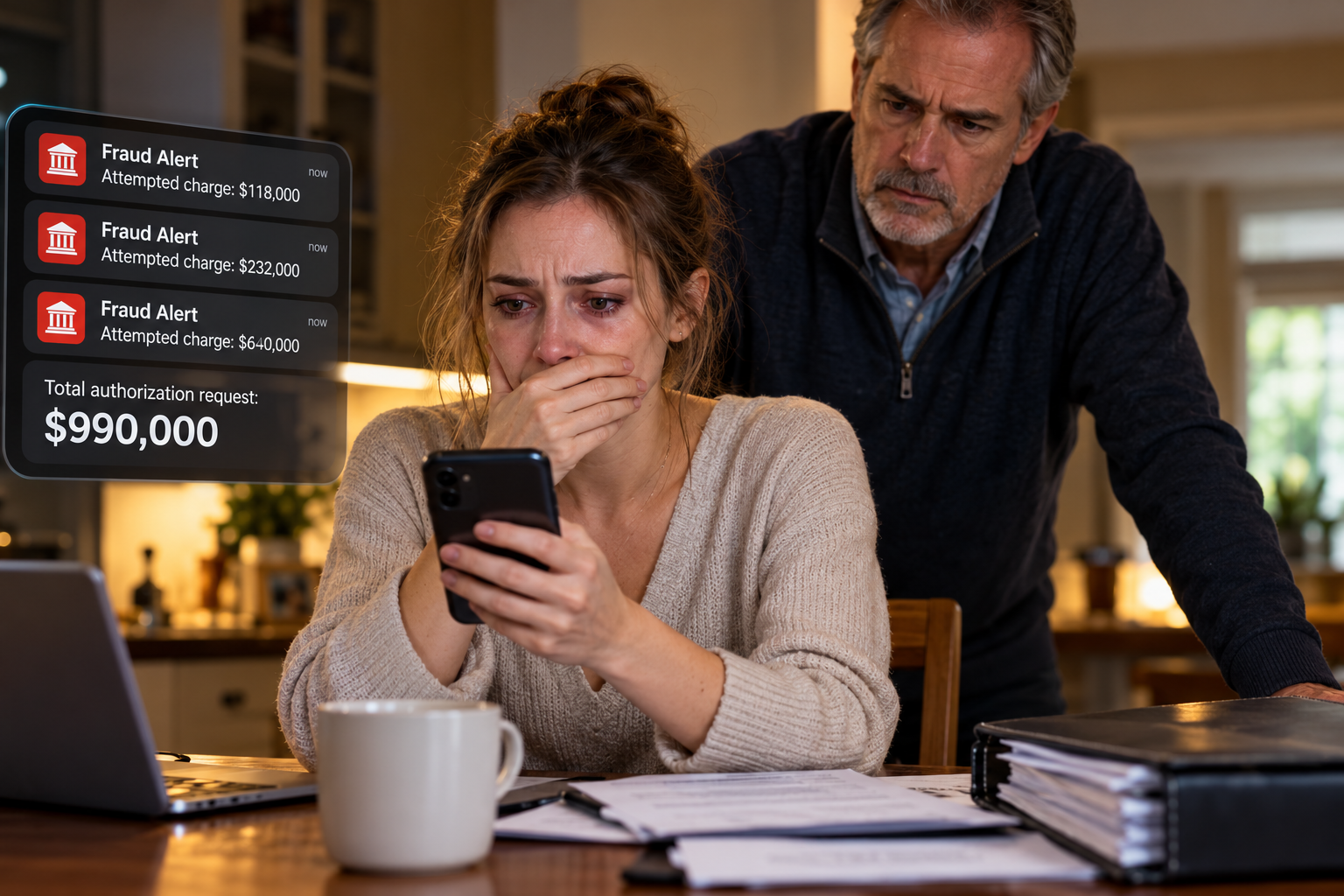
No new fraud alerts appeared.
The bank had not sent a new message about the attempted authorizations.
My phone remained still while I ate breakfast.
I noticed every time I looked at it.
I was beginning to understand how much of my attention had become attached to the possibility of another notification.
Even when nothing happened, I was waiting for it to happen.
My father noticed me glancing at the phone.
"You can leave it on the table."
"I know."
"You keep checking."
"I know that, too."
He didn't say anything else.
I placed the phone beside my mug.
Then I turned it facedown.
The gesture felt strangely difficult.
I had convinced myself that checking frequently would help me respond quickly if anything changed.
But I had already arranged the accounts as best I could with the information available.
I had saved the bank's instructions.
I knew what to do if another alert arrived.
Looking at the screen every few minutes would not improve those preparations.
I finished breakfast without touching the phone.
Afterward, I took the folder into the spare room and reviewed the questions I still needed answered.
The earlier transactions remained the main unfinished part of the financial review.
I had written down the dates and descriptions.
I had also noted which details the bank needed to examine further.
I decided not to keep repeating the same checks while waiting.
Instead, I wrote a short list of the information I would need to provide if I contacted the bank again.
I included the statement period.
I included the transaction descriptions.
I included the amounts.
I made sure not to mix those entries with the three declined authorization requests.
The difference was important.
The large requests had generated the fraud alerts.
The earlier entries were items I did not fully understand.
They might have required clarification for different reasons.
Until I knew more, I would not treat them as one event.
I put the list in the folder and closed it.
Then I went outside with my father.
We walked along the street at an easy pace.
He asked whether I wanted to stop at the small shop near the corner.
I said yes.
Inside, I picked up a few things we needed for lunch.
The cashier greeted us.
My father made a comment about the weather.
The cashier laughed.
For a few minutes, I was simply a person buying groceries.
I hadn't realized how much I missed that feeling.
Nothing about the conversation required me to explain the divorce.
Nothing about the purchase required me to solve the bank alerts.
We returned home carrying the bags.
I put the groceries away while my father made room in the refrigerator.
When I reached for the milk, I noticed that my hand was shaking slightly.
I set the carton down and rested my palms against the counter.
The fear had followed me even into the smallest parts of the day.
I was tired of it.
But being tired did not mean I could force it to disappear.
My father looked over.
"Are you all right?"
"I'm scared that if I stop paying attention, something will happen."
He dried his hands.
"Something might happen whether you watch the phone or not."
I stared at him.
He continued before I could answer.
"That doesn't mean you should ignore your accounts. It means you can't spend every minute trying to prevent every possible thing."
I looked at the phone on the table.
I had wanted vigilance to give me control.
Instead, it had begun to control me.
I could be careful without being constantly alert.
I could check the accounts at reasonable times.
I could respond to new information.
I could keep the records.
I could also eat lunch, walk outside, and sleep.
Those things were not signs that I had stopped caring.
They were signs that I was still living.
I took a breath and returned the milk to the refrigerator.
My hands had stopped shaking.
At lunch, I left my phone on the counter.
I could see it from the table, but I didn't keep it beside my plate.
My father and I talked about the groceries, the weather, and a small repair he wanted to make in the house.
I listened.
I answered when he spoke to me.
I even laughed when he complained about a cabinet door that had never closed properly.
For a little while, I wasn't trying to turn every moment into a clue.
After lunch, I checked my phone once.
There were no new alerts.
I reviewed the bank messages I had already saved and confirmed that I had not missed a request for information.
Then I put the phone away.
I did not interpret the quiet as proof that everything was safe.
I interpreted it as the absence of a new alert.
That was all.
It was a small distinction, but I could feel myself learning to respect it.
Later, I sat at the table and reviewed my notes about contacting my former husband.
The question remained the same.
Did he know anything about the attempted authorizations?
I still had no evidence that he had initiated them.
I also had no answer from him.
I considered whether the conversation would help me now.
I decided I could wait until I had finished the bank follow-up on the earlier transactions.
That would give me a clearer picture of what I needed to ask.
It would not guarantee that the conversation would provide answers.
I accepted that.
I was no longer willing to make a decision simply to escape the discomfort of waiting.
I wrote the date beside the note and put it back in the folder.
Then I closed the folder and carried it to the desk.
The afternoon light fell across the cover.
I left it there.
I had begun this process believing that the right piece of information would make everything clear.
Now I understood that some questions could only be answered in stages.
The bank could confirm the status of the attempted authorizations.
It could review the earlier entries.
I could protect my accounts.
I could preserve the records.
I could decide whether and when to speak to my former husband.
None of those actions required me to pretend I knew who was responsible.
None required me to assume that the worst had happened.
I stood at the window and watched a car turn into the driveway across the street.
For a moment, I felt the old urge to check my phone again.
I let the urge pass.
The phone was where I had left it.
If something changed, I would respond.
Until then, I could continue with my day.
That evening, I slept more easily than I had the night before.
I still woke once and checked the time.
But I did not open the banking application.
I turned over and went back to sleep.
The silence had not promised me safety.
I had stopped asking it to.
Click here to continue reading: PART 20: I Could Not Change What Had Happened in the Courtroom, but I Could Decide How I Would Face the Questions Waiting Beyond It
My Marriage Was Over, but My Father Was Watching Something I Could Not See Yet
Part 19 of 20