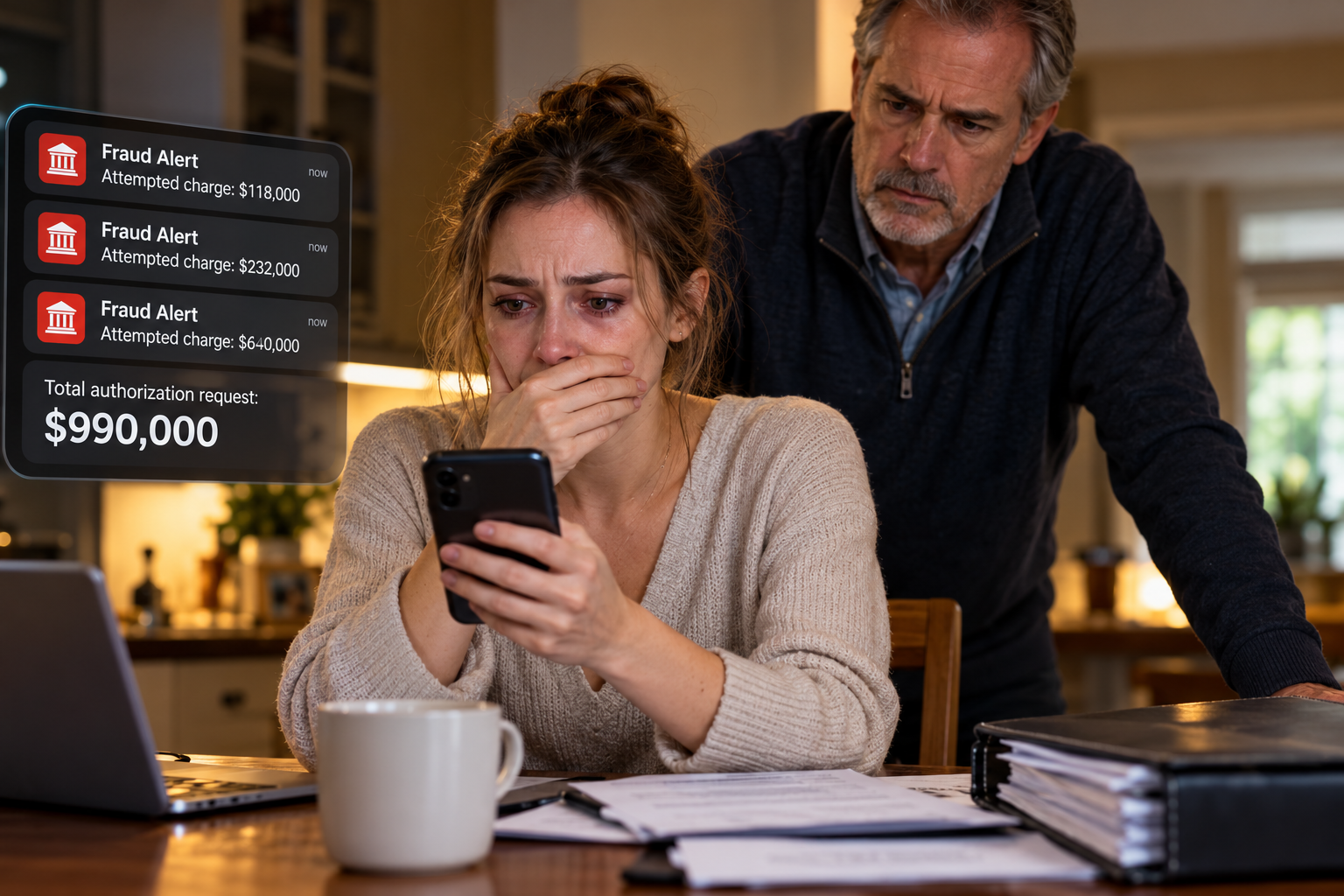
A few days had passed since the three alerts arrived.
The calendar had moved forward, though my thoughts still returned to the same morning.
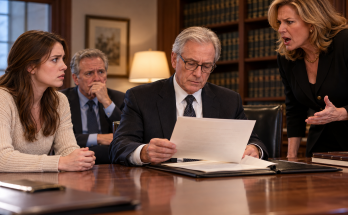
I could remember the courtroom doors.
I could remember my father's hand around my wrist.
I could remember how strange his warning had sounded when I first heard it.
Change every PIN on every card.
Right now.
At the time, I had almost laughed.
I had believed the marriage ending was the largest thing I would have to deal with that day.
I hadn't understood why my father was so urgent.
Now I knew that his warning had led me to act before I had answers.
It had not told me who was responsible.
It had not explained the attempted authorizations.
It had given me a reason to protect my accounts while I worked out what had happened.
That distinction mattered.
I sat at the kitchen table with the folder open in front of me.
My father was preparing breakfast.
I had decided to review the records once more, not because I expected a new discovery, but because I wanted to make sure I had kept everything organized.
The original alerts were saved.
The three amounts were recorded.
The bank had confirmed that the attempted authorizations were declined.
The affected cards had been secured.
The earlier transactions were listed separately for further clarification.
The account security checklist was complete as far as I could establish from the information available.
I read each line carefully.
Nothing in the folder identified the person who had initiated the large requests.
Nothing established that the earlier transactions were connected to them.
Nothing confirmed that my former husband was involved.
I had written those limits into my notes.
I didn't like seeing them.
But I no longer felt compelled to fill the empty spaces.
I closed the folder and placed it beside my notebook.
My father set a plate in front of me.
"Have you finished?"
"For now."
He sat down.
"How do you feel about that?"
I considered the question.
"I wish I knew more."
"That makes sense."
"I also think I understand what I need to do next."
He waited.
"I need to follow up on the transactions I couldn't identify. I need to keep the accounts secure. And I need to stop acting as if I can solve everything by staring at the records."
My father smiled slightly.
"That sounds like a reasonable plan."
I took a bite of breakfast.
For the first time in days, I wasn't trying to decide whether the plan was good enough to protect me from every possible outcome.
It was a plan for the information I had.
I could change it when new information arrived.
After breakfast, I made a clean copy of the remaining bank questions.
I kept the wording direct.
I included the relevant statement dates and descriptions.
I did not include guesses about who might be responsible.
I saved the document with the other records.
Then I checked that I had a way to reach the bank if another notification appeared.
I put my phone down.
The work was finished for the morning.
I could have spent the next hour reviewing everything again.
Instead, I helped my father with a few things around the house.
We put away the dishes.
We folded the laundry.
He asked me to hold a drawer in place while he tightened a loose handle.
The screwdriver slipped once, and he muttered under his breath.
I laughed.
He looked at me.
"What?"
"Nothing."
"You laughed at me."
"I laughed because you were arguing with a drawer."
"It started it."
I laughed again.
The sound surprised me.
I hadn't realized how long it had been since I had laughed without immediately feeling guilty for being distracted from the problem.
My marriage was over.
The financial questions remained unresolved.
I was still frightened about what I might learn.
None of that meant I was forbidden to have an ordinary moment.
When we finished the repair, I washed my hands and returned to the kitchen.
The folder sat where I had left it.
I opened it and added a note about the next bank follow-up.
Then I wrote a short reminder for myself.
IF NEW INFORMATION ARRIVES, REVIEW IT BEFORE DRAWING CONCLUSIONS.
I read the sentence once.
Then I put the pen down.
I had wanted a clean ending.
I had wanted the bank to identify the person responsible, the earlier transactions to make sense, and every unanswered question to fall into place.
I had wanted to know whether my former husband had anything to do with the attempted authorizations.
I still wanted those answers.
But wanting them did not give me the right to invent them.
I couldn't make the facts arrive faster by deciding what they should say.
I couldn't turn my suspicion into proof by repeating it.
And I couldn't undo the choices I had made during my marriage simply by regretting them.
What I could do was take responsibility for the decisions that belonged to me.
I could learn to understand my accounts.
I could ask questions when I didn't understand a transaction.
I could keep access information secure.
I could make sure I knew which accounts and cards were mine to manage.
I could seek clarification rather than allowing embarrassment to silence me.
Those were not grand promises.
They were practical changes.
I had spent years believing that being a good partner meant being willing to trust.
I still believed trust mattered.
But I no longer thought trust required me to stop asking questions.
I could care about someone and still want to understand a financial decision.
I could share responsibilities without surrendering my own awareness.
I could listen to an explanation without accepting it automatically.
And I could acknowledge that a person I loved might disappoint me without deciding in advance that they had done so.
Those lessons did not tell me who had initiated the attempted charges.
They did not make the amounts less frightening.
They gave me a better way to face the uncertainty.
My father came back into the kitchen.
He glanced at the folder.
"Anything new?"
"No."
He nodded.
"Then you can leave it there."
I looked at the papers.
For a moment, I considered taking them back out and checking every page again.
Then I left the folder closed.
I had recorded what I knew.
I had marked what I didn't.
I had taken the security steps available to me.
I had a plan for the remaining questions.
That was enough for the moment.
I carried my mug to the sink and rinsed it.
Outside, the day continued.
A car passed.
A neighbor called to someone across the street.
The ordinary sounds of the world filled the space around me.
I thought again about the courthouse.
My father had not asked whether I was okay.
He had told me to change every PIN on every card.
At first, I had wondered why he couldn't simply comfort me.
Now I understood that he had seen an immediate problem that needed attention.
He had not known everything that would follow.
Neither had I.
But he had given me one practical instruction at a moment when I was too overwhelmed to think clearly.
I had followed it.
Then I had made the next decision.
And the next.
Not every decision had been easy.
Not every question had been answered.
But I had stopped waiting for someone else to tell me what my own records meant.
I was learning to look at them myself.
That did not make me fearless.
It made me more careful.
I returned to the table and rested my hand on the closed folder.
I still didn't know who had tried to authorize $990,000 against my accounts.
I still didn't know whether the earlier transactions mattered.
I still didn't know what my former husband knew, if anything.
Those questions remained open.
I would follow up with the bank.
I would keep my accounts secure.
I would preserve any new information.
And if I decided to speak to my former husband, I would do it because I had a clear question to ask, not because fear had pushed me into the conversation.
I took my hand off the folder.
The marriage had ended in a courtroom.
The questions had followed me home.
I could not change either fact.
But I could decide how I would face what came next.
For now, I had enough information to take the next step.
I did not need to pretend it was the last one.
The End
Read more original stories on Feel Every Story.
My Marriage Was Over, but My Father Was Watching Something I Could Not See Yet
Part 20 of 20