I kept the list beside me while the morning light moved across my father's kitchen table.
The paper had started as a simple record of alerts.
Now it held dates, amounts, account names, and questions I was afraid to answer.
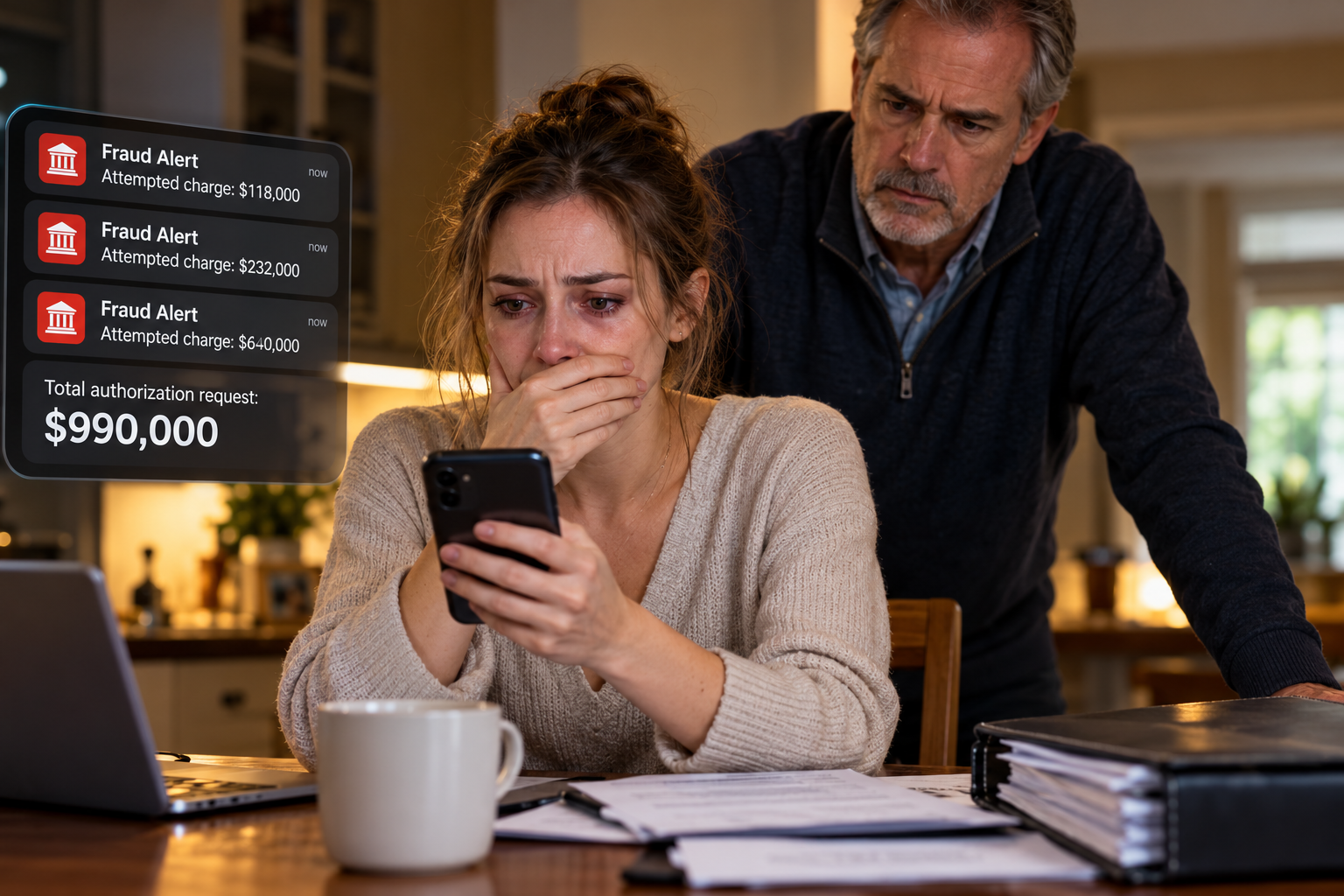
I had written the three attempted charges in a column.
$118,000.
$232,000.
$640,000.
Beneath them, I had underlined the total twice.
$990,000.
Seeing the numbers written in my own handwriting made them feel more real.
It also made them feel less like something I could understand.
My father sat across from me with his coffee untouched.
He had been awake before me, but he hadn't rushed me through anything.
That was one of the things I appreciated about him.
When I was younger, I had mistaken his quietness for disapproval.
Now I wondered how often he had been quiet because he was waiting for me to see something for myself.
I turned the paper toward him.
"Tell me what you think happened."
He studied it for several seconds.
"I think somebody tried to authorize payments against your accounts."
I looked at him.
"That's all?"
"That's what we know."
"You know what I mean."
"I do."
He set down his coffee.
"But if I tell you what I suspect, you'll start treating my suspicion like evidence."
I hated that he was right.
I had spent years accepting explanations because they came from people I loved.
Sometimes I had accepted them because questioning them would have meant admitting that something was wrong.
I didn't want to make the same mistake in the opposite direction.
I picked up my pen.
Under the three amounts, I wrote: WHO INITIATED THE REQUESTS?
Then I added another question.
HOW DID THEY GET THE INFORMATION?
My father read both lines.
"Those are the questions we need answered."
I tapped the paper.
"What about the earlier transactions we found?"
"We record them separately until the bank can tell us more."
"You don't think they're connected?"
"I didn't say that."
He leaned back in his chair.
"I said we shouldn't connect them before we have a reason to."
I looked down at the page again.
There was something frustrating about doing things this way.
I wanted a single explanation that would make every strange detail fit.
I wanted somebody to tell me that the three enormous requests were a mistake, or a deliberate attack, or the predictable consequence of something I had overlooked.
Instead, I had a list of questions.
And a father who refused to pretend he knew the answers.
I opened my banking application again.
The accounts looked ordinary.
Balances appeared where they belonged.
The cards showed as locked or replaced, depending on which account I was viewing.
Nothing on the screen explained why anyone had attempted such large transactions.
I refreshed the activity page.
Nothing changed.
I refreshed it again.
My father watched me.
"Checking it twice won't make the answer appear."
"I know."
I refreshed it once more.
He didn't comment.
After a moment, I put the phone down.
The silence that followed was not comfortable, but it was honest.
I had spent so much of my marriage trying to keep things comfortable.
I had learned to soften questions before asking them.
I had learned to make my worries sound smaller than they were.
When something upset me, I often began by explaining why it probably wasn't important.
That way, if the other person dismissed it, I could pretend I hadn't expected anything else.
I had done it with money.
I had done it with arguments.
I had done it with the small moments when my husband knew something about my accounts that I didn't remember telling him.
At the time, those moments had seemed ordinary.
Couples shared information.
Couples helped each other.
Couples didn't keep score.
I had used those beliefs to explain away things I didn't understand.
Now I couldn't tell whether I had been trusting or simply afraid to ask harder questions.
My father reached for the list.
"Can I see the dates again?"
I passed it to him.
He compared the dates with the notes we had made the night before.
He didn't circle anything or point to a dramatic discovery.
He simply checked that each entry matched the notification or account record we had saved.
When he finished, he returned the paper.
"Keep the original alerts, too," he said. "The list is useful, but the original records matter."
"I've saved the screenshots."
"Keep the emails and messages as well. Don't delete anything, even if it looks unimportant."
I nodded.
I checked the folder on my phone.
The screenshots were there.
So were the bank messages and the notes I had made while speaking to the representatives.
I copied the records into a separate folder and gave it a plain name.
Bank Records.
It wasn't clever.
It didn't need to be.
My father watched me finish.
"Now make sure you can get into the accounts without relying on a number or email address somebody else can access."
"I changed the passwords."
"Good. Check the recovery information, too."
I went through each account again.
I checked the phone number attached to the login.
I checked the recovery email.
I reviewed the devices and sessions the service showed me, signing out of anything I couldn't identify.
Where the bank offered additional security, I enabled it.
I didn't assume that every unfamiliar detail meant someone had interfered.
I recorded what I saw and asked the bank when I needed clarification.
The work was slow.
It was also the first thing I had done since the divorce that made me feel as if I were taking care of myself.
When I finished, I placed the phone beside the paper.
"That's everything I can find right now."
My father nodded.
"Then take a break."
"I can't just stop."
"You can stop for ten minutes."
"What if another alert comes in?"
"If one comes in, we'll deal with it."
He said it as if the possibility did not frighten him.
I knew better.
He was worried.
He had simply decided that worrying would not be the thing that guided us.
I carried my coffee to the window and stood there.
Outside, a neighbor was dragging a garden hose across a patch of dry grass.
A car passed slowly along the street.
Somewhere down the block, a child laughed.
The world had continued without noticing that my marriage had ended, that someone had tried to authorize nearly a million dollars, or that I was standing in my father's kitchen trying to understand my own life.
I had expected the end of my marriage to feel like a door slamming.
Instead, it had felt like a room slowly emptying.
First the arguments had gone.
Then the routines.
Then the familiar assumptions I had built around another person.
Now even my memories seemed to be asking questions.
My phone remained quiet.
For the first time that morning, I let it remain quiet without touching it.
When I returned to the table, my father had put a fresh glass of water beside my paperwork.
I sat down and drank it.
Then I picked up the pen again.
I added one final line to the page.
DO NOT ASSUME. VERIFY.
It looked severe in my handwriting.
But it was something I could follow.
I folded the list carefully and placed it inside the folder with the other records.
I wasn't ready to decide what the alerts meant.
I was ready to stop pretending they meant nothing.
Click here to continue reading: PART 10: The Bank Asked Me to Describe What I Recognized, and I Discovered How Difficult It Was to Admit What I Did Not Know
My Marriage Was Over, but My Father Was Watching Something I Could Not See Yet
Part 9 of 20