I waited until after lunch to review the statements.
My father had offered to leave me alone, but I asked him to stay nearby.
I didn't need him to read every line.
I needed to know I wasn't sitting with the uncertainty by myself.
I spread the documents across the table.
The first statement covered a period I remembered clearly.
The second covered a month when my former husband and I had been arguing more often.
I knew the arguments had happened.
I didn't know whether they had anything to do with the financial activity.
I put the statements in date order.
Then I opened my notebook.
I wrote down the account name, the statement period, and the balance shown at the beginning and end.
I checked each figure against the original page.
It was slow work.
I had never realized how much information could fit into a few pages of small print.
There were ordinary purchases, recurring bills, and payments I recognized immediately.
There were also entries whose descriptions meant little to me.
I marked those for clarification.
I did not label them fraudulent.
I did not label them unauthorized.
I wrote: NEEDS IDENTIFICATION.
The phrase became a small comfort.
It allowed me to acknowledge that I didn't understand something without deciding that I knew why.
My father sat at the far end of the table reading a newspaper.
Every so often, he looked up to make sure I was all right.
I appreciated that he didn't keep asking whether I had found anything.
The question would have made every unfamiliar entry feel like a test.
Instead, I worked at my own pace.
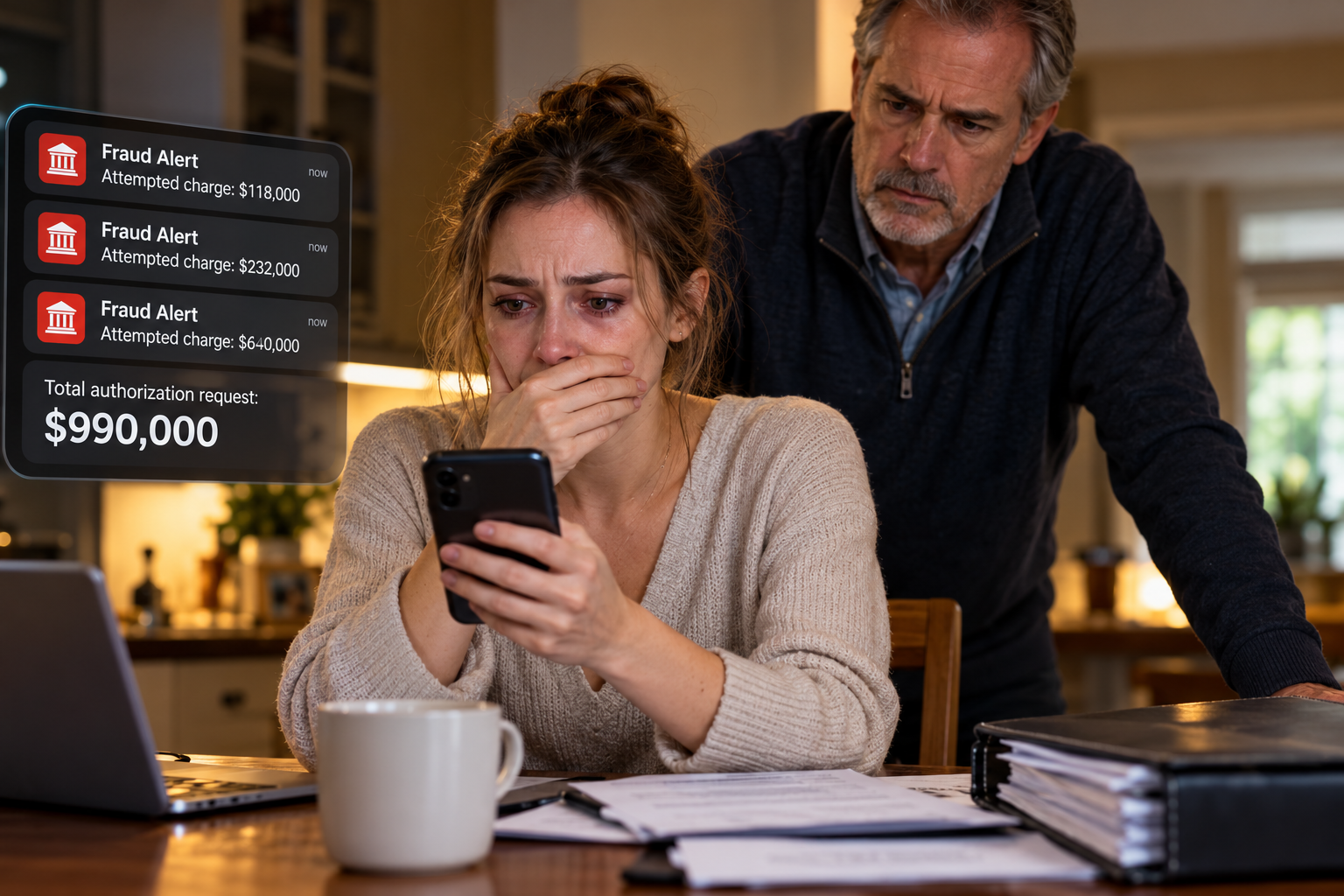
I compared the dates on the statements with the notes I had made about the attempted authorizations.
The dates did not provide a clear connection.
I checked them again.
Still nothing conclusive.
I looked at the amounts.
Some were small.
Others were larger household payments.
None of the records I was reviewing established who had initiated the three enormous requests.
I felt the old frustration returning.
I had hoped that the statements would reveal a pattern so clear that I would no longer have to wonder.
I had imagined finding one entry that explained everything.
Instead, I found the ordinary complexity of a financial life I had not been examining closely enough.
I leaned back in my chair.
"I don't understand how I let so much go by without checking."
My father folded the newspaper.
"How much did you let go by?"
I gestured toward the papers.
"All of this."
"Did you recognize the household bills?"
"Most of them."
"Did you know what the accounts were for?"
"Yes."
"Did you agree to the general arrangement?"
I paused.
"Yes."
"Then don't tell yourself you knew nothing."
I looked down.
"But I didn't understand every entry."
"Then that's what you need to work on."
He spoke gently, but he didn't turn it into reassurance.
I appreciated that.
There was a difference between acknowledging what I had known and pretending I had understood everything.
I could admit that I had participated in our financial decisions.
I could also admit that I had let some of the details pass without asking for explanations.
Both things could be true.
I returned to the statement.
One entry was unfamiliar because the description had been shortened.
I wrote down the date and amount, then added a question mark beside it.
Another entry looked familiar but needed confirmation.
I marked that one separately.
I did not group the two together just because I had noticed them on the same page.
By the time I reached the end of the first statement, I had a short list of items to ask the bank about.
None of them provided a confirmed explanation for the attempted authorizations.
I wrote that clearly at the bottom of the page.
The statement review had produced questions, not answers.
I placed the reviewed pages on one side of the table and the untouched statements on the other.
The neat separation made me feel more organized than I felt inside.
I took a short break.
My father asked whether I wanted something to eat.
I told him I would have a snack later.
He didn't insist.
I stood at the kitchen window and looked at the street.
A delivery driver stopped at a house across the road.
A woman came out to collect a package.
They exchanged a few words, and the driver returned to his van.
I watched until the van pulled away.
Then I went back to the table.
I had spent years thinking that the hardest part of marriage was learning to live with another person's habits.
I had not expected the harder lesson to come afterward.
I was having to learn how to trust my own judgment without treating every uncertainty as a failure.
The bank records could tell me what had happened in the accounts.
They could not tell me what my former husband had intended.
They could not tell me whether he knew about the attempted authorizations.
They could not explain every decision we had made together.
Those answers, if they existed, would require more than staring at a statement.
I finished reviewing the next set of pages.
Again, I marked the entries I needed to identify.
Again, I checked the dates.
Again, I kept the earlier transactions separate from the three declined requests.
The work was repetitive, but it taught me something.
I could sit with a question without immediately giving it an answer.
I could record a fact without forcing it to fit a larger story.
I could ask for clarification without deciding in advance what I expected to hear.
Those were small skills.
They were also skills I needed.
When I finished, I put the statements back in chronological order.
I clipped the questions to the front.
My father set his newspaper aside.
"How did it go?"
"I found some things I need to ask about."
"Anything that explains the alerts?"
"No."
He nodded.
"Then that's the answer for today."
I looked at him.
"It's frustrating."
"Of course it is."
"I keep feeling like I'm missing something."
"You might be missing information. That doesn't mean you can find it by forcing yourself to look at the same page until it changes."
I smiled despite myself.
"I know."
This time, I meant it.
I put the papers into the folder and wrote the review date on the tab.
I added the unresolved questions to the list I would use when contacting the bank.
I didn't add my former husband's name.
I didn't add a theory.
I simply recorded what needed to be checked.
When the folder was closed, I felt tired rather than triumphant.
I had hoped for certainty.
I had gained a clearer picture of what I knew and what I didn't.
It wasn't enough to settle the matter.
It was enough to keep me from confusing my fear with a conclusion.
Click here to continue reading: PART 16: My Father Asked Me What I Wanted to Know Before I Spoke to Anyone Else, and I Finally Understood Why He Kept Telling Me to Slow Down
My Marriage Was Over, but My Father Was Watching Something I Could Not See Yet
Part 15 of 20