The rest of the afternoon passed without another fraud alert.
I tried not to treat the silence as proof that the problem had ended.
It was simply a quiet afternoon.
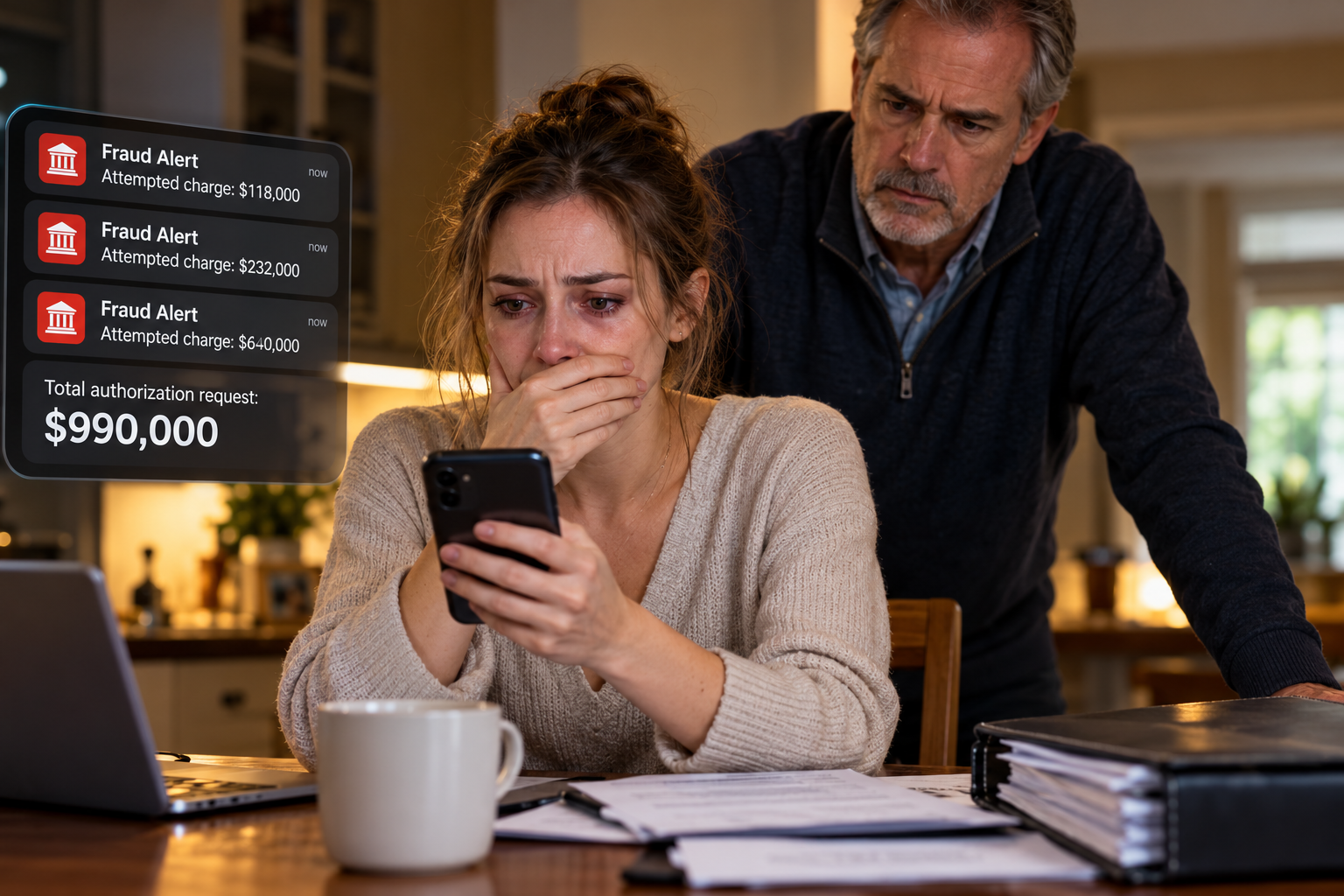
The bank had confirmed that the three attempted authorizations were declined.
The affected cards had been secured.
I had saved the notifications and recorded the information I had been given.
Those were the facts.
Everything beyond them remained uncertain.
I repeated that to myself while I helped my father prepare something simple for dinner.
He took vegetables from the refrigerator.
I washed them at the sink.
Neither of us mentioned the folder until I noticed that my hands were moving more slowly than usual.
I had spent so many hours looking at numbers that I had forgotten I was hungry.
My father noticed before I did.
"When did you last eat?"
I tried to remember.
"Breakfast."
"You had half of it."
"I had more than half."
He looked at me.
I sighed.
"Fine. Not enough."
He handed me a plate.
We finished preparing dinner without discussing the accounts.
For a little while, the only things that mattered were the knife on the cutting board, the water running in the sink, and the smell of food warming in the pan.
I found myself grateful for the ordinary details.
They didn't ask me to interpret them.
A plate was a plate.
A glass of water was a glass of water.
A question about whether I wanted more food was not a test of my loyalty.
When we sat down, my father asked whether I wanted to talk.
I looked at the table.
"I don't know what I would say."
"Then you don't have to say anything."
I ate a few bites.
After a while, the words came anyway.
"I keep thinking about how often I let him handle things because it was easier."
My father waited.
"If a bill came in, he might pay it. If a password needed changing, he'd offer to do it. If something about an account confused me, I'd ask him to explain it."
"That isn't automatically wrong."
"I know."
I moved my fork across the plate.
"But I stopped checking whether I understood."
He didn't interrupt.
"I would tell myself that we were a team. That if he understood something better than I did, there was no reason for both of us to worry about it."
I looked up.
"I thought sharing responsibility meant I didn't have to know every detail."
My father folded his hands.
"Sharing responsibility doesn't mean giving up the right to understand."
I felt something tighten in my throat.
I had heard advice like that before.
It had never seemed relevant when my marriage was still intact.
Now it sounded painfully simple.
I looked down at my plate again.
"Maybe I should have asked more questions."
"Maybe."
His answer surprised me.
He didn't rush to tell me that I had done everything perfectly.
He didn't say that none of my choices mattered.
He allowed the possibility that I had made mistakes without turning those mistakes into a reason to blame myself for everything that had happened.
"That doesn't mean you caused these attempts," he added. "We still don't know who initiated them."
I nodded.
The distinction was important.
I could examine my own decisions without inventing responsibility for someone else's actions.
I could admit that I had neglected parts of my financial life without deciding that I deserved to be frightened.
I could regret what I hadn't understood without pretending that I had known it all along.
After dinner, I carried our plates to the sink.
My father tried to take mine.
"I can do it."
"I know you can."
He let me keep the plate.
We washed the dishes together.
When the kitchen was clean, I returned to the table and opened the folder one more time.
The paper looked different in the evening light.
The amounts were still enormous.
The unanswered questions were still unanswered.
But the folder no longer looked like a collection of things I was afraid to touch.
It looked like a record I could use.
I checked the pages in order.
The first contained the original alerts and the dates they arrived.
The next held the notes from the bank conversations.
The later pages contained the earlier unfamiliar transactions, clearly separated from the attempted authorizations.
I checked that I had kept the distinction between confirmed information and questions.
Then I placed the pages in order and clipped them together.
My father watched from the other side of the table.
"Are you finished for tonight?"
"Almost."
I reviewed the list of accounts one final time.
There were still things I would need to confirm.
There were still details I didn't understand.
But I had no new information to examine, and repeating the same checks would not make the missing answers appear.
I closed the folder.
"Now I'm finished."
My father nodded toward the living room.
"Come sit down."
I followed him.
The television was on, but the volume was low.
Neither of us paid much attention to what was playing.
I sat on the couch and tucked my feet beneath me.
For the first time since the divorce, I allowed myself to feel the full weight of the day without immediately trying to turn it into a plan.
My marriage had ended.
Someone had attempted three enormous transactions.
The bank had declined them.
I had secured my accounts as best I could with the information available.
I still didn't know who was responsible.
Saying it plainly did not make the uncertainty disappear.
It did stop me from adding things I couldn't prove.
My father sat beside me.
After a few minutes, I leaned my head back against the couch.
"I don't know what happens next."
"Neither do I."
I turned toward him.
"You usually have an answer."
"I usually have an opinion."
That made me smile.
He looked at me with a tired gentleness that I hadn't noticed earlier.
"There's a difference."
I let the silence settle between us.
I had wanted him to tell me what the alerts meant.
I had wanted him to identify the person behind them, explain the amounts, and give me a clear path through the fear.
He couldn't do those things.
What he could do was sit beside me while I faced the parts I didn't understand.
That was less dramatic than an answer.
It was also real.
Later, I returned to the kitchen to retrieve my phone.
There were no new notifications.
I checked only the alerts that had already arrived, making sure they were still saved.
Then I placed the phone on the bedside table rather than carrying it around the house.
I wasn't ignoring the situation.
I was allowing myself to sleep.
Before going to bed, I looked at the folder one last time.
The page with the three amounts sat on top.
Below it, in my own handwriting, were the words I had written that morning.
DO NOT ASSUME. VERIFY.
I ran my finger along the edge of the paper.
I didn't know yet what the records would show.
I didn't know whether the earlier transactions mattered.
I didn't know whether my former husband had any connection to the attempted authorizations.
I knew only that I had stopped treating my fear as proof.
That was not the answer I wanted.
It was the first honest place I had stood all day.
I turned off the kitchen light and went to bed.
The phone remained silent beside me.
For once, I didn't ask the silence to promise me anything.
Click here to continue reading: PART 13: The Morning After the Alerts, I Tried to Return to My Ordinary Life, but Even Simple Decisions Felt Different Without Him
My Marriage Was Over, but My Father Was Watching Something I Could Not See Yet
Part 12 of 20