
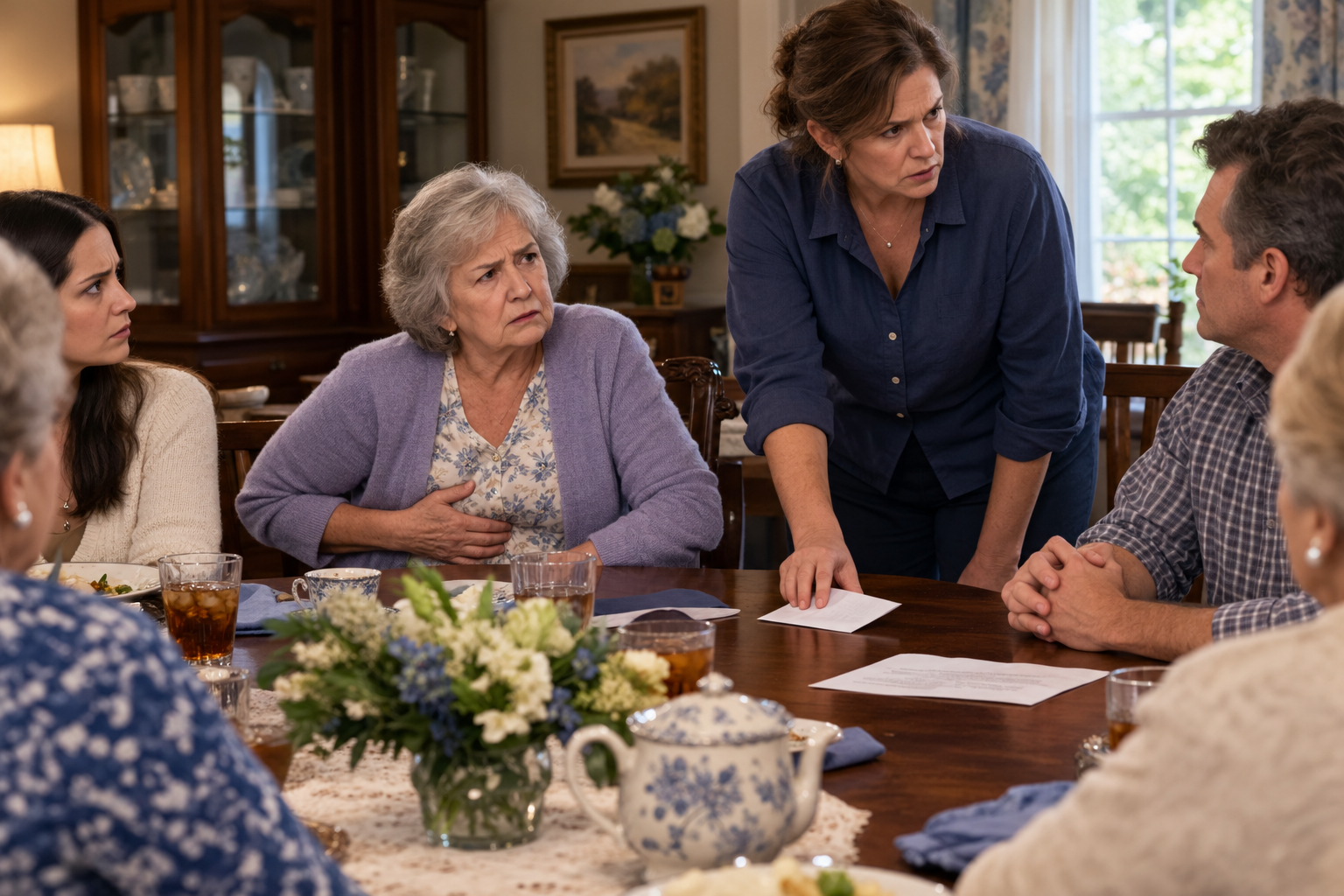
The bank representative stepped into the dining room and placed the folder on the table.
The deputy remained near the doorway.
He wasn't holding handcuffs.
He wasn't threatening anyone.
He didn't need to.
The sight of him was enough.
Daniel sat down slowly.
Karen began crying.
Mama remained standing.
The bank representative looked at her.
“We received a request to review several transfers made under the authority of your power of attorney.”
Mama looked at Daniel.
“Did you request the review?”
Daniel shook his head.
“No.”
The woman continued.
“There are concerns regarding transactions that may not have been authorized by you.”
Mama's eyes lowered.
“I didn't authorize them.”
Daniel closed his eyes.
The bank representative nodded.
“That's what we needed to confirm.”
I looked at Mama.
She looked at me.
Neither of us had called the bank that evening.
The review had already begun after Peterson contacted them.
Daniel opened his eyes.
“You did this.”
I shook my head.
“No.”
He stared at me.
“You went to the lawyer.”
“Yes.”
“You knew this would happen.”
“I knew your financial activity needed to be reviewed.”
His face tightened.
“You wanted to ruin me.”
Mama stepped between us.
“No.”
Daniel looked at her.
“She did.”
Mama shook her head.
“I did.”
He stared at her.
“I asked my lawyer to help me understand my own finances.”
Daniel looked stunned.
“You?”
“Yes.”
The bank representative explained that additional transfers had been frozen pending review.
Daniel rubbed his forehead.
“What happens now?”
“That depends on the investigation.”
Mama sat down.
Her hands were trembling.
I took the chair beside her.
Daniel stared at the papers.
For once, he had nothing persuasive to say.
The house folder remained on the table.
Mama reached for it.
She pushed it across to Daniel.
“I am not selling my house.”
He looked at her.
“I know.”
“No.”
She kept her hand on the folder.
“I need you to understand.”
He nodded.
“I understand.”
“You will not pressure me again.”
“I won't.”
“You will not handle my money.”
He swallowed.
“I won't.”
“And you will not cancel another medical appointment for me.”
His eyes filled.
“I won't.”
Mama leaned back.
“Good.”
The deputy and bank representative left after confirming the next steps.
When the door closed, the house became very quiet.
Daniel remained seated.
Karen stood beside him.
She looked at Mama.
“I'm sorry.”
Mama nodded.
“I know.”
Karen wiped her face.
“I didn't know.”
Mama looked at her.
“You didn't ask.”
Karen lowered her head.
That sentence seemed to reach everyone.
We had all accepted things because asking questions was uncomfortable.
Daniel had called it protection.
Karen had called it worry.
I had called it keeping peace.
Mama had called it love.
None of those words changed what happened.
Later that night, after Daniel and Karen left, Mama and I cleaned the dining room.
The dishes were still stacked beside the sink.
A piece of sausage sat untouched on a plate.
Mama picked it up with her fork and put it in the trash.
Then she smiled faintly.
“I never even liked that sausage.”
I laughed.
“You ate it because Daniel bought it.”
“I ate it because I didn't want him complaining.”
She looked at me.
“That's the problem, isn't it?”
“What?”
“I spent years eating things I didn't want so other people wouldn't complain.”
I leaned against the counter.
“Mom.”
She sighed.
“I don't want to live like that anymore.”
At eleven-thirty, she asked the question I had been dreading.
“Do you think I'm dying?”
I sat beside her.
“I don't know.”
She nodded.
“Thank you.”
“For what?”
“For not telling me I'm fine.”
I took her hand.
“I was scared too.”
“So was I.”
She looked toward the dark window.
“I've been scared since March.”
I squeezed her fingers.
She continued.
“After your father died, Daniel started handling everything.”
“I know.”
“He told me I was too emotional.”
I looked at her.
“He said I couldn't manage the bills.”
She paused.
“He said he would protect me.”
Her voice became quieter.
“And I believed him.”
I didn't know what to say.
Mama looked at me.
“I thought trusting my son was what mothers were supposed to do.”
“You can trust someone and still check the paperwork.”
She smiled.
“That sounds like your father.”
I laughed.
“That's a good thing.”
“Yes.”
She squeezed my hand.
Then her expression became serious.
“If something happens to me…”
“Mama.”
“Listen.”
I did.
“Don't let Daniel lose everything because of me.”
“What do you mean?”
“If he owes money, help him find a way to deal with it. But don't give him the house.”
“I won't.”
“And don't rescue him.”
I looked at her.
She shook her head.
“He needs consequences.”
I understood then.
She wasn't asking me to punish my brother.
She was asking me not to protect him from the consequences of what he had done.
The next morning, we drove sixty miles to Cedar Falls.
The doctor reviewed the scan.
Then he took off his glasses.
“Martha, I need you to listen carefully.”
Mama nodded.
“There is a mass that concerns me.”
My heart seemed to stop.
“What does that mean?”
“We need a biopsy.”
“How soon?”
“As soon as possible.”
Mama stared at the floor.
Then she asked the question both of us had been avoiding.
“Is it cancer?”
The doctor shook his head.
“I don't know.”
He turned toward the scan.
“But I don't want you waiting.”
Mama nodded.
The biopsy was scheduled for Friday.
On the way home, she held the appointment card in her lap.
“I'm afraid.”
“I know.”
“I'm still going.”
“I know.”
She looked at me.
“I don't want Daniel to know until we have answers.”
“That's your decision.”
She smiled.
“I like that.”
“What?”
“You saying that.”
“Which part?”
“My decision.”
She looked out the window.
“I forgot what that felt like.”
The days before the biopsy passed slowly.
Daniel called.
Then stopped calling.
Then called again.
He apologized.
He asked to see Mama.
She agreed only if I was there.
Thursday afternoon, he arrived.
He looked different.
He had lost weight.
His clothes hung loosely.
The certainty that used to sit in his voice had disappeared.
He sat across from Mama.
“I don't expect you to forgive me.”
Mama nodded.
“Good.”
He swallowed.
“I'll repay everything.”
“How?”
“I'm selling the lake property.”
Mama looked at him.
“Do it because you owe the money.”
“I know.”
“Not because you want me to forgive you.”
He nodded.
“And the house?”
“I won't touch it.”
“Good.”
He looked at me.
“I am sorry.”
I believed him.
But belief was not the same as trust.
Trust had been damaged too many times.
The biopsy happened Friday.
The wait afterward was worse.
Mama slept badly.
I barely slept at all.
Six days later, the doctor called us into his office.
He smiled before he spoke.
That was how I knew.
“It's not cancer.”
Mama covered her mouth.
I started crying.
She began crying too.
The doctor explained that the condition was serious and would require surgery and a long recovery.
But it was treatable.
We left the office holding hands.
Outside the hospital, Mama hugged me.
“I get more time,” she whispered.
“Yes.”
She took a shaky breath.
“Then I'm going to use it.”
And she did.
She changed her power of attorney.
She opened an account Daniel couldn't access.
She hired an independent financial adviser.
She worked with Peterson to protect the house through a proper estate plan.
And she made Daniel sign a repayment agreement.
There was no shouting.
No dramatic punishment.
Just paperwork.
For the first time, consequences had become real.
Daniel sold the lake property.
He sold his second truck.
He closed one part of his business.
He worked out the rest of his debt.
It wasn't easy.
There were months when he called Mama asking for help.
She refused.
Not cruelly.
Firmly.
“You need to solve this yourself.”
He learned to do exactly that.
Mama underwent surgery and months of recovery.
Some days were difficult.
Some were surprisingly ordinary.
She complained about hospital food.
She argued with physical therapists.
She insisted she could walk farther than she actually could.
And slowly, she got stronger.
One morning, she stood on the porch in her robe and announced that she was going outside.
“You're not dressed.”
“I have clothes underneath.”
“That isn't the point.”
“It is to me.”
I laughed.
She smiled.
“I have things to do.”
Months later, Daniel came over carrying groceries.
He stopped at the bottom of the porch steps.
“Can I come in?”
Mama smiled.
“You don't need permission to enter your childhood home.”
He nodded.
“But I do need permission to make decisions for you.”
She looked at him.
“Now you're learning.”
He hugged her.
I watched from the doorway.
It wasn't the old family.
That family had depended on silence.
This one was learning how to survive honesty.
A year later, we sat around the same dining table.
There was sausage on Mama's plate.
Daniel looked at it.
“Do you want me to take that away?”
Mama laughed.
“No.”
She took a bite.
“I'm seventy-seven.”
Daniel smiled.
“And?”
She pointed her fork at him.
“And I can eat what I want.”
Everyone laughed.
I looked around the table.
The same walls.
The same chairs.
The same old clock.
But nothing felt the same.
Mama no longer apologized for needing help.
Daniel no longer confused helping with controlling.
And I no longer mistook silence for peace.
Later that evening, Mama and I stood together on the porch.
The sky was turning orange over the trees.
She rested her head against my shoulder.
“You know what I learned?”
“What?”
“Your body whispers before it screams.”
I nodded.
“And families whisper too.”
She looked at me.
“When people keep telling you something is nothing, listen anyway.”
“Especially when it's your mother.”
She smiled.
“Especially then.”
Inside, Daniel was washing dishes.
Nobody had asked him.
He was simply doing it.
I watched him through the kitchen window.
Mama noticed.
“He's learning.”
“So are we.”
She smiled.
“Put the kettle on.”
“For tea?”
“For tea.”
I laughed.
“You just ate sausage.”
She grinned.
“Then don't tell your brother.”
Our laughter carried through the house.
Not because everything had been forgotten.
Not because what Daniel did no longer mattered.
It mattered.
The canceled appointments mattered.
The missing money mattered.
The fear Mama had carried mattered.
The months when she believed her pain was an inconvenience mattered.
But so did what came afterward.
The truth.
The boundaries.
The treatment.
The decision to stop rescuing people from consequences.
And, eventually, forgiveness that did not require forgetting.
Mama had spent most of her life taking care of everyone else.
Now she was finally taking care of herself.
And when she lifted her tea that evening, she looked at me and smiled.
“I think I have another twenty good years in me.”
I believed her.
Because this time, she believed it too.
Click here to continue reading: PART 5: The First Morning After the Diagnosis, Mama Refused to Let Fear Decide What Happened to Her Next
At Sunday Dinner, My Mother Finally Admitted the Pain Was Worse Than She Had Let Anyone Believe
Part 4 of 20

