
Years passed.
Not quickly.
Not dramatically.
Just one ordinary season after another.
The little tree became enormous.
Its branches reached over the side of the house.
Mama complained that it dropped too many leaves.
Then she complained when the leaves stopped dropping.
She had become impossible in exactly the way she had promised.
Daniel's life stabilized.
His business remained smaller than before.
He preferred it that way.
“I sleep now,” he told me once.
“You didn't before?”
“Not really.”
He smiled.
“Turns out living beyond your means is exhausting.”
I laughed.
He had learned to say things plainly.
There was no excuse attached.
No attempt to make himself the victim.
Just truth.
Mama noticed.
She always did.
One spring morning, she found an old envelope in a drawer.
She called me into the kitchen.
“Look.”
I recognized the handwriting.
Daniel's.
“What is it?”
“I don't know.”
She opened it.
Inside was a note he had written years earlier.
It was dated shortly after the bank review.
Mama read it silently.
Then she handed it to me.
The note was simple.
He had written that he was sorry.
Not for being caught.
Not for losing the house.
Not for the bank investigation.
For making Mama afraid to ask for help.
I looked at her.
“You kept this?”
“Yes.”
“Why?”
“I didn't know what to do with it.”
“What did you do with it?”
“Kept it.”
She smiled.
“Sometimes that's enough.”
She folded the note again.
Then placed it back in the envelope.
“I think I can throw it away now.”
“Why?”
“Because he doesn't need the letter anymore.”
She closed the drawer.
“He's showing me.”
I nodded.
That afternoon, Daniel came over.
Mama showed him the note.
He looked embarrassed.
“You kept that?”
“Yes.”
“For years?”
“Yes.”
“I wish you hadn't.”
“Why?”
“It's embarrassing.”
Mama smiled.
“Good.”
He laughed.
Then she handed it back.
“I don't need it anymore.”
He looked at the paper.
Then at her.
“You don't?”
“No.”
He folded it carefully.
“I'll keep it.”
“Why?”
“To remember who I don't want to be.”
Mama nodded.
“That is a good reason.”
We sat together in the kitchen.
For a while, nobody spoke.
Then Daniel asked, “Do you ever regret not selling the house?”
Mama laughed.
“Never.”
“Even with the repairs?”
“Especially with the repairs.”
He smiled.
“Fair.”
She looked around.
“This house has too many memories.”
“Some bad.”
“Yes.”
“Some good.”
“Mostly good.”
I looked toward the porch.
“Dad built that railing.”
Mama nodded.
“You painted it.”
Daniel smiled.
“You painted over my initials.”
“You carved them into the wood.”
“I was twelve.”
“You were destructive.”
He laughed.
“I was artistic.”
Mama shook her head.
“You were a menace.”
The laughter that followed was easy.
There was no bitterness in it.
That was another thing time had done.
It had softened the edges.
Not erased them.
Softened them.
Later that year, Mama turned eighty-five.
She refused a big party.
“No fuss.”
We ignored her.
Daniel organized a small gathering.
Neighbors came.
June came.
The doctor who had treated Mama years earlier sent a card.
Peterson sent flowers.
The garden center employee who had helped Mama choose the tree had somehow become a family friend.
Everyone sat beneath the tree.
Mama looked around.
“This is too much.”
Daniel smiled.
“You're eighty-five.”
“I know.”
“You're allowed.”
She laughed.
Then June stood.
“I want to say something.”
Mama looked surprised.
June smiled.
“You changed my life.”
Mama shook her head.
“No.”
“Yes.”
June told the story of the casserole.
The pain.
The doctor.
The appointment she nearly canceled.
“I kept thinking I was being dramatic.”
Mama listened.
“Then I remembered what you said.”
“What did I say?”
“Listen to your body.”
Mama smiled.
June continued.
“I did.”
Everyone became quiet.
“I caught something early.”
Mama's eyes filled.
June hugged her.
“You gave me courage.”
Mama whispered, “You gave yourself courage.”
June smiled.
“But you reminded me I had it.”
Afterward, Daniel stood beside Mama.
He looked at the crowd.
“I have something to say too.”
Mama groaned.
“Oh no.”
Everyone laughed.
Daniel smiled.
“I spent a long time thinking my mother needed me to manage her life.”
Mama raised an eyebrow.
“She did not.”
“No.”
He looked at her.
“She needed me to listen.”
Mama nodded.
“And sometimes she needed me to stay out of the way.”
Everyone laughed.
Daniel continued.
“I didn't understand that.”
He took a breath.
“But I do now.”
He looked at me.
“And my sister taught me that sometimes loving someone means making them face the truth.”
I shook my head.
“You don't have to make this about me.”
“It is.”
He looked back at Mama.
“I'm sorry.”
Mama reached for his hand.
“I know.”
He smiled.
“And I'm grateful you're still here.”
Mama squeezed his hand.
“So am I.”
That evening, after everyone left, Mama sat beneath the tree.
I brought her a blanket.
She looked up at the branches.
“It's beautiful.”
“Yes.”
“I still remember planting it.”
“So do I.”
“I wasn't sure I'd live to see it this big.”
“But you did.”
“Yes.”
She smiled.
“That keeps happening.”
“What?”
“I keep getting to see things I thought I wouldn't.”
I sat beside her.
“That's because you're stubborn.”
“Maybe.”
She looked toward the house.
“I want you to have the photographs.”
“All of them?”
“Most.”
“That's a lot.”
“I know.”
“What am I supposed to do with them?”
“Remember.”
I smiled.
“I can do that.”
She looked at me.
“And if you ever start thinking about throwing them away…”
“I won't.”
“Good.”
She leaned back.
“You know, I don't think the Sunday dinner was the worst thing that happened.”
I looked at her.
“No?”
“No.”
“What was?”
She thought about it.
“The months when I believed my pain didn't matter.”
I nodded.
“And the best thing?”
She smiled.
“You listened.”
I shook my head.
“The doctor listened.”
“The doctor came because you listened.”
She took my hand.
“That is why I tell people not to ignore the quiet things.”
“The quiet things?”
“The pain. The fear. The questions. The little voice that says something isn't right.”
She looked at the house.
“Most disasters don't begin loudly.”
I thought about that.
She continued.
“They begin with someone saying, 'It's probably nothing.'”
I felt a chill.
She smiled.
“But you don't have to live afraid of every little thing.”
“No.”
“You just have to pay attention.”
We sat quietly.
The wind moved through the branches.
A few leaves fell.
Mama looked up.
“I think that's enough.”
“What?”
“Today.”
She smiled.
“Let's go inside.”
I helped her stand.
She refused my arm halfway to the porch.
“I can walk.”
“I know.”
She walked beside me anyway.
Inside, Daniel was waiting.
He had made tea.
Mama looked at him.
“You made it too strong.”
“I knew you'd say that.”
“You still did it.”
“Yes.”
She smiled.
“Good.”
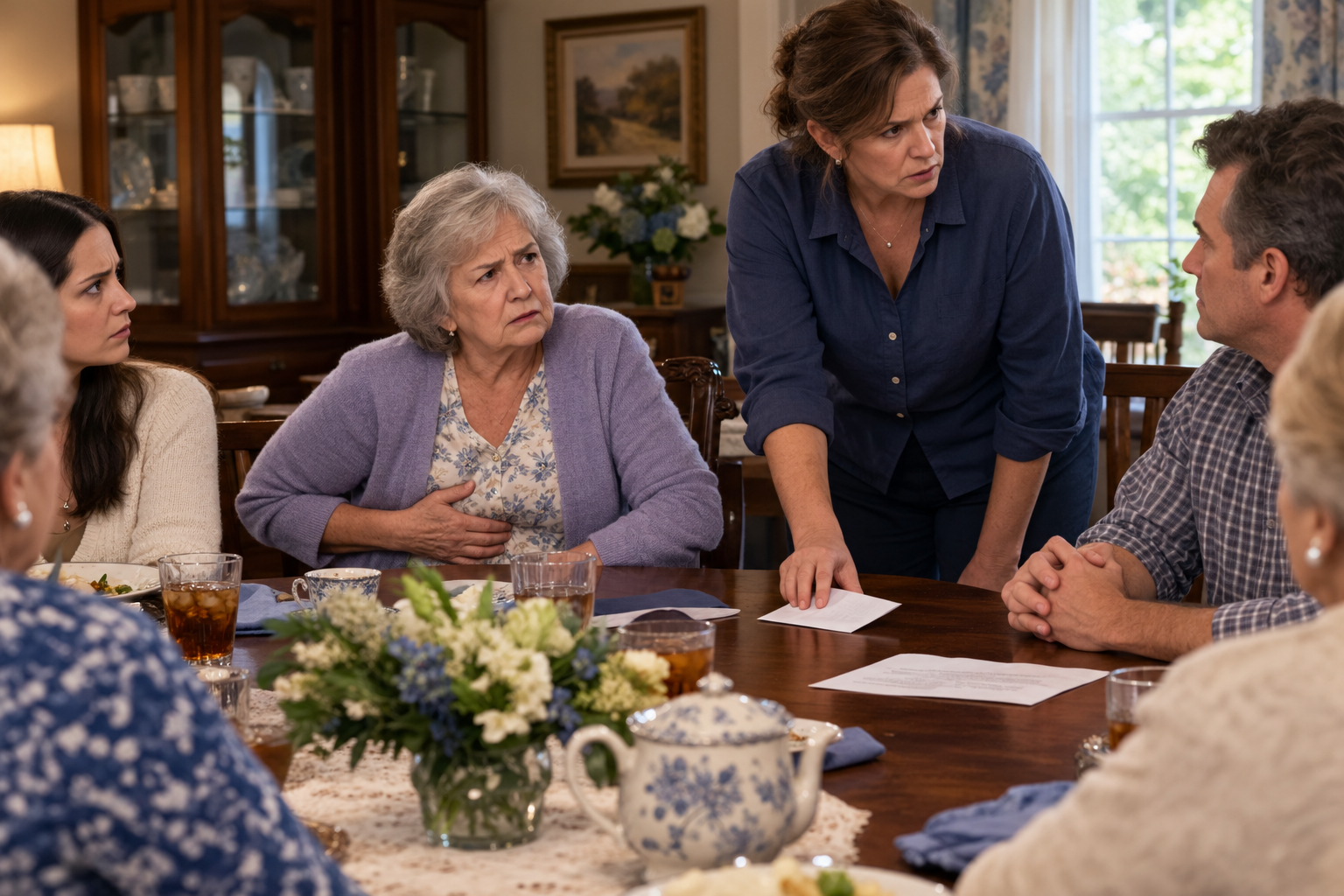
We sat around the same table where everything had started.
The same table where Mama had once pressed her hand beneath her ribs.
The same table where Daniel had laughed.
The same table where we had found the bank statements.
The same table where Mama had finally said no.
Now there was tea.
Cake.
A vase of flowers from the garden.
No hidden documents.
No fear.
No secrets.
Mama looked around.
“I like this table.”
Daniel smiled.
“So do I.”
I touched the edge.
“Me too.”
Mama lifted her cup.
“To the table.”
Daniel laughed.
“To the table.”
I raised mine.
“To listening.”
Mama nodded.
“To listening.”
We drank.
And that was how the story finally became what it had needed to become all along.
Not a story about money.
Not a story about a house.
Not even a story about illness.
It was about what happens when people stop listening to the person sitting right in front of them.
Mama had spoken softly because she was afraid of being a burden.
Daniel had dismissed her because he was afraid of losing control.
I had nearly accepted the family's silence because I was afraid of causing a fight.
Fear had made every one of us smaller.
The truth made us larger.
It gave Mama her voice back.
It forced Daniel to face what he had done.
It taught me that asking uncomfortable questions can sometimes be an act of love.
And it taught all of us that forgiveness is not the same as permission.
Mama kept the house.
Daniel repaid the money.
The bank records were corrected.
The medical treatment worked.
The tree grew.
June got help.
The family survived.
Not perfectly.
Honestly.
And sometimes, that is the better ending.
Years later, people would still ask me how Mama was doing.
I always gave them the same answer.
“She is fine.”
Then I would correct myself.
“She is better than fine.”
Because fine had once meant hiding.
Fine had meant swallowing pain.
Fine had meant saying nothing.
Fine had meant letting other people decide.
Mama had taught me that there was a better word.
Alive.
She was alive.
She was laughing.
She was complaining.
She was planting things that would take years to grow.
She was asking questions.
She was saying no.
She was making plans.
And every once in a while, she still bought sausage.
Only now, nobody laughed when she said her side hurt.
Everyone listened.
That was the part that mattered most.
Click here to continue reading: PART 13: The Things We Stop Carrying
At Sunday Dinner, My Mother Finally Admitted the Pain Was Worse Than She Had Let Anyone Believe
Part 12 of 20

