
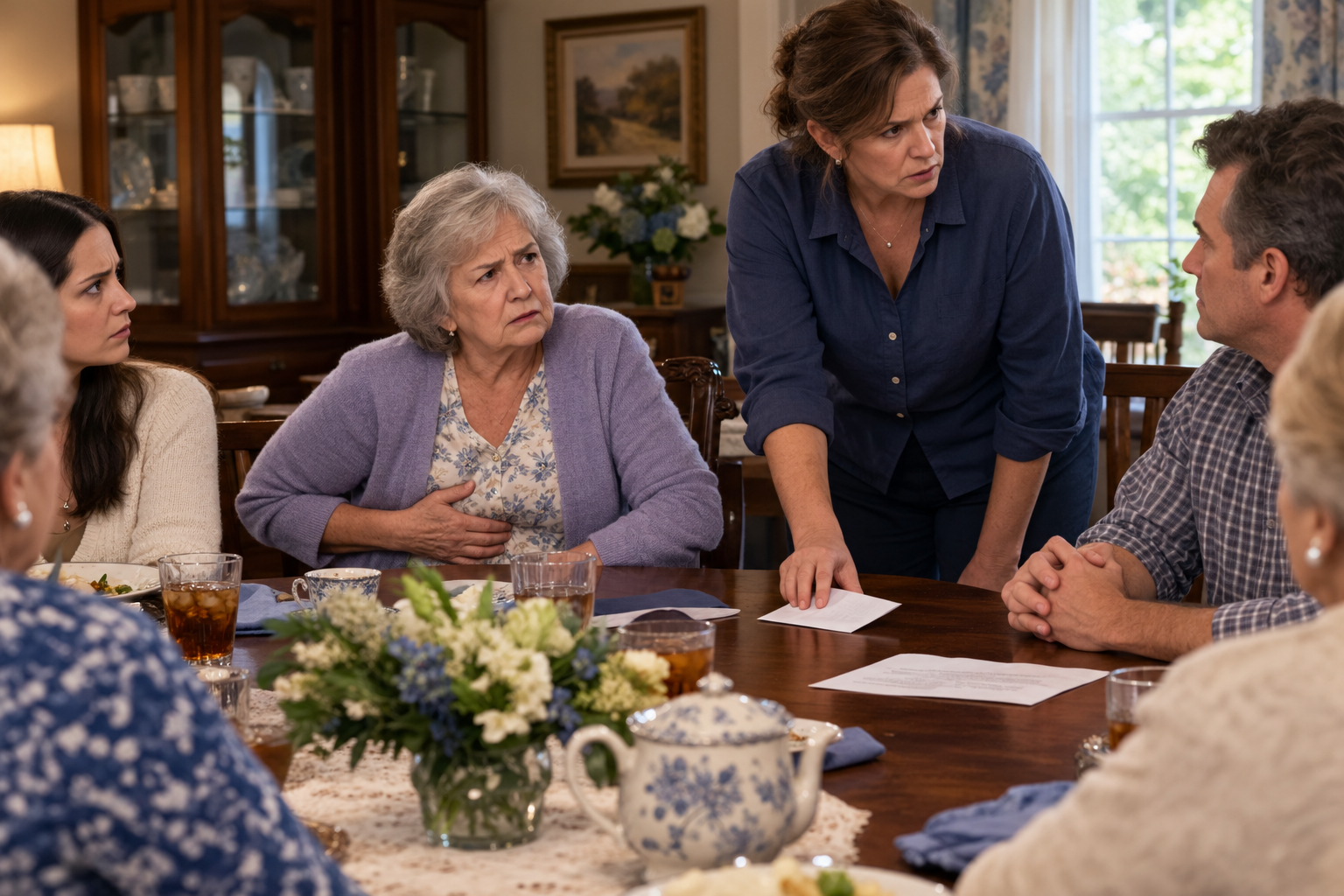
My mother stopped eating halfway through Sunday dinner and pressed her palm beneath her ribs. It was such a small movement that nobody at the table looked up at first. She had been doing it for months, quietly, almost apologetically, as if even her own pain needed to wait until everyone else had finished talking.
Daniel noticed eventually. He always noticed things when they affected the conversation, though he rarely noticed the things that mattered before they became inconvenient.
“What is it now, Mom?” he asked.
Mama lifted her hand from her side and reached for her water. “Nothing.”
Daniel gave a short laugh. “There you go again.”
His wife, Karen, smiled without looking up from her plate. “She worries herself into feeling sick.”
I put my fork down.
The dining room suddenly seemed too warm. The roast chicken sat in the middle of the table beside a bowl of green beans and a platter of sausage that Mama had barely touched. The ceiling fan clicked once each time it turned, an old sound I remembered from childhood.
Mama took a careful sip of water.
“It just hurts a little,” she said.
Daniel leaned back in his chair. “You know what hurts? Eating sausage when your stomach is already bothering you.”
Karen laughed.
Mama smiled weakly.
I didn't.
“Where does it hurt?” I asked.
She looked at me instead of answering.
“Here,” she finally said, touching the right side beneath her ribs.
“How long?”
She glanced toward Daniel.
That was the first thing that made me uneasy.
“Since when?” I asked again.
“A while.”
Daniel cut another piece of chicken. “Since spring.”
Mama's eyes dropped.
I looked at him. “You knew?”
“Of course I knew.”
“And she hasn't seen a doctor?”
Daniel sighed as though I had interrupted something important. “She's been to the doctor.”
Mama shook her head slightly.
I caught the movement.
Daniel didn't.
Karen reached for the gravy. “She went once. They told her it was probably digestive.”
“Probably?”
Karen shrugged. “She's seventy-seven. Things ache.”
Mama's fingers tightened around her napkin.
I had driven two towns over that afternoon because Mama had called me the night before and said she didn't want to be alone. She hadn't explained why. She had simply said, “Can you come Sunday?”
Now I understood why.
“What did the doctor actually say?” I asked.
Daniel's fork stopped halfway to his mouth.
“I already told you,” he said. “Nothing serious.”
“I wasn't asking you.”
His expression changed.
Mama looked at me.
“I didn't get to finish the tests,” she said.
“Why not?”
Daniel put his fork down.
“Because she didn't want to.”
Mama stared at him.
“I was scared,” she said.
Daniel shook his head. “You were tired of appointments.”
“I was scared.”
“Same difference.”
“No,” I said quietly. “It isn't.”
Karen looked at me. “Don't start.”
I turned toward her. “I'm not starting anything.”
“You're making it bigger than it is.”
I looked at Mama.
Her face had gone pale.
I had seen that expression before. Not fear exactly. Something more familiar. The look of a person preparing to apologize for causing trouble.
“Mom,” I said, “when was your last appointment?”
She opened her mouth.
Daniel answered for her.
“May.”
“May?”
“Yes.”
“And you have still been hurting?”
Mama nodded.
Daniel rubbed his forehead. “She's stubborn.”
Mama looked at him.
Then she said something so softly that I almost missed it.
“I didn't want to be a burden.”
The room went quiet.
Daniel looked irritated rather than concerned.
“Mom, nobody said you're a burden.”
Mama didn't answer.
I did.
“Someone made her feel that way.”
Daniel's chair scraped against the floor as he shifted.
“Don't turn this into an accusation.”
“I asked a question.”
“You're always asking questions.”
“Because nobody answers them.”
Karen sighed loudly.
Daniel picked up his fork again.
“Can we just eat?”
Mama pushed her plate away.
She had eaten maybe three bites.
“I think I'm going to lie down.”
I stood immediately.
“I'll take you.”
“No,” Daniel said.
I looked at him.
“She needs to rest.”
“I can take her upstairs.”
“She asked me to come.”
Daniel's jaw tightened.
Mama looked between us.
“I can walk.”
I reached for her hand.
Her fingers were cold.
We left the dining room together.
Halfway up the stairs, she stopped.
I turned.
“What?”
She breathed slowly through her nose.
“It hurts when I climb.”
I felt something drop inside me.
“How long?”
She looked toward the bottom of the stairs where Daniel stood watching us.
Then she whispered, “Long enough that I stopped telling him.”
That was the moment I knew the dinner conversation had not been about sausage.
It had been about silence.
I helped her into her bedroom and sat beside her while she rested against the pillows. Her room still smelled faintly of the lavender sachets she kept in the dresser drawers. On the wall hung a photograph of my father, taken before his hair turned completely gray.
Mama looked at it.
“He would have made me go.”
“Dad would have carried you to the car.”
She smiled.
“Yes.”
I waited.
Eventually she said, “Your brother thinks I'm always looking for attention.”
My throat tightened.
“Did he say that?”
She looked down at her hands.
“Not exactly.”
“Then what did he say?”
“He said I talk about my pain too much.”
I stared at her.
“How often do you talk about it?”
She gave a tiny shrug.
“Mostly when it gets bad.”
“And how often does it get bad?”
She didn't answer.
I leaned forward.
“Mom.”
“Every day.”
The words came out almost soundlessly.
I closed my eyes for a moment.
Every day.
She had been hurting every day and still making breakfast, still watering the flowers, still answering Daniel's calls, still pretending everything was fine.
“Why didn't you tell me?”
She looked at me with tired eyes.
“You have your own life.”
“So?”
“You work.”
“So?”
“You have children.”
“So?”
She smiled faintly.
“Your father used to say you were the only person he knew who could turn a simple question into an interrogation.”
“That sounds like him.”
“It does.”
She laughed, then winced.
I reached for her shoulder.
“Does laughing hurt?”
“A little.”
I stood.
“I'm calling a doctor.”
“No.”
“Yes.”
“Tomorrow.”
“Tonight.”
She shook her head.
“Please don't make a fuss.”
I looked at her.
“Mom, you are not a fuss.”
Her eyes filled.
I sat beside her again.
“Something is wrong.”
“I know.”
That answer frightened me more than denial would have.
She wasn't pretending anymore.
She was afraid.
Downstairs, I heard Daniel laughing with Karen.
The sound drifted through the ceiling.
I looked at Mama.
“I'm taking you somewhere tomorrow.”
“Where?”
“To a doctor who will actually listen.”
She hesitated.
“Daniel won't like that.”
“I don't care.”
She closed her eyes.
“I do.”
I knew she did.
For most of her life, Mama had measured her choices by how they affected Daniel. After Dad died, that habit had only become stronger. Daniel had stepped into the practical things—bills, repairs, insurance, paperwork—and gradually, without anyone noticing exactly when it happened, practical help had become authority.
Mama had begun asking him what she could afford.
Then what she should sign.
Then whether an appointment was necessary.
Then whether she was making too much of a symptom.
I had been away often enough to miss the transition.
That guilt sat heavily in my chest.
The next morning, I drove Mama to Cedar Falls.
She almost changed her mind twice.
At the first red light, she said, “Maybe we should turn around.”
At the second, she said, “Maybe I'm just getting old.”
I kept driving.
At the clinic, the doctor listened for nearly twenty minutes before touching his pen.
He asked when the pain started.
Mama said March.
He asked whether it was getting worse.
She said yes.
He asked about appetite, fatigue, nausea, weight loss.
I watched his expression become more serious with each answer.
Then he asked about previous testing.
Mama looked embarrassed.
“There were appointments.”
“Were they completed?”
“No.”
“Why?”
She looked at me.
I answered.
“Some were canceled.”
The doctor looked at Mama.
“By whom?”
She hesitated.
“My son.”
The doctor wrote something down.
Then he asked, “Did you ask him to cancel them?”
Mama shook her head.
“No.”
The doctor put his pen down.
He didn't say anything for several seconds.
Then he looked directly at her.
“Martha, I want to order imaging immediately.”
Her hands folded tightly in her lap.
“Is it serious?”
“I don't know yet.”
That was the first honest answer she had received in months.
We left with orders for blood work and a scan.
On the drive home, Mama stared out the passenger window.
“What if it's nothing?”
“Then we'll be grateful.”
“And if it isn't?”
I tightened my hands around the steering wheel.
“Then we'll deal with what it is.”
She nodded.
Neither of us said anything for several miles.
When we arrived at her house, Daniel's truck was already in the driveway.
Mama looked at me.
“He's going to be angry.”
“Let him.”
She reached for the door handle.
Then stopped.
“Don't tell him everything.”
I turned toward her.
“Why?”
“Because I don't know what he will do.”
That sentence stayed with me as we walked toward the front door.
Daniel opened it before we reached the porch.
His eyes went immediately to the paperwork in my hand.
“Where were you?”
Mama looked at me.
I looked at him.
And for the first time, I realized that whatever happened next was going to change our family.
Click here to continue reading: PART 2: The Records in My Purse Explained Why My Mother Had Been Getting Sicker While Everyone Else Called It Nothing
At Sunday Dinner, My Mother Finally Admitted the Pain Was Worse Than She Had Let Anyone Believe
Part 1 of 20

