
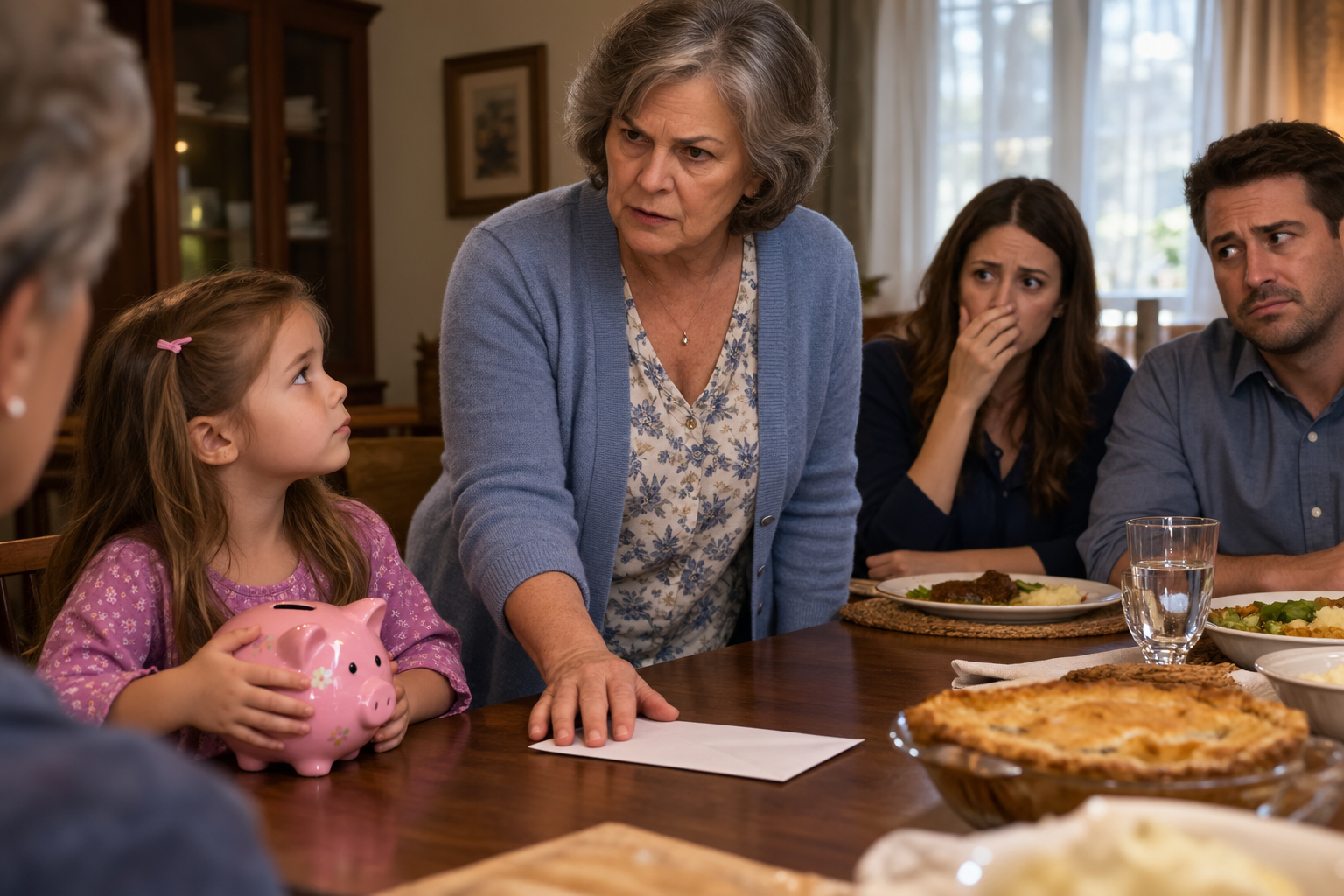
I kept the file box for one final year.
Not because I needed it.
Because I wasn't ready to let it go.
There is a difference.
Some things stay with us after they stop hurting because we aren't finished saying goodbye to who we were when they did.
The last time I opened it, I was alone.
The house was quiet.
The garden outside the window had gone dormant for winter.
I spread the papers across the table.
Forty-eight months of false records.
Forty-eight months of someone deciding what my time was worth without asking me.
I looked at the first page.
Then the last.
Nothing had changed on the paper.
Everything had changed in me.
I could remember the fear.
I could remember the anger.
I could remember sitting in that kitchen wondering whether the people I loved had ever understood what they were doing.
But the memories no longer demanded an answer.
I knew.
Derek had made a selfish choice.
Emily had been caught inside the consequences.
Lily had been too young to understand.
I had been hurt.
The company had eventually corrected what it could.
Money had been repaid.
Trust had been rebuilt in pieces.
And life had continued.
That was the truth.
Not a cleaner truth.
Not a prettier one.
Just the truth.
I put the first receipt into the shredder.
The machine made a rough, ordinary sound.
I fed in another.
Then another.
There was no ceremony.
No tears.
No speech.
Just paper disappearing.
When the final page went through, I sat back.
The box was empty.
I carried it outside.
The recycling bin was already half full.
I placed the box inside.
Then I stood there for a moment.
I expected something.
Relief.
Sadness.
Freedom.
Instead, I felt ordinary.
And that was better.
The story was finally ordinary.
A few weeks later, Lily came to visit.
She brought Daniel.
They were planning their fifth anniversary.
“Five years already,” I said.
“I know.”
“Did you survive marriage?”
Daniel laughed.
“Barely.”
Lily hit his arm.
“I heard that.”
He smiled.
“She knows I love her.”
“I do.”
I watched them together.
They were not perfect.
They interrupted each other.
They disagreed.
They apologized.
They made plans.
They changed them.
They kept choosing each other.
That was enough.
Lily noticed the empty space where the file box had been.
“You finally did it.”
“Yes.”
“How do you feel?”
“Fine.”
“Just fine?”
“Yes.”
She smiled.
“That's actually good.”
“I think so.”
She sat beside me.
“Did you keep anything?”
“The notebook.”
“And the piggy bank?”
“Yes.”
“Good.”
She looked around.
“The fund is doing well.”
“I know.”
“We helped sixty-three caregivers this year.”
“That's wonderful.”
“Somebody asked me yesterday why we don't expand faster.”
“What did you say?”
“That fast isn't always better.”
I smiled.
“You're learning.”
She laughed.
“From you.”
“Unfortunately.”
Daniel sat across from us.
“I think she gets it from both of you.”
Lily smiled.
“What?”
“Being stubborn about principles.”
“That sounds flattering.”
“It wasn't meant to be.”
We laughed.
Then Lily reached into her bag.
She took out an envelope.
“What is that?”
“Your retirement paperwork.”
I stared.
“What?”
“You officially retired from the fund.”
“I already retired.”
“No.”
“You made me honorary chair.”
“That was ceremonial.”
“Exactly.”
She laughed.
“You still read every report.”
“Because nobody reads them properly.”
“I do.”
“You miss commas.”
“Nana.”
I smiled.
She put the envelope in my hands.
“This is your final letter from the fund.”
I opened it.
It wasn't financial.
It was from the board.
They thanked me.
Not for the money.
Not for the original dispute.
For teaching the organization what it was supposed to protect.
Choice.
Dignity.
Boundaries.
I read it twice.
Then I folded it.
“That's enough.”
“What?”
“I don't need anything else.”
Lily hugged me.
“I know.”
That evening, she stayed for dinner.
Afterward, we sat in the garden.
The tomato plants were beginning to grow again.
“You know,” she said, “I used to think the happiest ending would be Dad apologizing.”
I looked at her.
“And now?”
“Now I think the happiest ending was that I didn't have to choose.”
“Choose between what?”
“Between loving him and loving you.”
I nodded.
“That was important.”
“Very.”
She looked toward the house.
“You never asked me to hate him.”
“No.”
“Even when you were angry.”
“I was angry at him. You didn't need to carry it.”
She nodded.
“I think that saved me.”
“Your mother helped too.”
“Yes.”
She smiled.
“She's happy.”
“I know.”
“Michael proposed.”
I turned.
“What?”
“She said yes.”
I laughed.
“When?”
“Last week.”
“Why didn't you tell me?”
“I wanted to tell you in person.”
I hugged her.
“That's wonderful.”
“She wants a small wedding.”
“Good.”
“Derek is paying for part of it.”
I smiled.
“Is he?”
“Yes.”
“Did he ask permission?”
“No.”
I raised an eyebrow.
“Then he's still learning.”
She laughed.
“He asked me.”
“That's better.”
We sat quietly.
Then she looked at me.
“Nana?”
“Yes?”
“Do you ever wish you could go back?”
“To what?”
“That day.”
I knew which day.
The day everything broke.
“No.”
She looked surprised.
“Never?”
“I wish it hadn't happened.”
“That's different.”
“Yes.”
“But you wouldn't go back.”
“No.”
“Why?”
I looked at the garden.
“Because I'd lose everything that came after.”
She nodded.
“The fund.”
“Not just the fund.”
“You.”
“Maybe.”
“Mom.”
“Yes.”
“Dad becoming who he is now.”
“Yes.”
“Me.”
I smiled.
“Especially you.”
She rested her head against my shoulder.
“I think that's the answer.”
“What answer?”
“To everything.”
I laughed softly.
“You've become very philosophical.”
“Blame the notebook.”
We stayed there until the light disappeared.
Later, I went inside.
The kitchen was clean.
The old table was still there.
I touched its surface.
This was where Lily had colored.
Where Emily had cried.
Where I had sorted receipts.
Where lawyers had sat.
Where plans had been made.
Where the first idea for the fund had been written on a grocery receipt.
The table had witnessed every version of us.
I opened the drawer.
Inside was the pink piggy bank.
I took it out.
There was still no money inside.
I turned it over.
The paint had chipped around the ears.
I smiled.
Then I placed it beside the notebook.
I didn't need to fill it.
That had never been the point.
The next morning, Lily sent me a photograph.
A new tomato plant.
The caption said:
First one of the season.
I wrote back:
Looks small.
She answered immediately:
You said that last time.
I smiled.
Then I went outside.
The garden needed watering.
I carried the hose between the rows.
The soil was dry on top but damp underneath.
That was how gardens worked.
You couldn't always see what was happening beneath the surface.
You had to trust the roots.
I watered slowly.
The morning was warm.
Birds moved through the fence.
A car passed in the street.
Somewhere, a neighbor was mowing grass.
Nothing dramatic happened.
And I was grateful.
Because after years of thinking a meaningful ending needed a final confrontation, I had finally learned otherwise.
Sometimes the ending is simply waking up and realizing the thing that once controlled your thoughts no longer does.
Sometimes it is watching the people you love make their own choices.
Sometimes it is putting away the evidence.
Sometimes it is refusing to turn generosity into guilt.
Sometimes it is accepting that another person can hurt you without owning the rest of your life.
And sometimes the most important thing a child can learn is not what love costs.
It is what love does not cost.
It does not cost your dignity.
It does not cost your voice.
It does not cost your right to say no.
It does not cost your future.
It does not require you to disappear.
I thought about the little girl with purple crayons.
She had asked a question because she believed everything had a number.
I had answered with a hug because I didn't know what else to say.
Years later, I understood that both of us had been right in our own way.
Everything important does have a cost.
Time.
Effort.
Sacrifice.
Trust.
But those costs should be chosen.
That was the difference.
A gift given freely is still a gift when you decide its limits.
Care is still care when you need rest.
Love is still love when you say no.
Family is still family when someone leaves.
Forgiveness is still forgiveness when trust must be rebuilt.
And a person's worth does not rise or fall according to what someone else is willing to pay.
That was what Lily had learned.
That was what Derek had learned.
That was what Emily had learned.
And, eventually, that was what I had learned too.
The garden grew.
The fund continued without me.
Lily built her own family.
Emily built another life.
Derek kept showing up.
Daniel kept forgetting where I put the good plates.
Claire still brought flowers.
Michael still teased Emily.
People kept needing help.
People kept offering it.
Life remained imperfect.
It also remained full.
That was enough.
I went back inside.
On the kitchen shelf sat the notebook.
Beside it sat the empty piggy bank.
I looked at them one last time.
Then I smiled.
The little girl had once asked what I cost.
The woman she became had spent years learning why the question mattered.
And I had spent years learning the answer.
I was never worth a number.
Neither was my time.
Neither was my care.
Neither was the love I gave my family.
The real gift was not that they learned to pay me.
It was that they learned to see me.
And once they did, I was finally free to give without fear, refuse without guilt, forgive without forgetting, and love without disappearing.
The question had started everything.
But it was never the question that mattered most.
The real question was always this:
What happens when someone finally understands that love is not a debt?
The answer was all around me.
A garden.
A family.
A life.
And the quiet certainty that I no longer needed anyone to put a price on me.
The End
Read more original stories on Feel Every Story.
A Six-Year-Old Asked One Innocent Question About My Worth, and Before Dinner Was Over, I Realized Someone Had Been Keeping Count
Part 20 of 20

