
Years passed.
The Nana Fund became an established organization.
It still wasn't enormous.
That was intentional.
Lily refused offers to turn it into something flashy.
“No gala,” she said.
“Why?”
“Because the money should go to people who need it.”
“No fancy dinner?”
“No.”
“No giant banner?”
“No.”
“You're no fun.”
“I learned from you.”
The grants continued.
Caregivers received help with education.
Some bought computers.
Some paid for transportation.
Some reduced work hours long enough to finish a course.
Some simply received enough support to stop living one emergency away from collapse.
I met dozens of recipients.
I didn't remember every name.
But I remembered the ones who wrote letters.
The letters became my favorite part.
One man wrote that his grandmother had raised him and he wanted to finish his teaching certificate because she had always told him education was the one thing nobody could take away.
A woman wrote that she had finally opened a small bookkeeping business.
Another wrote that the childcare support allowed her to take a class without choosing between school and caring for her children.
Their stories kept changing.
The principle did not.
Care had value.
People had value.
Love was not permission to erase yourself.
Then one autumn, Lily called.
“I want to come over.”
“You're always welcome.”
“Can I bring everyone?”
“Who is everyone?”
“Mom. Michael. Dad. Claire. Daniel.”
“That sounds crowded.”
“It is.”
“Then yes.”
They arrived on Sunday afternoon.
The kitchen filled quickly.
Coffee.
Food.
Voices.
Laughter.
Derek brought bread.
Claire brought flowers.
Emily brought a pie.
Daniel carried folders.
Lily brought nothing.
“What happened to you?”
“I brought myself.”
“That's enough.”
She smiled.
After dinner, Lily cleared the plates.
Then she returned with the old notebook.
I stared at it.
“I thought you had it.”
“I did.”
“Then why bring it back?”
She placed it on the table.
“Because it's yours.”
I opened it.
The pages were full.
The original notes.
The letters.
The fund's first application.
The newspaper clipping.
Photographs.
Then I reached the final page.
There was a new entry.
I looked at Lily.
“You wrote this?”
“Yes.”
“What does it say?”
“Read it.”
I did.
It was short.
She had written about the day she first asked me what I cost.
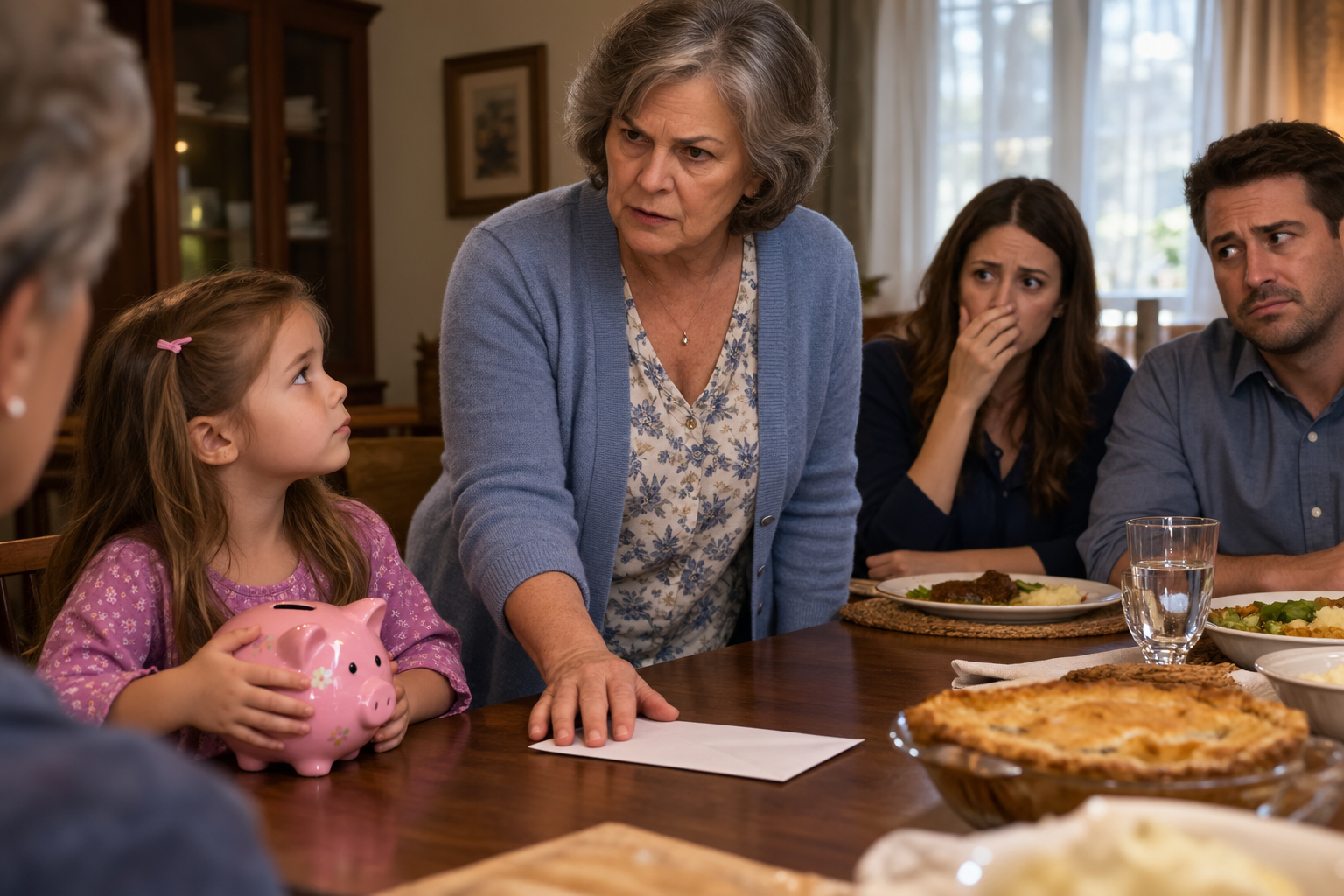
She described the piggy bank.
The crayons.
The kitchen.
Then she wrote about everything that followed.
At the bottom, she had written:
I spent years thinking Nana taught me the answer. Now I understand she taught me how to ask better questions.
I closed the notebook.
“That is beautiful.”
“Thank you.”
She sat beside me.
“I have another question.”
“Of course you do.”
She smiled.
“Would you like to step down from the fund?”
I looked at her.
“What?”
“You don't have to work anymore.”
“I don't work.”
She laughed.
“You read every application.”
“That's not work.”
“You call people.”
“That's not work.”
“You correct my grammar.”
“That is absolutely work.”
Everyone laughed.
Then Lily became serious.
“You've given enough.”
I looked at the table.
“I don't want to disappear.”
“You won't.”
“I don't want to become a symbol.”
“You aren't.”
“I don't want people thanking me for something I did because I loved you.”
Lily reached for my hand.
“They aren't thanking you for loving me.”
She paused.
“They're thanking you for helping them believe they could love their families without losing themselves.”
I swallowed.
“That sounds bigger than me.”
“It is.”
She smiled.
“That is why I think you can finally rest.”
I looked around the table.
Emily was watching me.
Derek was quiet.
Daniel smiled.
Claire held Lily's shoulder.
Michael nodded.
“What happens if I say no?”
Lily laughed.
“I knew you'd ask.”
“What happens?”
“You keep doing what you're doing.”
“And if I say yes?”
“You become honorary chair.”
“That sounds suspiciously like work.”
“Very little.”
“Then yes.”
Everyone applauded.
I shook my head.
“You planned this.”
“Of course.”
That evening, after everyone left, Lily stayed.
We sat on the porch.
The garden had changed.
The tomato plants were old now.
She had planted new ones.
“You know what I remember most?” she asked.
“What?”
“The sound of the washing machine.”
I laughed.
“Why?”
“Because when I was little, I thought that sound meant you were always there.”
I looked at her.
“You remember that?”
“Yes.”
She leaned back.
“I didn't understand money.”
“I know.”
“I didn't understand divorce.”
“I know.”
“I didn't understand what Dad had done.”
“You didn't need to.”
“But I understood that you showed up.”
I smiled.
“That was enough.”
She nodded.
“That's why I wanted the fund.”
“Because of me?”
“Because of what showing up meant.”
She looked toward the garden.
“People think help has to be enormous.”
“It doesn't.”
“No.”
“Sometimes it's an hour.”
“Sometimes it's a ride.”
“Sometimes it's five hundred dollars.”
“Sometimes it's listening.”
She smiled.
“Sometimes it's telling someone they can say no.”
I nodded.
The sun was setting.
The same backyard where we had planted her first tomato was now filled with flowers.
She had built a life.
A good one.
Not perfect.
Good.
Daniel had become her husband, not her rescuer.
Emily had found happiness again.
Derek had become a dependable father and a different man.
Claire had become part of the family without trying to rewrite its history.
Michael had learned to love Emily without fearing the past.
And I had become something I never expected.
Not the center of the family.
A witness to it.
That distinction felt right.
A month later, Lily held a small meeting for the fund.
She introduced me as honorary chair.
Then she said something I hadn't expected.
“This organization exists because one person once refused to let love become an unpaid obligation.”
I looked at her.
She continued.
“But it survives because hundreds of people have decided that caring for others should not require abandoning themselves.”
The room was silent.
Then people applauded.
I didn't stand.
I didn't want attention.
Lily looked toward me.
I smiled.
Afterward, a woman approached.
“Can I tell you something?”
“Of course.”
“My mother cared for me when I was sick.”
I listened.
“I thought I had to repay her by becoming everything she wanted.”
“What did you do?”
“I stopped.”
She smiled.
“I finally became myself.”
I squeezed her hand.
“That sounds like repayment enough.”
She laughed.
“Maybe.”
She walked away.
I watched her go.
Then I looked at Lily.
She was talking with Daniel.
Laughing.
Healthy.
Busy.
Alive.
I realized I had spent years afraid that what happened to me would become Lily's burden.
Instead, it had become one of the questions she used to understand the world.
That was different.
Pain had not become inheritance.
Wisdom had.
That night, I opened the notebook one last time.
The first page still held the child's question.
The final page held the woman's answer.
Between them were years.
Receipts.
Arguments.
Gardens.
Letters.
Mistakes.
Forgiveness.
Work.
Love.
I closed the notebook.
Then I put it on the shelf beside the pink piggy bank.
They belonged together.
Click here to continue reading: PART 20: When I Finally Put Away the Last Receipt, I Understood What Lily Had Been Trying to Tell Me All Along About Love, Work, and the Freedom to Choose
A Six-Year-Old Asked One Innocent Question About My Worth, and Before Dinner Was Over, I Realized Someone Had Been Keeping Count
Part 19 of 20

