
The letter arrived without warning.
I carried it inside and left it unopened beside the fruit bowl.
I knew the logo.
Harrison Manufacturing.
Again.
I made tea first.
Then I sat at the table.
There are times when opening an envelope feels like choosing to disturb something that has finally become quiet.
I opened it anyway.
The letter concerned Carla.
The investigation had concluded that she had violated company procedures by signing provider authorizations without personally verifying the identities involved.
She had not known about Derek's full scheme.
She had not received any of the money.
But she had signed my name.
That mattered.
The company had suspended her for two weeks and placed a formal warning in her personnel file.
She had also been required to complete additional compliance training.
I read the letter twice.
Then I called her.
She answered quickly.
“I thought you might call.”
“Did you know about the decision?”
“Yes.”
“How do you feel?”
“Embarrassed.”
“Anything else?”
“Relieved.”
“Relieved?”
“That it's over.”
I understood.
“Are you keeping your job?”
“Yes.”
“Good.”
She was silent.
Then she asked, “Are you angry?”
“Yes.”
She exhaled.
“I understand.”
“But I'm not asking them to fire you.”
She didn't answer.
“I don't think punishment is useful if nobody learns anything.”
“I learned.”
“I hope so.”
“I did.”
She paused.
“I've changed how I handle everything.”
“Good.”
“I also called my granddaughter.”
“What did you tell her?”
“That I made a mistake at work.”
“And?”
“She asked if I was going to lose my job.”
“What did you say?”
“I told her I might.”
Carla laughed softly.
“She said, ‘Then you better do better.’”
I smiled.
“Sounds familiar.”
“It does.”
We talked for another few minutes.
Before we hung up, she said, “Thank you.”
“For what?”
“For not pretending I did nothing wrong.”
I understood exactly what she meant.
There is a strange kind of mercy in being allowed to tell the truth about your mistake.
Not being excused.
Not being protected from consequences.
Just being allowed to admit what happened without having someone make you either a monster or a victim.
After the call, I put the letter away.
That afternoon, Emily came by.
She had Lily with her.
Lily ran into the garden.
Emily sat at the table.
“You got another letter?”
“Yes.”
“About Carla?”
“Yes.”
“What happened?”
I told her.
Emily nodded.
“She did wrong.”
“She did.”
“But she admitted it.”
“Yes.”
“Derek did too.”
“Eventually.”
She looked out the window.
“I used to think justice meant people hurting as much as they hurt you.”
“And now?”
“I think justice is making sure they can't do it again.”
I smiled.
“That's wiser than I was at your age.”
She laughed.
“I learned from you.”
“No. You learned from what happened.”
“Maybe both.”
Outside, Lily shouted.
“Nana!”
I stood.
“What?”
“Come look!”
I walked into the garden.
She was kneeling beside the tomato plants.
One small green tomato hung beneath a leaf.
“It's coming!”
“It is.”
“Can we pick it?”
“Not yet.”
“But it's ready.”
“Not quite.”
She sighed dramatically.
“Everything takes forever.”
I laughed.
“So does growing up.”
“I don't want to.”
“Good.”
She looked at me.
“Why?”
“Because you're doing it perfectly slowly.”
She grinned.
That summer, the garden produced more tomatoes than we could eat.
We gave bags away to neighbors.
Emily made sauce.
Lily sold none, despite repeatedly announcing that she was opening a restaurant.
One afternoon, she brought her pink piggy bank outside.
“I'm saving.”
“For what?”
She wouldn't tell me.
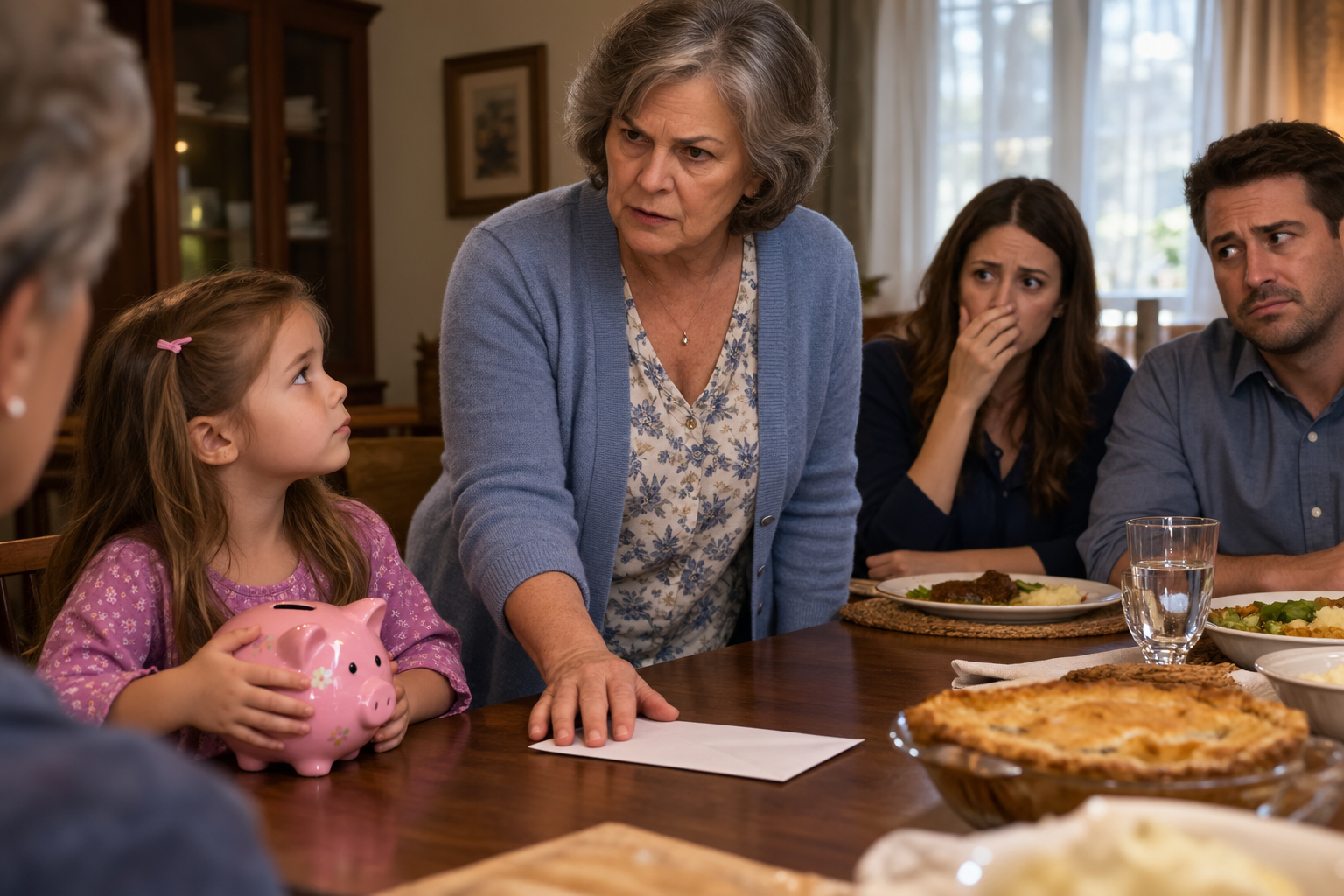
A week later, she gave me a small envelope.
Inside was a handwritten note.
I opened it.
It said:
Nana,
You don't cost money.
You cost hugs.
I laughed so hard I had to sit down.
“Who taught you to write this?”
“You did.”
“I don't remember.”
“You teach me things even when you don't know.”
I folded the note carefully.
Then I put it inside the same drawer where I had kept the old childcare documents.
But I didn't keep the old documents there anymore.
Those had gone into a secure file box.
The drawer held photographs now.
Lily's drawings.
Her school projects.
The invoice she had made when she was six.
And the little note she had just given me.
The old paperwork still existed.
But it no longer owned the space.
That distinction mattered.
A year later, Emily asked me to come to her townhouse for dinner.
Derek was there.
It was the first time we had all gathered under one roof since the divorce.
I almost didn't go.
Then Lily called me.
“Nana, please.”
So I went.
The dinner was awkward for the first twenty minutes.
Then Lily dropped a spoon.
Everyone laughed.
The tension loosened.
Derek had changed.
Not dramatically.
Not magically.
He was quieter.
He listened more.
He didn't explain himself when nobody asked.
He paid his debts.
He kept his promises.
He had not become a different man overnight.
He had simply stopped expecting forgiveness to arrive before accountability.
After dinner, he helped me clear plates.
“I still think about that day,” he said.
“Which day?”
“The kitchen.”
I knew immediately.
“The forms.”
“Yes.”
“What do you think about?”
He dried a plate.
“How easily I convinced myself it wasn't serious.”
I looked at him.
“That is the dangerous part.”
“I know.”
“I don't think you did then.”
“No.”
He put the plate down.
“I thought because you loved Lily, you would never object.”
I nodded.
“That was your mistake.”
“I know.”
“No. Listen.”
He looked at me.
“You thought my love made me available to you.”
He swallowed.
“That's true.”
“My love made me generous.”
“Yes.”
“It never made me yours to use.”
His eyes filled.
“I understand now.”
I believed him.
That didn't mean I trusted him.
But understanding is where trust sometimes begins.
Not with promises.
With changed behavior repeated long enough that you stop needing to watch for the old one.
Later that evening, Lily fell asleep on the couch.
Derek carried her to the guest room.
Emily watched him go.
“He's a good father,” she said quietly.
“He is.”
She looked at me.
“That doesn't change what happened.”
“No.”
“I think I'm finally okay with both truths.”
I smiled.
“That's a good place to be.”
When I returned home that night, I found the old letter from Harrison Manufacturing.
I read the sentence again.
The perfect provider.
This time it didn't hurt as much.
Not because what Derek had done was smaller.
Because I had finally understood the difference between being used and being valuable.
He had used my name.
He had never created my worth.
That belonged to me.
The following morning, Lily came over before school.
She sat at my kitchen table eating toast.
“Nana?”
“Yes?”
“How much do I cost?”
I smiled.
“Here we go again.”
She giggled.
“I'm serious.”
“So am I.”
She waited.
“You cost exactly what you should.”
“What is that?”
“Nothing.”
She frowned.
“Nothing?”
“Nothing you owe.”
She smiled.
Then she hugged me.
“That means I'm rich.”
I hugged her back.
“Very.”
She ran outside to wait for Emily.
I stood at the doorway watching her.
The tomato plants moved gently in the morning breeze.
The garden was full.
The house was quiet.
And for the first time, the word “free” didn't feel like something that had been taken from me.
My time had never been free.
My love had never been free.
My name had never been free.
They had all belonged to me.
And I had chosen where to give them.
That was the lesson Derek had taken years to understand.
Love can be generous without being permission.
Family can ask for help without claiming ownership.
Forgiveness can exist without trust.
And a person can say no without loving anyone less.
I closed the door.
On the kitchen table, Lily had left one final note.
The handwriting was still crooked.
At the bottom she had drawn a little tomato.
Under it she had written:
NANA IS PRICELESS.
I folded the paper and put it with the others.
The receipts were gone from the table.
The numbers were gone from the refrigerator.
The forged signatures were locked away in a file.
The money had been repaid.
The marriage had ended.
The company had changed its rules.
Carla had learned to question what she was asked to sign.
Derek had learned that apologies required action.
Emily had learned that leaving someone did not mean she had failed.
And Lily had learned something no six-year-old should have needed to learn, but something she would carry carefully into adulthood:
Love is not a bill.
It is not a contract.
It is not permission.
And it is never a reason to make another person smaller.
I picked up Lily's note one last time.
Then I placed it in the drawer.
Not with the old paperwork.
With the photographs.
Because that was where it belonged.
Not as evidence of what had been taken.
As evidence of what remained.
Click here to continue reading: PART 9: The Red Folder Put Derek Back Into Lily’s Story, and I Had to Help Her Understand That Loving Someone Never Means Excusing What They Did
A Six-Year-Old Asked One Innocent Question About My Worth, and Before Dinner Was Over, I Realized Someone Had Been Keeping Count
Part 8 of 20

