
My granddaughter was six when she asked me how much I cost. She said it while coloring a crooked purple house at my kitchen table, as casually as if she were asking how many cookies were left. I was rinsing tomato juice from a cutting board, and the question stopped me with my hands still under the faucet.
“How much do you cost, Nana?”
I turned off the water. Lily kept coloring, her tongue caught between her teeth in concentration. She wasn't teasing me. There was no little smile waiting to see whether she'd hurt my feelings. She genuinely wanted an answer.
“What makes you ask that?”
She held up three fingers, then folded one down. “Mommy said the Saturday sitter costs nine dollars an hour. And Daddy said Grandma doesn't cost anything because you're family.”
I dried my hands slowly.
There are some sentences children repeat without understanding the weight adults put behind them. Lily was simply sorting the world into categories. School cost money. Groceries cost money. The woman who watched her on Saturdays cost money. Nana, apparently, belonged in a different column.
“You cost a hug,” I told her.
She frowned at the page.
“That isn't money.”
“No.”
“How much is one hug?”
“Depends on the hug.”
She considered that seriously. “A big one?”
“Very expensive.”
That satisfied her enough to return to her drawing. She added a green tree beside the purple house and asked whether tomatoes could grow in winter. I answered her, but something had lodged beneath my ribs.
For five years, I had watched Lily every weekday. Before kindergarten, I had kept her from breakfast until her parents came home. After kindergarten started, I picked her up, brought her to my house, helped with homework, fed her, watered the tomato plants with her, and waited until Emily finished work. I had never called it a job.
It was simply what grandmothers did.
My daughter Emily had never asked me to keep track of hours. In the beginning, she had apologized constantly. She and Derek were trying to get ahead financially, she said. Childcare was expensive. Their schedules were difficult. I told her to stop apologizing and hand me the diaper bag.
That was how it began.
Then one month became another, and another. Lily grew from a toddler who needed help holding a spoon into a little girl who could read chapter books and argue passionately about whether tomatoes counted as fruit.
I never asked Emily for a dollar.
I didn't think I needed one.
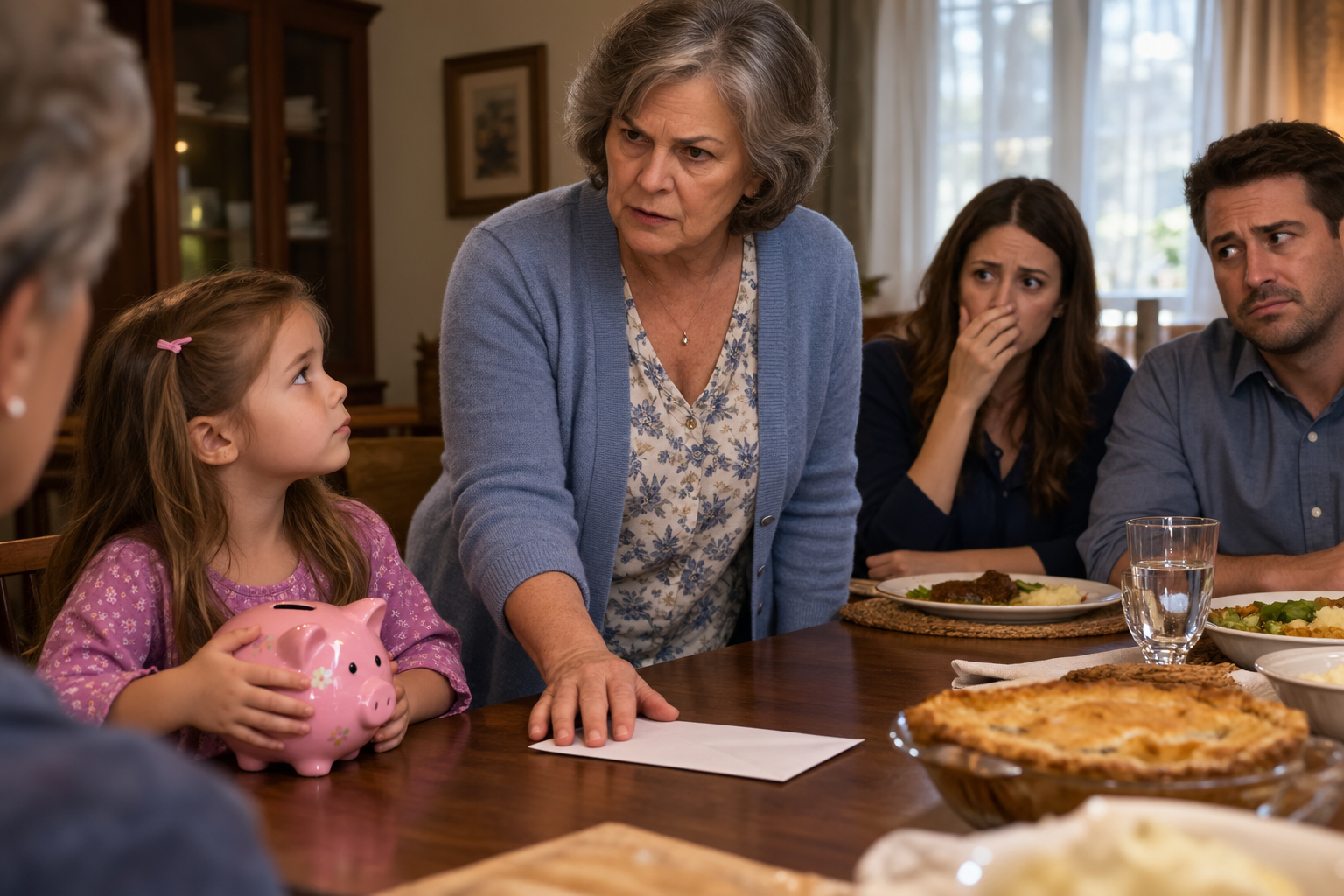
That Sunday, Emily, Derek, and Lily came to my house for dinner. I had made roast chicken, potatoes, green beans, and the tomato salad Lily always insisted tasted better because she had helped grow the tomatoes.
Derek arrived carrying a grocery bag and wearing the expensive watch he had bought the previous Christmas. He kissed Emily, ruffled Lily's hair, and handed me a bottle of wine.
“Thanks, Mom.”
“You're welcome.”
He smiled in the easy way he always did around me, the smile of a man who had never had to wonder whether he was welcome.
During dinner, Lily climbed halfway out of her chair to reach for another potato.
“Nana makes the best potatoes.”
“That's because she puts too much butter in them,” Emily said.
“That's why they're good.”
Derek laughed. “She's got you figured out.”
I smiled.
Then Lily looked at me again.
“Nana?”
“Yes?”
“Do you get paid for taking care of me?”
Emily's fork stopped halfway to her mouth.
Derek looked down at his plate.
I laughed lightly because I didn't want the child to feel she'd done something wrong.
“No, sweetheart.”
“Why?”
“Because I love you.”
She seemed to think about that.
“So love is free?”
Emily glanced at me.
Derek's smile disappeared.
“Love isn't really about money,” I said.
Lily nodded as if I'd given her a useful answer and went back to her potatoes.
The adults didn't speak for several seconds.
Emily finally cleared her throat.
“She heard us talking about childcare last week.”
Derek picked up his water.
“Kids hear everything.”
I noticed his fingers tightening around the glass.
It was small. So small I might not have remembered it later if everything else hadn't happened.
“What were you talking about?” I asked.
Emily looked embarrassed.
“Nothing important. We were trying to figure out our expenses.”
Derek answered before she could continue.
“Just budgeting.”
I nodded.
Then he smiled again.
“Don't worry about it, Mom. We know how much you do for Lily.”
The sentence should have reassured me.
Instead, it bothered me.
Not because I expected payment. I didn't.
It was the word “how much.”
I looked across the table at him.
He was already cutting another piece of chicken.
After dinner, Lily helped me carry plates into the kitchen. Emily followed with the glasses while Derek stayed in the dining room answering something on his phone.
Lily stopped beside the counter.
“Nana?”
“Yes?”
“If someone pays you, do you have to keep watching them?”
I crouched so we were eye to eye.
“Who told you that?”
She shrugged.
“I don't remember.”
Children often remember exact words but not where they heard them.
“You never have to pay me for loving you,” I said.
She wrapped her arms around my neck.
“I love you too.”
“I know.”
When I straightened, Emily was watching us.
Her expression had changed.
“What?”
She shook her head.
“Nothing.”
But it wasn't nothing.
That night, after they left, I washed the last plate and stood at the kitchen window. The street outside was quiet. A porch light glowed across the road, and somewhere a dog barked once before going silent.
I thought about the conversation at dinner.
I thought about Lily's question.
Then I thought about Derek's hand tightening around his glass.
I told myself I was imagining things.
The next morning, I found a small pink piggy bank on my kitchen table.
Lily had left it behind.
I smiled when I saw it because she had decorated it with stickers of stars and strawberries. I picked it up and shook it.
Something rattled inside.
Coins.
Probably the allowance Emily had started giving her.
I set it beside the fruit bowl.
Then I noticed the envelope underneath it.
My name was written across the front.
Not Nana.
Not Mom.
My full name.
I stood very still.
I didn't recognize the handwriting.
I opened the envelope.
Inside was a photocopy of a form.
At the top were the words “In-Home Child Care Provider.”
Below that was my name.
My address.
A list of hours.
And at the bottom was a signature that looked almost like mine.
Almost.
I read the amount beside the payment line.
$1,960.
For one month.
I sat down.
I read it again.
My hands had started to shake.
I had never received that money.
I had never signed that form.
And suddenly Lily's innocent question from the day before no longer sounded innocent.
It sounded like the first clue.
Click here to continue reading: PART 2: The Paper in My Kitchen Was Only the Beginning, Because the More I Checked, the More Impossible Numbers Appeared Beneath My Name
A Six-Year-Old Asked One Innocent Question About My Worth, and Before Dinner Was Over, I Realized Someone Had Been Keeping Count
Part 1 of 20

