Two years can change a child completely.
When Lily was six, she needed help tying her shoes.
At eight, she could do it while talking without looking down.
She had lost two front teeth, grown nearly an inch, and developed a serious opinion about which tomatoes were sweetest.
She still spent several afternoons each week at my house.
The difference was that nobody called it childcare anymore.
Emily didn't use that word.
I didn't either.
Lily simply came over.
Sometimes we did homework.
Sometimes she read on the couch.
Sometimes she sat in the garden and complained that the tomatoes were taking too long to ripen.
Life had become ordinary again.
That was the strange part.
After enough time passes, even the worst thing becomes something you can put in a drawer.
You don't forget it.
You simply stop opening the drawer every morning.
Then one Wednesday afternoon, Lily came through my front door carrying a red folder.
She dropped her backpack beside the chair.
“Nana?”
“Yes?”
“Can you help me?”
“With homework?”
“No.”
She placed the folder on the kitchen table.
“My teacher gave us a project.”
I opened it.
Inside were photographs.
There was one of Emily holding Lily when she was a baby.
Another showed Lily beside her teacher.
Another showed me standing beside the tomato garden with dirt on my knees.
Then I saw the fourth photograph.
Derek.
It had been taken years earlier.
He was holding Lily when she was a toddler, and both of them were laughing at something outside the frame.
I looked at Lily.
She was watching my face.
“I want to use this one too.”
My chest tightened.
“You can.”
“Mom got quiet when I showed her.”
I closed the folder.
“She has reasons for that.”
“Because Daddy did something bad?”
There it was.
The question we'd spent years avoiding.
I pulled out the chair beside me.
“Come sit.”
She climbed up.
“What did Daddy do?”
I thought carefully.
There are truths children need.
There are details they don't.
“Your father made a very serious mistake with money.”
“What kind?”
“He used Nana's name without asking me.”
She frowned.
“Why?”
“Because he thought he could get money from his work.”
“Did he steal your money?”
“No.”
She looked relieved.
“Then why were you mad?”
“Because my name belongs to me.”
She considered that.
“So he took your name?”
“He used it.”
“Is that the same?”
“Close enough for you to understand.”
She nodded.
Then she looked at the photograph.
“Can I still love him?”
I didn't hesitate.
“Yes.”
Her shoulders relaxed.
“Even though he did something bad?”
“Yes.”
“Even though Mommy doesn't love him anymore?”
“Your mother can decide what she feels about him.”
“And I can decide what I feel?”
“Exactly.”
She smiled.
“That makes sense.”
She opened the folder again.
“I want him in my project.”
“Then put him in.”
“Mom might get sad.”
“She might.”
“Should I leave him out?”
“No.”
She looked at me.
“Why?”
“Because your project is about the people who helped you become who you are. You don't have to erase someone just because the story became painful.”
She thought about that for a long time.
Then she took out a pencil.
“What should I write?”
“You should write what you believe.”
She began.
For nearly an hour, I said almost nothing.
She wrote slowly.
Sometimes she erased whole sentences.
Sometimes she asked how to spell a word.
At one point she looked up.
“How do you spell ‘forgave’?”
I paused.
“Why do you need that word?”
“I'm not sure yet.”
I smiled.
“F-O-R-G-A-V-E.”
She wrote it.
Then crossed it out.
I didn't ask why.
When she finished, she read the paragraph aloud.
“My mom taught me that you can be hurt and still keep going. My nana taught me that loving someone does not mean letting them use you. My dad taught me that mistakes can hurt people, but you still have to tell the truth about them.”
I looked at her.
She looked back.
“Is that good?”
“Yes.”
“Really?”
“Really.”
She folded the paper.
Then she added one more sentence.
“I learned that love and trust are not exactly the same thing.”
I stared at the words.
“Where did you learn that?”
She shrugged.
“From you.”
That afternoon, Emily arrived early.
She came through the door carrying groceries.
“How was the project?”
Lily ran toward her.
“Good!”
She held up the red folder.
“Mom, I put Daddy in it.”
Emily stopped.
For a moment, neither of us spoke.
Then Emily crouched down.
“You did?”
“Yes.”
“Why?”
“Because he is still my dad.”
Emily closed her eyes briefly.
Then she opened them.
“That’s true.”
Lily looked relieved.
“Are you mad?”
“No.”
“Sad?”
Emily smiled.
“A little.”
“Do you want to see?”
“Yes.”
They sat together at the table.
I went into the kitchen and started putting groceries away.
I could hear Lily reading her project aloud.
When she reached the sentence about love and trust, Emily went quiet.
I waited.
Then I heard her say, “That's a very grown-up thing to understand.”
Lily answered, “Nana helped.”
I smiled to myself.
Later that night, after Lily had gone to bed, Emily and I sat on the porch.
“I thought I would be angry,” she said.
“At Lily?”
“No.”
“At Derek?”
“Maybe.”
She rubbed her hands together.
“I was angry at him for years.”
“You had reason.”
“I still do.”
“I know.”
“But I don't want Lily to carry it.”
“She doesn't have to.”
Emily stared into the yard.
“Sometimes I wonder if I'm allowed to be happy.”
I turned toward her.
“Why wouldn't you be?”
“Because I was married to him.”
“That doesn't make you responsible for his choices.”
“I know that in my head.”
“Your heart takes longer.”
She smiled.
“You always know what to say.”
“No. I just had thirty years of practice listening to children.”
She laughed.
The next morning, Lily left her red folder at my house.
I put it in the desk drawer for safekeeping.
That afternoon, my phone rang.
It was Derek.
I hadn't heard his voice in almost a year.
I almost didn't answer.
Then I did.
“Hello?”
“Mom?”
He still called me that.
The word felt different now.
“Yes.”
There was a long pause.
“How's Lily?”
“She's eight.”
“I know.”
“How do you know?”
“I talk to her.”
I looked out the window.
“Does Emily know you're calling?”
“Yes.”
That surprised me.
“Why?”
“I asked if I could.”
“What do you want?”
He exhaled.
“I heard about her project.”
I stiffened.
“How?”
“Emily told me.”
“What do you want?”
“I wanted to thank you.”
“For what?”
“For not telling Lily that I'm a bad person.”
I closed my eyes.
“I never said you were a bad person.”
“I know.”
“I told her you made a bad choice.”
“I know.”
“And you did.”
“Yes.”
His voice was quieter.
“I think about that every day.”
I didn't know what to say.
He continued.
“I've paid back most of it.”
“Good.”
“I know it doesn't fix anything.”
“No.”
“I know.”
Another pause.
Then he said, “I didn't understand what I was taking.”
“You took my name.”
“I know.”
“No, Derek. I don't think you did.”
Silence.
“You thought you were taking money.”
I could hear him breathing.
“You were taking the right to decide for myself.”
He didn't answer.
“That is why it hurt.”
“I understand now.”
“Good.”
“I wish I had understood then.”
“So do I.”
The conversation ended shortly afterward.
I put the phone down.
For several minutes I sat still.
Then I opened the drawer and looked at Lily's project.
She had written about all three of them.
Her mother.
Her father.
Her grandmother.
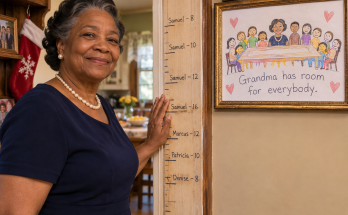
She had left room for everyone.
Even people who had disappointed her.
That was when I understood something.
The child wasn't carrying the past.
She was carrying the truth.
And perhaps that was the healthiest thing any of us could do.
Click here to continue reading: PART 7: When Derek Asked to See Lily Again, Emily Had to Choose Between Protecting Her Daughter and Refusing to Let Fear Decide Everything
A Six-Year-Old Asked One Innocent Question About My Worth, and Before Dinner Was Over, I Realized Someone Had Been Keeping Count
Part 6 of 20