
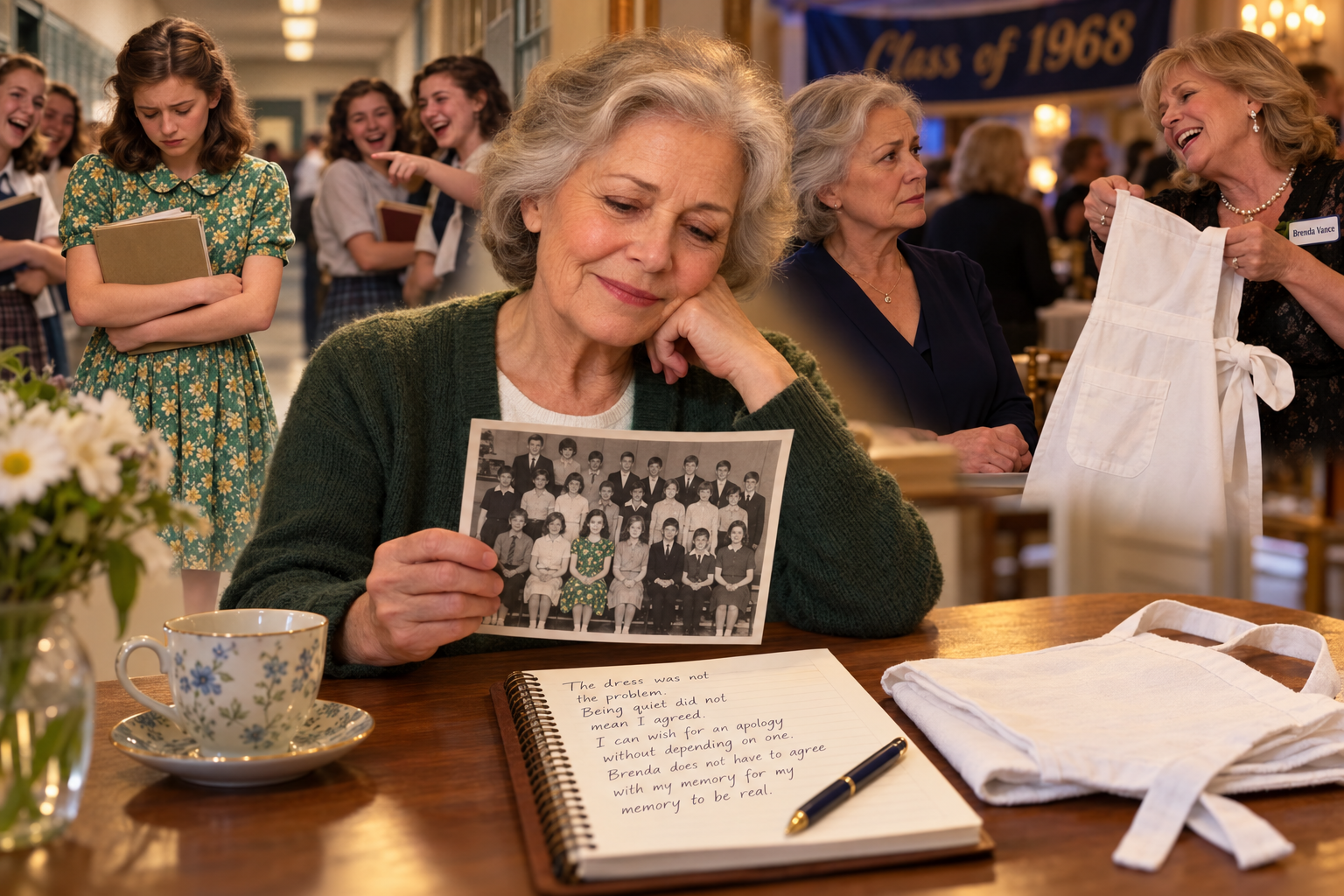
The sentence in my notebook stayed with me the next morning.
I read it while my tea cooled beside the window.
I do not have to make my pain smaller to make other people comfortable.
I had written it the night before, but it felt as though somebody else had finally said it to me.
For years, I had treated discomfort as something I should manage privately.
If someone spoke sharply, I softened my answer.
If someone made an unkind joke, I searched for a reason to laugh.
If I felt embarrassed, I tried to behave as though nothing had happened.
I had believed that was how a considerate person acted.
I was beginning to understand that consideration without honesty could become another way of disappearing.
I closed the notebook and carried my cup to the sink.
The ordinary work of the morning waited for me.
I washed the dishes, wiped the counter, and straightened the small rug near the back door.
Nothing about the house had changed.
Yet I noticed how often I moved through my day without asking myself what I wanted.
I made choices by habit.
I avoided certain subjects because I didn't want to trouble anyone.
I even apologized to empty rooms when I bumped into a chair.
That last habit made me laugh.
Then I stopped laughing.
It reminded me how automatic my apologies had become.
I had apologized when I was late, even if I had been delayed by something beyond my control.
I had apologized when someone misunderstood me.
I had apologized for asking a question that needed an answer.
Sometimes I apologized before I had even decided whether I had done anything wrong.
I wondered how much of that had begun at school.
I could not blame every habit on Brenda.
My life had contained many influences, and I had made my own choices.
But I could recognize the way that old humiliation had taught me to anticipate disapproval.
I had learned to make myself smaller before anyone else had the chance.
That morning, I decided to pay attention.
Not to every word I said or every movement I made.
I didn't want to turn my life into another test I could fail.
I simply wanted to notice when I was about to dismiss my own feelings for the sake of keeping things easy.
The first opportunity came sooner than I expected.
I was on the telephone arranging an ordinary appointment when the person on the other end offered me a time that would not work.
My usual response was ready.
I almost said, “That's fine.”
Instead, I paused.
“I'm afraid that time won't work for me,” I said. “Do you have anything later?”
There was a brief silence.
Then the person offered another time.
We settled on it in less than a minute.
Nothing bad happened.
Nobody sounded offended.
Nobody accused me of being difficult.
I put down the telephone and stood still for a moment.
It was such a small exchange.
I felt almost foolish for noticing it.
But I did notice.
I had expressed a preference without wrapping it in an apology.
I had allowed another person to respond to a simple request.
The world had continued.
I thought about the girl in the green floral dress.
Perhaps she had believed that if she could become agreeable enough, nobody would find a reason to mock her.
Perhaps she had thought that being quiet would protect her.
I wished I could tell her that there was no perfect way to behave that would prevent every unkind person from being unkind.
I wished I could tell her that other people's cruelty was not a puzzle she had to solve.
She could have worn a different dress, spoken more confidently, or laughed at Brenda's joke.
None of those things would have made Brenda's behavior right.
I returned to the table and opened my notebook.
I wrote, Being quiet did not mean I agreed.
Then I added, It often meant I didn't know what I was allowed to say.
I looked at those words for a long time.
I had spent so many years treating my silence as evidence that I had no complaint.
If I had not objected at the time, I told myself, then perhaps the incident could not have been that bad.
But silence had never been proof of comfort.
Sometimes it was proof that I was afraid.
Sometimes it was the only response I could find.
And sometimes I had been so surprised by somebody's behavior that I needed time to understand what had happened before I could answer.
That was what had happened at the reunion.
Brenda had held out the white apron.
For a moment, I had felt the same old embarrassment.
The room had seemed to grow smaller.
Then I had heard myself say no.
Not loudly.
Not dramatically.
Just no.
I had been proud of that answer afterward, although part of me still worried that I had been too severe.
I decided to let the memory stand as it was.
I had not shouted.
I had not insulted Brenda.
I had simply refused to participate in a joke that made me feel small.
That afternoon, Eleanor called again.
She wanted to know whether I had found the book she had mentioned during our walk.
I had not.
We spent several minutes trying to remember the title.
Neither of us succeeded.
Eventually, we laughed at ourselves and agreed to keep looking.
Before we ended the call, she asked how my week was going.
“Quietly,” I said.
“Quietly good or quietly difficult?”
I smiled.
“Quietly good, I think.”
“I'm glad.”
I almost told her that I had been practicing saying what I meant.
Instead, I said it.
“I've been trying not to agree to things just because it's easier than saying no.”
Eleanor was quiet for a moment.
“How is that going?”
“It's harder than it sounds.”
“I imagine it is.”
“I feel as though I ought to have learned this years ago.”
“Perhaps you did learn it,” she said. “Perhaps you're only learning to use it now.”
I leaned back in my chair.
That was a kinder way of looking at it.
I had learned to be responsible.
I had learned to work hard.
I had learned to keep promises and take care of the things entrusted to me.
Those lessons had served me well.
But I had also learned to put my discomfort away so quickly that sometimes I forgot it had been there.
Now I was learning something else.
I could be considerate and still disagree.
I could be polite and still set a limit.
I could understand why someone might make a mistake without pretending the mistake had not hurt me.
Those ideas did not cancel one another.
They could exist together.
When I hung up, I looked again at the photograph on the shelf.
The girl in the green dress had not been weak because she was quiet.
She had been young.
She had been trying to get through a difficult moment with the tools she had.
I did not need to judge her for failing to deliver a speech she could never have been expected to give.
I could give her the understanding I had withheld for so long.
That evening, I wrote one more sentence in the notebook.
I can be kind without making myself disappear.
I read it once.
Then I closed the cover.
For the first time, I felt that I was not simply revisiting the past.
I was changing the way I carried it.
Click here to continue reading: PART 14: The Memory of Brenda’s Laughter Lost Some of Its Power When I Stopped Blaming Myself
The Woman Who Once Made Me Ashamed of My Clothes Had No Idea What My Life Had Become
Part 13 of 20

One Comment on “PART 13 – I Began to Understand That Being Quiet Had Never Meant I Agreed”