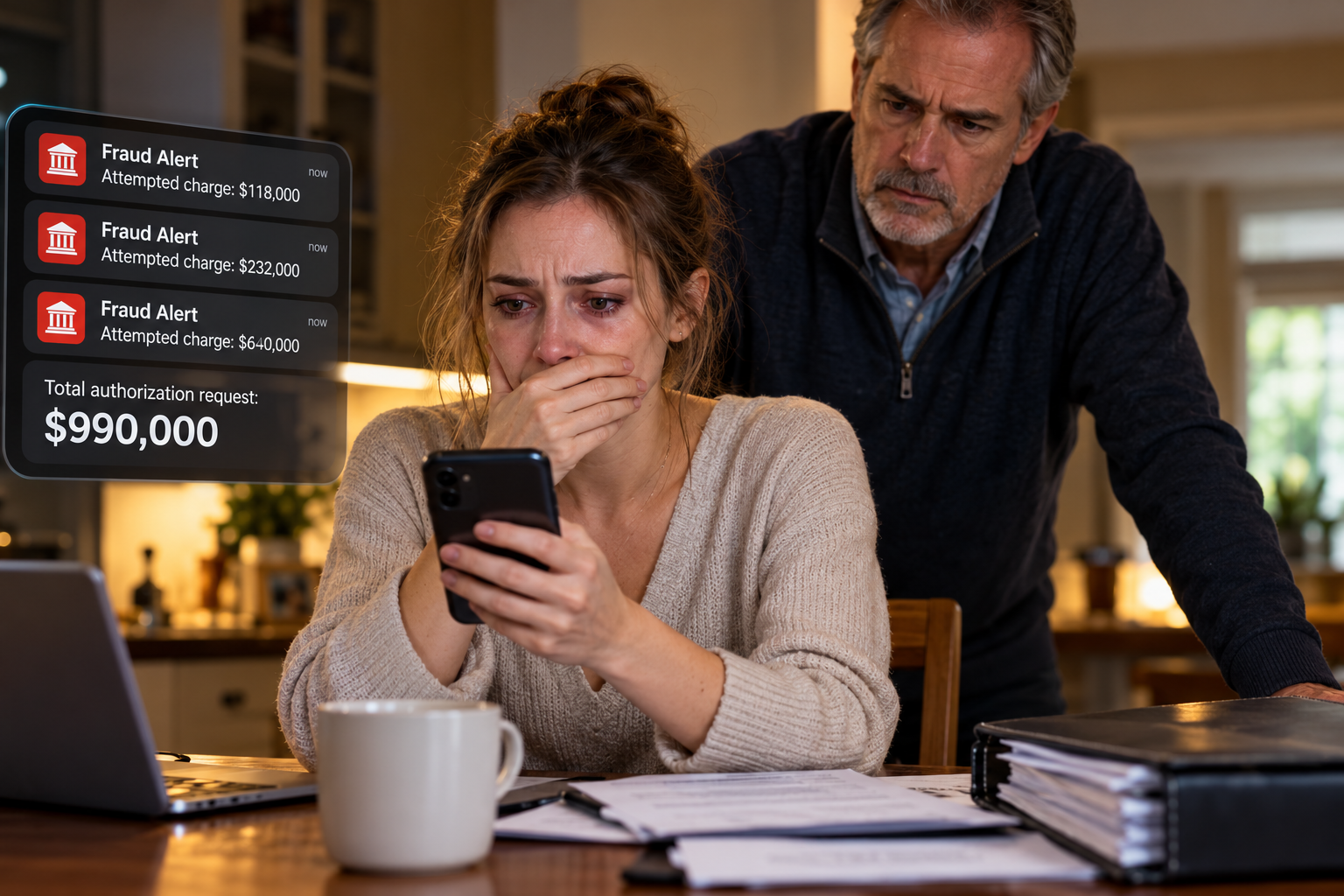
The notification said that a transaction had been declined.
I read the amount.
Then I read it again.
It was far larger than anything I had ever spent on a single purchase.
I checked the account number.
It belonged to one of my cards.
For a moment, I thought I had misunderstood the message.
I opened the banking app and checked the transaction details.
The attempted charge was still listed.
I looked at the merchant information.
It meant nothing to me.
My father pulled out the chair beside mine.
"Show me."
I handed him the phone.
He read the screen without moving his lips.
Then he gave it back.
"Call the bank."
I was already pressing the number.
The automated system asked me to verify my identity.
I answered the questions, entered the required digits, and waited for a representative.
The hold music sounded absurdly cheerful.
I wanted to throw the phone across the kitchen.
Instead, I sat there listening to a tune that seemed designed for people who had never had a bad day in their lives.
When the representative answered, I explained that I had received an alert about a transaction I did not recognize.
She asked me to confirm the amount.
I did.
She placed me on hold while she reviewed the account.
My father stood near the window.
He was watching the street.
I wondered whether he was trying to give me privacy.
Then I noticed that he kept glancing back at my phone.
The representative returned and asked whether I had recently made a large purchase.
"No."
Had I authorized anyone else to make a purchase on my behalf?
"No."
Had I shared the card information with a family member?
I hesitated.
My husband had known the account details.
I explained that we had recently divorced and that I had changed the PIN.
The representative asked whether the card itself had been replaced.
It hadn't.
She recommended that I lock it immediately and request a replacement.
I followed her instructions.
Then I asked about the attempted transaction.
She said the authorization had been declined, but she couldn't yet tell me how the merchant had obtained the card information.
I thanked her and ended the call.
My hands were cold.
My father came back to the table.
"Was it approved?"
"No."
"Good."
I stared at him.
"Good?"
He pulled out the chair and sat down.
"At least that one didn't go through."
I looked at the alert again.
The number seemed unreal.
I had never had that much money available on a card.
I couldn't understand why anyone would try to charge such an amount to it.
Maybe it was a mistake.
Maybe someone had entered the wrong information.
Maybe the bank had flagged something that wasn't actually connected to me.
I started listing possibilities in my head.
My father watched me.
"What are you thinking?"
"That there has to be an explanation."
"There may be."
His answer surprised me.
He wasn't telling me that my husband had done something wrong.
He wasn't pretending he knew who was responsible.
He was simply refusing to let me confuse an explanation with proof.
I looked at the screen again.
The alert remained there, bright and undeniable.
I asked the bank to block further transactions while the account was reviewed.
The representative confirmed the request.
Then I checked my other cards.
No new warnings.
Not yet.
I let out a breath I hadn't realized I was holding.
My father brought me a glass of water.
I took a sip and set it beside my phone.
The kitchen had become painfully quiet.
I could hear the refrigerator humming.
A car passed outside.
Somewhere down the street, a dog barked twice.
Nothing in the world appeared to have changed.
Yet I was sitting at my father's table, trying to understand why someone had attempted to charge a sum of money that could have changed my life.
I wanted to call my husband.
The urge came suddenly.
I wanted to ask whether he knew anything about the transaction.
I wanted him to tell me there had been a mistake.
I wanted him to sound annoyed at the inconvenience rather than frightened by the accusation.
I wanted him to be the man I had believed I married.
My thumb hovered over his contact.
My father noticed.
"Don't."
I lowered the phone.
"I'm not doing anything."
"You were about to."
I felt ashamed.
Then I felt angry at him for noticing.
"He's still my husband until today," I said.
The words sounded weak even to me.
My father didn't correct me.
The divorce was final.
I knew that.
But years of habit didn't disappear because a judge signed a document.
I had spent so long treating my husband as the first person I should call that I couldn't imagine a crisis without him at the center of it.
Even now, when the crisis might have involved my money, part of me wanted to give him the first chance to explain it.
My father folded his hands.
"Let the bank investigate."
I looked down at my phone.
I deleted nothing.
I wrote down the time of the attempted charge.
I saved the notification.
Then I opened my email and found the bank's confirmation of the card lock.
I forwarded it to an email account my husband couldn't access.
The small task gave me something to do with my hands.
My father watched me finish.
"Good."
I almost asked him why he seemed so certain that this was only the beginning.
Instead, I checked the rest of my accounts.
One was connected to a savings account I had opened before I got married.
Another was a credit card I rarely used.
Both appeared normal.
I checked them again.
Still normal.
My shoulders loosened slightly.
Maybe the alert was an isolated incident.
Maybe the bank's security system had done exactly what it was supposed to do.
Maybe, for once, I could let a problem remain a problem instead of turning it into a catastrophe in my mind.
I leaned back in my chair.
My father didn't relax.
He took my wallet and examined the remaining cards again.
"What are you doing?"
"Making sure we've covered everything."
I almost snapped at him.
Then I stopped.
He wasn't taking pleasure in my fear.
He wasn't telling me I had been foolish.
He was trying to make sure I didn't overlook something because I was too hurt to think clearly.
That realization softened my anger.
A little.
I helped him check the accounts one by one.
We wrote down the names of the banks.
We noted which cards had been locked and which still needed attention.
I changed another password.
Then I changed the security questions on an account I had forgotten was linked to my old email address.
It was tedious work.
It was also the first time since the courtroom that I felt I could do something useful.
By midafternoon, I had spoken to two bank representatives and saved several confirmation messages.
I had not called my husband.
I had not sent him an angry text.
I had not asked anyone to tell me what I should feel.
I was beginning to believe I could get through the day without making the situation worse.
Then another notification arrived.
This one came from a different card.
I opened it immediately.
Another attempted transaction.
Another amount I couldn't explain.
I checked the details.
The bank had declined it.
I stared at the screen.
The first alert might have been a mistake.
The second made that harder to believe.
My father moved beside me.
"How much?"
I turned the phone toward him.
He read the number.
His face changed, but only slightly.
He didn't curse.
He didn't demand that I call the police.
He simply reached for the notepad and wrote down the amount and the time.
I watched his pen move across the paper.
For some reason, that ordinary action frightened me.
It made the whole thing feel real.
The amount was no longer just a number glowing on my screen.
It was something that had happened.
Someone had tried to make it happen.
And I had no idea who.
I called the second bank.
The representative confirmed that the attempted charge had been blocked.
She advised me to lock the card and request a replacement.
I did both.
Then I asked whether the bank could tell me if the same merchant had tried to use another card.
She said she would document the concern and explain the next steps for investigating possible fraud.
I wrote down her instructions.
My father remained beside me.
When the call ended, I looked at the two alerts.
They sat one above the other.
Different cards.
Different amounts.
The same sick feeling in my stomach.
I began to think about the information my husband had known.
The cards he had handled.
The accounts he had helped me set up.
The passwords I had once shared because I believed a marriage was supposed to have no secrets.
I hated myself for wondering whether those ordinary acts of trust had made me vulnerable.
I hated myself even more for still hoping there was an innocent explanation.
My father put the notepad in front of me.
"Write down everything you remember about who had access to these accounts."
I picked up the pen.
For several seconds, I couldn't move.
Then I began to write.
Click here to continue reading: PART 4: Three Enormous Requests Arrived Before I Could Catch My Breath, and My Father Finally Told Me What He Had Been Waiting For
My Marriage Was Over, but My Father Was Watching Something I Could Not See Yet
Part 3 of 20