
The drive back to the house took less time than I remembered.
I had expected every familiar street to bring back a memory.
Some did.
The grocery store where we used to shop on Sundays.
The intersection where my former husband had once forgotten to turn toward home.
The small coffee shop where we had waited out a storm during the first year of our marriage.
Those memories came and went without asking permission.
I didn't try to interpret them.
They were memories, not evidence.
When I arrived, I parked outside and sat with my hands on the steering wheel.
The house looked ordinary.
The curtains were where I had left them.
The front steps needed sweeping.
A package sat near the door.
Nothing about the building suggested that my life had changed.
I unlocked the door and went inside.
The quiet was immediate.
I had lived there long enough to recognize every small sound.
The refrigerator hummed.
The clock above the kitchen doorway ticked.
A floorboard creaked near the hallway.
I set my bag on the counter and took out the list I had made.
I had promised myself that I would stick to it.
The first item was my personal identification and paperwork.
I went to the drawer where we kept household documents.
The folders were arranged in the same order as before.
Insurance.
Utilities.
Tax records.
Bank statements.
I pulled out the papers that belonged to me and placed them in a separate folder.
I didn't take documents simply because I was angry.
I didn't leave something behind simply because it reminded me of my former husband.
I worked through the list one item at a time.
When I reached the financial records, I slowed down.
There were statements I had reviewed before.
There were others I remembered seeing only when my former husband brought them to me.
I set them aside for careful review rather than trying to understand everything while standing in the kitchen.
The folder was already getting thick.
I placed it in my bag.
Then I checked the small desk where I kept personal paperwork.
My notebook was still there.
So were a few receipts and an envelope containing old account information.
I examined the envelope before putting it away.
Some of the information was outdated.
I didn't assume that it had been used by anyone.
I simply marked it for review so I could decide what needed to be changed or securely discarded.
I was beginning to understand that a careful person did not have to turn every discovery into a revelation.
Sometimes a document was just a document.
Sometimes it was useful.
Sometimes it needed to be updated.
The important thing was knowing which was which.
I carried the folder to the kitchen and placed it beside my bag.
Then I stood still.
The rest of the house waited around me.
I could have gone into the bedroom and opened every drawer.
I could have searched the study for anything that looked unfamiliar.
I could have checked the shelves and cupboards, looking for some small object that would explain the attempted authorizations.
For a moment, I wanted to.
The urge was strong enough that I took two steps toward the hallway.
Then I stopped.
I had no reason to believe that searching every room would answer the question I had.
I didn't know what I was looking for.
I was only afraid that if I failed to look everywhere, I might miss something important.
That was not the same as having a clear purpose.
I returned to the kitchen and checked my list.
I had collected the papers I came for.
There were a few personal items in the bedroom I still wanted to take, so I went upstairs.
I packed clothes, toiletries, and a small box of things that belonged to me.
I didn't linger over every photograph.
I couldn't yet decide which memories I wanted to keep close and which I needed to put away for a while.
I placed the photographs in a box and closed the lid.
That decision could wait.
When I returned downstairs, I noticed the package beside the door.
It was addressed to the household.
I carried it inside and placed it on the counter.
I didn't open it.
I added it to the list of ordinary matters that would need to be handled separately from the bank issue.
The distinction felt almost absurd.
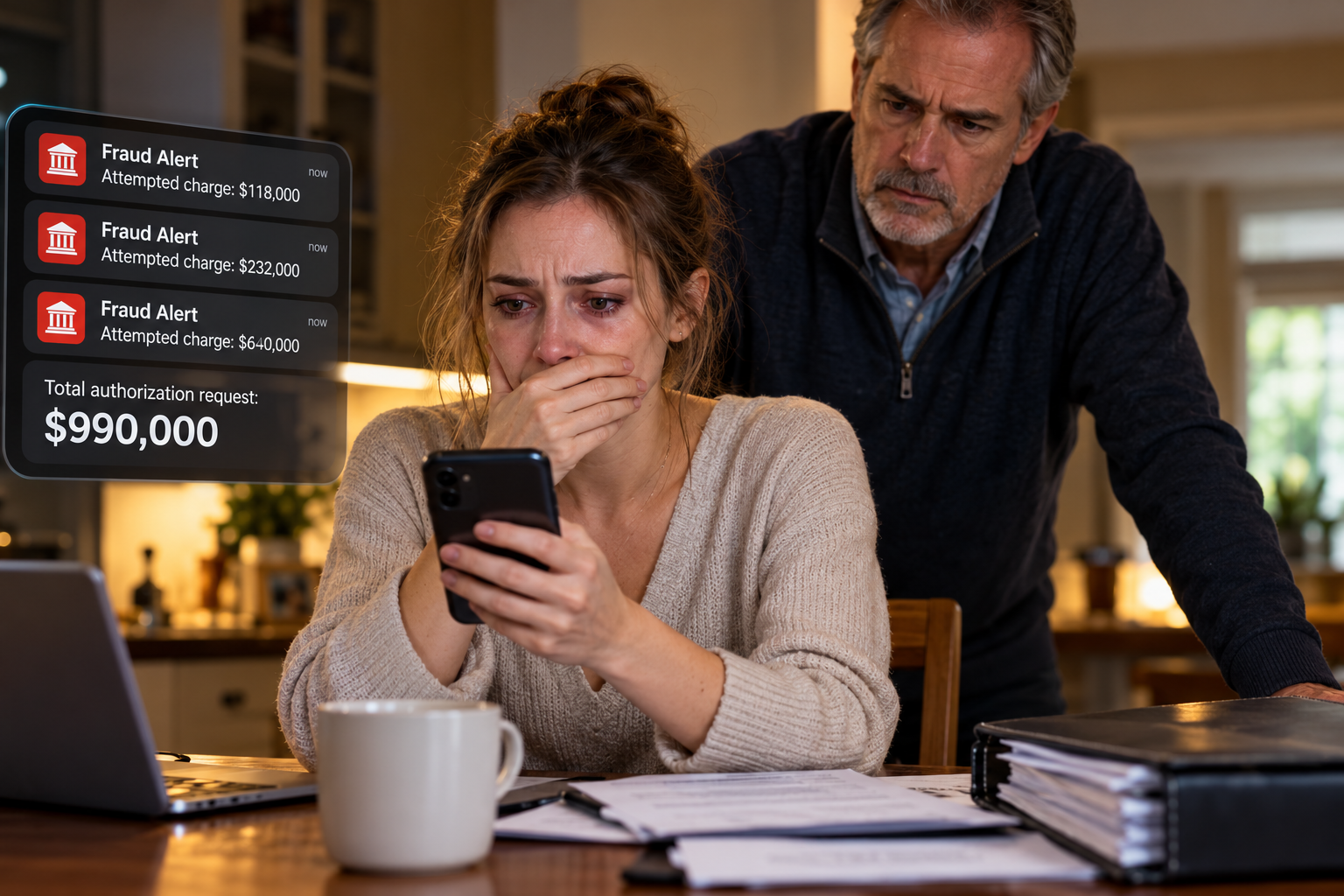
A package and a nearly million-dollar authorization request belonged to the same day.
Yet both required a response, and neither would become easier if I confused them.
I checked my phone.
No new alerts.
I opened the banking application only long enough to confirm that the account status hadn't changed.
Then I put the phone away.
Before leaving, I walked through the kitchen once more.
I looked at the table where we had eaten meals.
I looked at the counter where my former husband used to set his keys.
I looked at the chair where I had sat while waiting for him to explain something about a bill.
The objects were familiar.
The meaning I had attached to them was not as certain anymore.
I had thought that a shared home meant that we were sharing responsibility.
Now I needed to determine what that responsibility had actually involved.
That question was painful, but it was not the same as an accusation.
I locked the door behind me and carried my bags to the car.
The drive back to my father's house was quieter.
I didn't turn on the radio.
I wanted to hear my own thoughts, even if I couldn't organize them into anything useful.
When I arrived, my father came to the door.
He took one of the bags without asking what I had found.
"Everything you needed?"
"Most of it."
He carried the bag inside.
I followed him to the kitchen and placed the financial folder on the table.
"I found statements I want to review."
"Then review them when you're ready."
"I thought you would ask whether there was anything suspicious."
He looked at me.
"Was there?"
"I don't know."
"Then we shouldn't call it suspicious yet."
I gave him a tired look.
"You really are consistent."
"I try."
I sat down and opened the folder.
The statements were ordinary-looking pages filled with dates, amounts, and descriptions.
I recognized many of the entries.
Some required more attention.
I didn't begin by looking for large numbers.
I began by checking the statement periods and making sure I knew which accounts each document belonged to.
I marked the pages I needed to review with small paper tabs.
I didn't write conclusions in the margins.
I didn't draw connections simply because two entries appeared near each other.
When I finished organizing the documents, I closed the folder.
My father set a glass of water beside me.
I drank it slowly.
The visit had not produced the explanation I wanted.
But I had brought back the records I needed to understand my own finances.
That was a real result.
I placed the folder next to the earlier bank records.
The two collections belonged together in one sense.
They also needed to remain separate until I had a reason to connect them.
I wrote that reminder at the top of the new page.
REVIEW FIRST. CONCLUDE LATER.
Then I put down my pen.
I had gone back to a house that still looked like the home I remembered.
I had left with documents, personal belongings, and questions.
For now, that was enough.
Click here to continue reading: PART 15: The Statements Did Not Give Me the Answer I Wanted, but They Forced Me to Face How Little I Had Been Checking for Myself
My Marriage Was Over, but My Father Was Watching Something I Could Not See Yet
Part 14 of 20

One Comment on “PART 14 – Returning to the Place Where My Marriage Had Ended Felt Strange, Especially When I Realized How Many Decisions I Had Left for Someone Else”