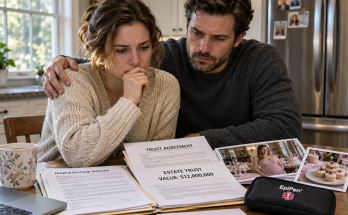
I read the letter slowly.
Then I read it again.
Mom had never been good at writing about feelings.
She could fill three pages explaining why a grocery bill was unreasonable, but emotional honesty usually made her uncomfortable.
This letter was different.
She began with the grocery card.
Not the money.
The loss of it.
She admitted that when the card stopped working, what frightened her wasn't the food.
It was the sudden realization that the safety she had taken for granted could disappear.
Then she wrote about Dad.
She said that after he died, the house felt too large.
Every room reminded her of him.
His chair.
His tools.
The coffee mug he always used.
The sound of his footsteps on the stairs.
She said the life insurance money had seemed like a final piece of security.
Then Greg convinced her she could turn it into something larger.
She trusted him.
She lost it.
And instead of admitting what happened, she hid the truth.
From Ethan.
From me.
From herself.
That was the part I hadn't known.
Mom hadn't simply made a bad investment.
She had built a second life around pretending she hadn't.
When the money disappeared, she became terrified that the rest of her life would disappear with it.
Then I stepped in.
At first, she wrote, she had been grateful.
Then relieved.
Then dependent.
And finally entitled.
That last word sat alone on the page.
I had to stop reading.
I walked to the window.
Outside, snow had begun falling.
Small flakes drifted beneath the streetlight.
I thought about the woman I had spent years protecting.
The woman who had once carried me when I was sick.
The woman who had packed my lunches.
The woman who had sat beside Dad's hospital bed.
The woman who had also told my daughter that crackers were enough.
People were rarely only one thing.
That was what made family so difficult.
I returned to the letter.
Mom wrote that she knew she couldn't repay six years of expenses.
She didn't promise to.
Instead, she said she hoped to spend the next years becoming someone who no longer needed to be rescued.
Then came the sentence that made me cry.
She wrote that she wanted Sophie to have the grandmother she should have had all along.
I folded the letter.
I placed it beside Dad's photograph.
Then I sat there for a long time.
When Sophie came home later, she found me at the kitchen table.
“What's that?”
“A letter from Grandma.”
“Is it bad?”
“No.”
“Good?”
I smiled.
“Very.”
She dropped her backpack.
“Can I read it?”
I hesitated.
“Not this one.”
She accepted that immediately.
“Okay.”
Then she pulled something from her coat pocket.
“Grandma gave me this.”
She held up the recipe card.
Dad's handwriting.
I touched it.
“Take care of that.”
“I will.”
We stood together beside the photograph.
“Grandpa made cookies?”
“He did.”
“Were they good?”
I smiled.
“Terrible.”
She laughed.
“Mom!”
“He burned them.”
“Grandma said they were good.”
“Grandma was in love.”
Sophie giggled.
The following months were calmer.
Mom continued paying rent.
She kept her budget.
She worked part-time doing bookkeeping.
She stopped shopping as though every grocery trip were a luxury event.
She discovered the farmers' market.
She complained about the price of tomatoes.
She became strangely enthusiastic about coupons.
One Saturday morning, she called me.
“Do you know that the store has a double-coupon day?”
I laughed.
“You sound excited.”
“I saved seventeen dollars.”
“Congratulations.”
“I bought oatmeal.”
“Very glamorous.”
She laughed.
Then she said, “I'm making cookies with Sophie.”
“I'll bring her over.”
When I arrived, flour covered the kitchen.
Sophie was holding a wooden spoon.
Mom was reading Dad's recipe card.
“Grandpa's handwriting is hard to read,” Sophie said.
“It always was,” I replied.
Mom smiled.
“He wrote like a doctor.”
We laughed.
The cookies came out slightly uneven.
Some were too dark.
Others were almost perfect.
Sophie insisted on arranging them on a plate.
Mom insisted on making tea.
Nobody talked about money.
Nobody talked about the house.
Nobody talked about the grocery card.
That was when I realized something.
The conflict had never really been about food.
Food had simply exposed the imbalance.
The card was where the problem became visible.
The real issue was that Mom had forgotten the difference between being loved and being provided for.
And I had forgotten the difference between helping someone and preventing them from growing.
We were learning both lessons together.
A month later, Ethan invited us to dinner.
His house was small.
Two bedrooms.
A narrow kitchen.
A backyard barely large enough for a grill.
He had been saving for it for months.
Sophie ran through the front door.
“Uncle Ethan!”
He hugged her.
“Hey, trouble.”
Mom walked in behind us.
She looked around.
“You bought it.”
Ethan smiled.
“I did.”
“It's wonderful.”
He looked at me.
“Because I finally started saving.”
I smiled.
“I’m proud of you.”
He shrugged.
“I should have done it sooner.”
Mom touched his shoulder.
“We all should have.”
Dinner was homemade lasagna.
Halfway through, Ethan cleared his throat.
“I have news.”
Sophie immediately raised her hand.
“You're getting married.”
Everyone laughed.
“No.”
“A puppy?”
“No.”
“A baby?”
Ethan nearly choked.
“Definitely no.”
He laughed.
“I got promoted.”
We cheered.
Then he looked at me.
“And I paid off the last of my credit-card debt.”
I smiled.
Mom smiled too.
“That’s wonderful.”
Ethan looked around the table.
“I think we're all getting better at something.”
“What?”
“Taking care of ourselves.”
Nobody answered.
We didn't need to.
Later that evening, Mom helped Sophie put on her coat.
She adjusted the collar.
“You know,” she said quietly, “your mother was always the strong one.”
Sophie nodded.
“I know.”
“But strong doesn't mean doing everything alone.”
Sophie looked at her.
“Mom doesn't.”
Mom smiled.
“No.”
She glanced toward me.
“She finally learned that.”
I heard them.
I pretended I hadn't.
At Christmas, Mom gave me another envelope.
This one was smaller.
Inside was Dad's old watch.
I stared at it.
“Mom.”
“I want you to have it.”
“You've kept this for years.”
“I know.”
She touched the watch face.
“Your father wore it every day.”
I swallowed.
“Are you sure?”
“Yes.”
She smiled.
“You should have had it a long time ago.”
I closed my hand around it.
“Thank you.”
She nodded.
Then she said, “There is one more thing.”
“What?”
“I changed my will.”
I looked at her.
“Mom, you don't have to—”
“I know.”
She raised one hand.
“I'm not doing it to repay you.”
I waited.
“I want whatever I leave behind to go toward Sophie.”
My throat tightened.
“Why?”
“Because she taught me something.”
“What?”
“That children remember how adults make them feel.”
She looked at me.
“I want her to remember that I eventually became someone worth remembering.”
I couldn't answer immediately.
So I hugged her.
It wasn't the hug of a daughter rescuing a mother.
It wasn't the hug of someone pretending the past hadn't happened.
It was simply a hug.
Two people who had hurt each other in different ways.
Two people who were still here.
Two people choosing to do better.
A few months later, Sophie received the Citizenship Award at school.
She walked to the podium holding a small sheet of paper.
I expected her to thank her teachers.
Instead, she talked about the lunch account.
She didn't tell the story dramatically.
She simply told the truth.
She said that she had once believed asking for help meant admitting she was weak.
Then she looked toward me.
“My mom taught me that asking for help is not weakness.”
She paused.
Then she looked toward Mom.
“My grandma taught me something too.”
Mom's eyes widened.
Sophie smiled.
“She taught me that people can change when they're willing to admit they were wrong.”
Mom began crying.
Not quietly.
Not discreetly.
She didn't hide it.
The audience stood.
Applause filled the room.
I watched Sophie return to her seat.
She had once sat silently in a cafeteria because she didn't want anyone to know she was hungry.
Now she stood in front of hundreds of people and told the truth.
That was the part I was proudest of.
Not the lunch fund.
Not the money.
Not the house.
Her courage.
That evening, our family gathered in the backyard.
Nothing elaborate.
A grill.
Lemonade.
Potato salad.
Music playing softly from a speaker.
Mom carried out a tray of burgers.
She dropped one.
Sophie laughed.
“Five-second rule!”
Mom laughed too.
Ethan shook his head.
“You two are impossible.”
I looked around the yard.
My brother had his own home.
My mother had her own budget.
My daughter had learned to ask for help.
And I had finally learned that saying no did not make me cruel.
The sun disappeared behind the maple trees.
Sophie slipped her hand into mine.
“Mom?”
“Yes?”
“I'm hungry.”
I smiled.
“Perfect timing.”
We walked toward the table together.
Everyone had a seat.
Everyone had enough to eat.
And for the first time, I understood that the best thing I could give my daughter was not a perfectly protected life.
It was the confidence to speak when something was wrong.
The wisdom to accept help without shame.
And the courage to understand that love can have boundaries without becoming less loving.
The old grocery card had once represented everything I thought a family was supposed to be.
Now it represented something else.
The moment we finally stopped pretending.
The moment my mother began standing on her own.
The moment my daughter learned that her voice mattered.
And the moment I finally understood that sometimes the kindest way to help someone is to stop carrying what they are capable of carrying themselves.
Click here to continue reading: PART 9: The Morning My Mother Called Me Before Sunrise, I Knew Something Had Gone Wrong With the Life She Had Finally Learned to Manage
By Friday Afternoon, I Finally Discovered Why My Quiet Daughter Had Been Eating Cold Pasta Like She Hadn’t Seen Food in Days
Part 8 of 20