
I drove back to the farmhouse the next morning.
Eleanor was waiting on the porch.
The envelope sat in her hands.
Robert arrived shortly afterward.
Nobody spoke as we entered.
The farmhouse had become a place of revelations.
Every time I crossed its threshold, another piece of Theresa's life seemed to surface.
Eleanor placed the envelope on the table.
“It's been here since before I left.”
“Why didn't you find it earlier?”
“I wasn't looking.”
I stared at the handwriting.
Theresa's.
The words were unmistakable.
Open only when Daniel has told you the entire truth.
Robert looked at me.
“Has he?”
“I thought he had.”
“Then open it.”
I slipped my finger beneath the flap.
Inside was a single letter.
Ernest,
If you're reading this, Daniel has probably finally told you what happened.
I stopped.
Robert waited.
I continued.
But there is one thing I could never make myself tell you while I was alive.
I felt my chest tighten.
Theresa wrote that Daniel had come to the hospital shortly before her death.
She had expected him to ask for help.
Instead, he told her Mercer had approached him.
But that wasn't the first time Daniel had met Mercer.
The first meeting happened years earlier.
Before the gambling.
Before the debts.
Before Northstar.
I looked at Eleanor.
She already knew.
“Keep reading,” she whispered.
Theresa explained that Daniel had discovered the family records as a teenager.
He had found the old photograph.
He had learned about Eleanor.
He had learned that his grandmother's family had money.
He became fascinated by the idea that something had been hidden from him.
At eighteen, he confronted Theresa.
He wanted to know why she had never told him about Eleanor.
Theresa refused.
Not because she was ashamed.
Because she was afraid he would go looking.
He did anyway.
Daniel found Victor.
And Victor found Mercer.
The relationship had begun long before the debt.
I closed my eyes.
So Daniel had not been an innocent man suddenly corrupted by gambling.
He had been curious.
Then ambitious.
Then desperate.
Then trapped.
Each choice had led to the next.
Theresa wrote that she had tried to stop him.
She warned him about Victor.
She begged him to leave Northstar alone.
He promised.
He lied.
The next page contained something worse.
Theresa had discovered that Daniel had copied documents from her files.
He had already been looking for a way to reach the trust.
Years before he needed money.
I felt sick.
“Why didn't she tell me?”
Eleanor answered quietly.
“Because she still believed he could change.”
I kept reading.
Theresa wrote about the night she confronted him.
Daniel had cried.
He had told her he was ashamed.
He had promised to stop.
She believed him.
Then, months later, she discovered he had contacted Mercer again.
This time, he asked about the house.
I put the letter down.
Robert said nothing.
I picked it up again.
The final paragraphs were addressed directly to me.
Ernest, you will want to decide whether Daniel deserves your forgiveness.
Don't make that decision because I am asking you to.
Don't make it because he is your son.
Make it after you know everything.
I looked toward the window.
Theresa's final words were simple.
He did not become this person in one day.
Neither will he become someone better in one day.
If he ever comes back to you, watch what he does, not what he promises.
The letter ended there.
I sat silently.
Robert finally spoke.
“That changes things.”
“Yes.”
“Are you angry?”
“Yes.”
“At Daniel?”
“At myself.”
“Why?”
“Because I wanted the story to be simpler.”
Eleanor nodded.
“So did Theresa.”
I folded the letter.
“What happens now?”
Robert looked at me.
“Nothing has to happen today.”
But something did.
I called Daniel.
He answered immediately.
“Dad?”
“Come to the farmhouse.”
Silence.
“Why?”
“Because I found another letter.”
His breathing changed.
“What letter?”
“From Mom.”
Another pause.
“I'll come.”
He arrived an hour later.
When he stepped through the door, he looked at Eleanor.
Then Robert.
Then me.
“You know.”
“Yes.”
He closed his eyes.
“What did she tell you?”
“Everything.”
He sat.
“I was hoping she'd never leave that letter.”
“Why?”
“Because I didn't want you to know how far back it went.”
I looked at him.
“You were involved before the gambling.”
“Yes.”
“How old were you?”
“Eighteen.”
“Why?”
He looked down.
“I wanted to know why Mom kept secrets.”
“And when you found out?”
“I wanted what I thought we were owed.”
“You thought the family money belonged to you.”
“Yes.”
“You believed that for years.”
“Yes.”
“Even after you knew it wasn't yours.”
“Yes.”
I nodded.
“Why didn't you tell me?”
“Because every time I thought about telling you, I imagined your face.”
He swallowed.
“I was afraid you'd see me differently.”
“You're right.”
He nodded.
“I do.”
He looked at me.
“But I'm not going to pretend you're beyond saving.”
His eyes filled.
“I don't know how to fix it.”
“You don't fix it.”
“What do I do?”
“You live differently.”
He nodded.
“Every day?”
“Every day.”
He wiped his eyes.
“I can do that.”
“I hope you can.”
He stood.
Before leaving, he stopped.
“Dad?”
“Yes?”
“I really am sorry.”
I looked at him.
“I know.”
That was all I could give him.
Not absolution.
Not certainty.
But the truth.
After Daniel left, Eleanor came to sit beside me.
“You didn't reject him.”
“No.”
“Why?”
“Because Theresa asked me to watch what he does.”
Eleanor smiled.
“She knew you.”
“Yes.”
Robert gathered the papers.
“The legal side is finished.”
“Mostly.”
He smiled.
“Mostly.”
I laughed.
It was the first time the farmhouse had felt less like a courtroom.
Years later, people would probably remember the story differently.
Some would say my son tried to take my house.
Others would say my wife left behind a secret trust.
Some would focus on Victor.
Some on Mercer.
Some on the money.
But none of that was the whole story.
The real story was about choices.
A woman who saw danger before anyone else did.
A son who confused desperation with entitlement.
A family that spent generations burying the truth.
And a house that survived because someone finally stopped pretending love required silence.
I returned home that evening.
The sun was low.
I stood on the porch and looked through the window.
The kitchen table was still there.
The clock still ticked.
Theresa's photograph still rested beside the lamp.
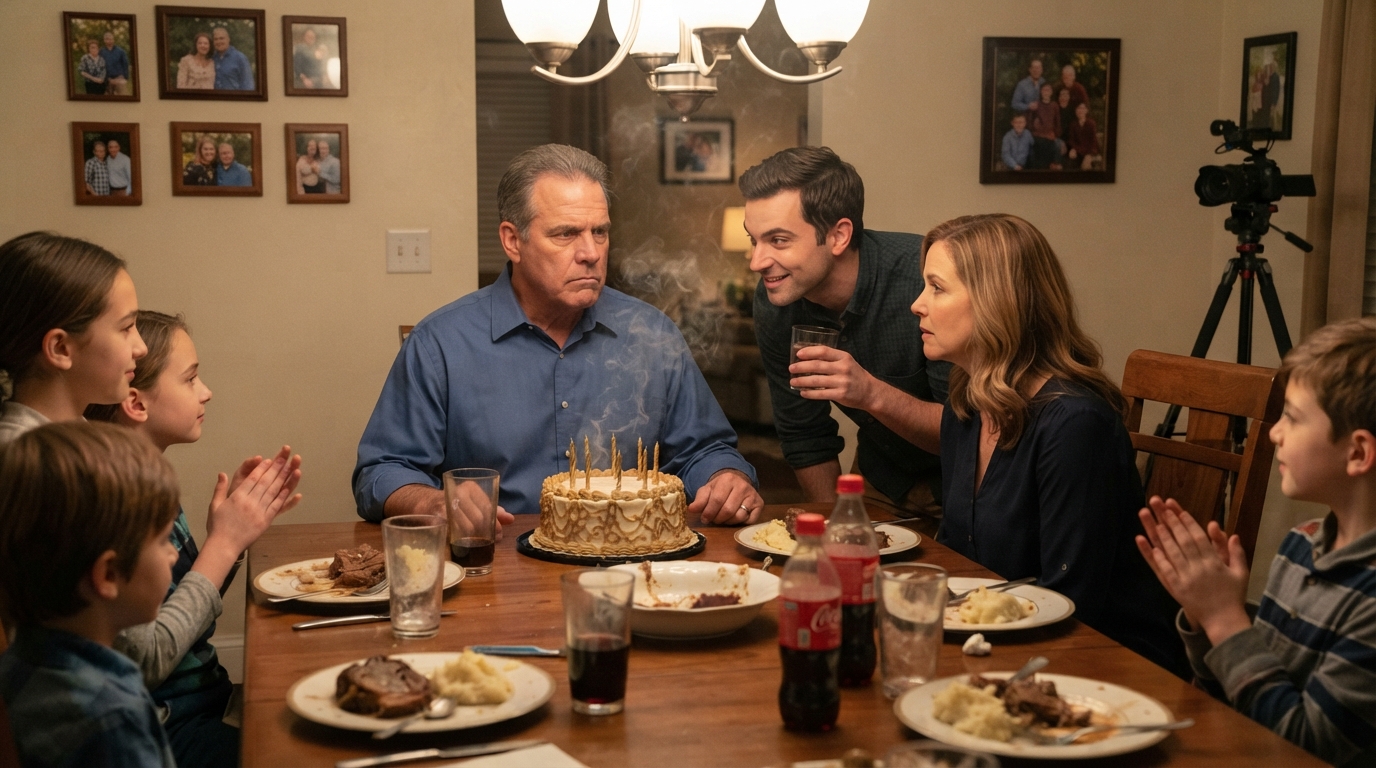
I thought about the birthday when Daniel had whispered those terrible words.
I had believed that night might be the beginning of the end.
Instead, it became the moment I finally began asking questions.
Not every answer had brought comfort.
Some had brought anger.
Some had brought grief.
Some had forced me to see my son without the excuses I had built around him.
But truth had done something else too.
It had given everyone a chance to stop lying.
That mattered.
Months later, Daniel came for another visit.
He brought no gifts.
No documents.
No requests.
He simply stood on the porch.
“Coffee?” he asked.
I opened the door.
“Bad coffee?”
He smiled.
“The worst.”
I let him in.
We sat at the kitchen table.
For a while, neither of us spoke.
Then he said, “I got another payment in.”
“For the restitution?”
“Yes.”
“How much?”
He told me.
I nodded.
“Good.”
He smiled.
“I thought you'd say that.”
“I will always notice what you do.”
He looked down.
“I know.”
We drank coffee.
Outside, children were playing in the yard.
Noah's voice carried through the open window.
Daniel listened.
“That's a good sound,” he said.
“Yes.”
He smiled.
Then he looked at me.
“I used to think you were keeping things from me because you didn't trust me.”
I waited.
“Now I understand you were trying to protect something.”
“The family.”
“No.”
He looked toward Theresa's photograph.
“Mom.”
I nodded.
Daniel was quiet for a long time.
Then he said, “I think I finally understand what she wanted.”
“What?”
“That we stop hurting each other because we were afraid to tell the truth.”
I looked at my son.
For the first time, I believed he understood.
Not because he said the right words.
Because he had spent years learning to live with the consequences of the wrong ones.
That was enough.
I stood and walked to the safe.
I opened it.
Daniel watched.
I removed Theresa's letters and placed them on the table.
Then I closed the safe again.
I did not lock it.
Daniel noticed.
“You don't lock it anymore.”
“No.”
“Why?”
I smiled.
“Because I don't need to hide from my own life.”
He looked at the letters.
Then at me.
“I'll never forget what I did.”
“Good.”
He nodded.
“Neither will I.”
We sat there together.
Not as the father and son we had once been.
Not as strangers.
Something in between.
Something harder.
Something honest.
And for the first time, I understood that this was what surviving the truth looked like.
Not returning to the past.
Not pretending nothing happened.
Just sitting across from someone who had hurt you, knowing exactly who they were, and deciding that their worst choice would not be allowed to become your entire future.
:::
Click here to continue reading: PART 13: The First Sign That Daniel Had Truly Changed Arrived Quietly, But It Forced Me to Reconsider What I Thought I Knew About Him
The Birthday Candle Went Dark, But My Son’s Quiet Words Kept Burning Long After Everyone Had Gone Home
Part 12 of 25

