
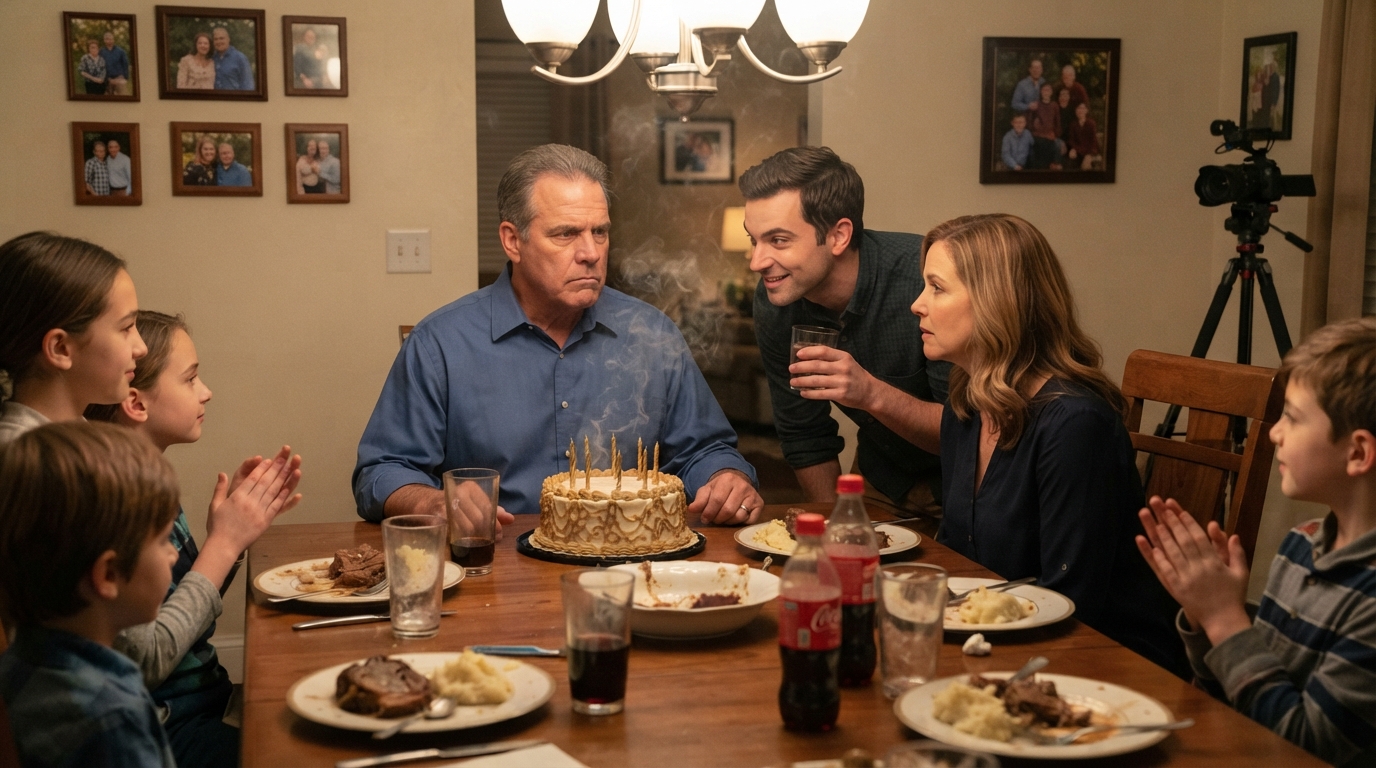
The room went silent.
Daniel stared at the deed.
“I don't understand.”
Neither did I.
Robert took the document and examined the notation.
“This is legitimate.”
“How could we have missed it?”
“It was recorded separately.”
“Why?”
“Because the transfer was conditional.”
I looked at Daniel.
“What condition?”
Robert read the attached clause.
The house would remain occupied by me for the rest of my life.
Daniel would receive ownership afterward.
But only if he completed a list of requirements.
Daniel laughed once.
Not because anything was funny.
“Mom knew.”
“Yes.”
“She knew I'd eventually try to take it.”
“She knew it was possible.”
He read the list.
Complete repayment of all personal debts.
Cooperate with any investigation involving the family estate.
Surrender any fraudulent claim against the trust.
And one final requirement.
Maintain the property for the benefit of future beneficiaries.
Daniel looked up.
“What does that mean?”
Robert smiled faintly.
“It means the house was never supposed to be yours as a possession.”
Daniel stared at the paper.
“It was supposed to be a responsibility.”
“Yes.”
The revelation hit me harder than the earlier discoveries.
Theresa had not been preparing to take everything away from Daniel.
She had been trying to give him something he could not simply consume.
A home that could become an obligation.
A place that required care.
A legacy measured in maintenance rather than money.
Daniel sat down.
“I don't deserve this.”
Robert corrected him.
“Deserving isn't the point.”
Daniel looked at me.
“Would you have signed it?”
I thought about it.
“I would have signed whatever your mother believed protected the family.”
He nodded.
The deed explained something else.
The house had been transferred years before the confrontation.
That meant the threats against me had been even more misguided than we knew.
Mercer had been trying to obtain property that Theresa had already protected.
The legal transfer had been hidden from almost everyone.
Even me.
Daniel's eyes filled.
“She was trying to save me from myself.”
“Partly.”
“And from them.”
“Yes.”
He folded the deed.
“I thought she was choosing you over me.”
“She was trying to make sure neither of us lost the house.”
The family remained at the farmhouse until late.
We discussed what should happen next.
The answer was surprisingly simple.
The house would remain mine for as long as I lived.
Daniel would maintain it.
After my death, ownership would pass to him under the conditions Theresa established.
If he failed them, the property would transfer into the family trust.
No loopholes.
No private sale.
No borrowing against it without approval.
It wasn't a prize.
It was a responsibility.
Daniel signed the acknowledgment that night.
He didn't ask for changes.
That mattered.
Weeks passed.
He began repairing things immediately.
He fixed the leaking gutter.
Repainted the porch.
Repaired the garden wall.
He even learned how to prune Theresa's roses.
He was terrible at it.
“Too much,” I told him.
“I barely touched them.”
“You removed half the bush.”
“They'll grow back.”
I shook my head.
He laughed.
For once, laughter didn't feel like disrespect.
It felt like life returning.
The house changed slowly.
Not dramatically.
A new hinge.
A repaired window.
Fresh paint.
A cleaned attic.
Daniel spent Saturdays there.
He brought no friends.
No expensive tools.
He worked quietly.
One afternoon, he found Theresa's old recipe book.
Inside was a handwritten note.
He brought it to me.
“What is this?”
I read it.
It wasn't a recipe.
It was a list of names.
People Theresa had helped.
Teachers.
Neighbors.
Former employees.
A widow whose husband had worked for Victor.
A mechanic who had been denied payment.
A family whose business had collapsed after one of Victor's companies withheld money.
The names matched the compensation fund.
Daniel looked at me.
“She knew all of them.”
“Yes.”
“She didn't just protect us.”
“No.”
“She remembered everyone.”
That became the purpose of the fund.
Daniel contacted every person whose claim could still be verified.
Some were elderly.
Some had moved.
Some had children who answered on their behalf.
A few refused the money at first.
They didn't trust the family name.
Daniel understood.
He didn't argue.
He sent documentation.
He waited.
Over time, payments went out.
Small amounts compared with the fortune.
Large amounts compared with what those people had once lost.
The work changed him.
I could see it.
He stopped talking about what he deserved.
He started asking what could be repaired.
One evening, he came to my house carrying a folder.
“Three more claims were approved.”
“Good.”
“One woman cried.”
“Why?”
“She thought nobody remembered.”
I looked at him.
“Your mother did.”
He nodded.
“That sentence keeps coming back.”
“What sentence?”
“Remember them.”
I smiled.
“That sounds like her.”
The final legal hearing regarding the trust occurred six months later.
The court confirmed the distribution plan.
The main trust remained protected.
Daniel's restricted interest remained under independent supervision.
Jonathan received his lawful share.
Eleanor received hers.
The compensation fund continued.
The house remained under the deed's conditions.
Nothing could be changed without oversight.
The structure Theresa had built had survived everyone who had tried to break it.
After the hearing, we went to the farmhouse.
There was no celebration.
We ate sandwiches.
Jonathan complained about the bread.
Eleanor told him to stop complaining.
Daniel laughed.
Martin sat quietly at the end of the table.
He had become less present over time.
Not because anyone had forgiven him completely.
Because he understood his place.
Before leaving, he approached me.
“I've thought about what Eleanor said.”
“What?”
“She told me I could stop hiding.”
“And?”
“I think I'm going to.”
He handed me a file.
Inside were additional documents from the old firm.
Nothing new legally.
But one contained a letter from Theresa.
She had written that Martin was not to be trusted with the family's future.
Yet she still believed he could tell the truth if given enough time.
That was Theresa's way.
She rarely reduced people to one decision.
She allowed room for consequences and change to exist together.
I placed the letter back.
“Thank you.”
Martin nodded.
“I'm sorry.”
“I know.”
He left.
Daniel stood beside the porch.
“You forgive a lot.”
“No.”
He looked at me.
“I remember a lot.”
There was a difference.
He smiled.
“That might be the thing I've learned most from you.”
The sun was setting behind the farmhouse.
The repaired porch cast a long shadow across the yard.
I thought about how many times we had stood there afraid.
Now the same place held laughter.
Work.
Documents.
Arguments.
Apologies.
Ordinary things.
The things a home was supposed to contain.
Daniel walked toward the truck.
Then stopped.
“Dad.”
“Yes?”
“There is one thing we haven't figured out.”
“What?”
“The person who first told Mercer about the house.”
I looked at him.
“We know Mercer had records.”
“Yes.”
“But someone originally told him where to look.”
I felt the old uneasiness return.
“Do you have a name?”
“Not yet.”
He held up a photocopy.
A single handwritten note.
The ink was faded.
But the words were clear.
Ask the son.
Below it was a name.
Daniel.
I stared at him.
He stared back.
The note had been written before he ever met Mercer.
Someone had been directing Mercer toward Daniel years earlier.
Someone had known exactly which weakness to exploit.
And the handwriting wasn't Theresa's.
Click here to continue reading: PART 20: The Final Missing Piece Pointed to Someone Outside the Family, and Finding the Truth Required Daniel to Face His Oldest Lie
The Birthday Candle Went Dark, But My Son’s Quiet Words Kept Burning Long After Everyone Had Gone Home
Part 19 of 25

