
We read Mercer's letter at Robert's office.
He insisted on having the original because he wanted to examine the paper and handwriting.
There were only four pages.
The first contained facts.
The second contained names.
The third contained dates.
The fourth contained an explanation.
Mercer claimed Theresa had approached him herself.
Not because she trusted him.
Because she knew he was already involved.
Years before Daniel had discovered anything, Theresa had learned that Mercer was connected to the network surrounding Victor's old accounts.
She confronted him.
He expected her to threaten him.
Instead, she offered him a choice.
Help her document the remaining fraud.
Or watch her expose him alongside everyone else.
Robert frowned.
“Why would he agree?”
“Because she had evidence,” I said.
Mercer's letter said the same.
Theresa had discovered that Mercer had been keeping copies of transactions.
He wasn't simply helping Victor.
He was protecting himself.
He had built a private archive.
That archive became the source of many of the records we eventually recovered.
I looked at the photograph again.
Theresa handing him the folder.
Maybe she hadn't been giving him evidence.
Maybe she had been taking it from him.
Robert agreed.
“The photograph doesn't show what happened before or after.”
“Then the letter does?”
“Possibly.”
Mercer wrote that Theresa had made him promise to keep certain records hidden until she gave him permission to release them.
He claimed that was why he had access to information others couldn't find.
But he also admitted that, years later, he had broken the agreement.
He had begun using the information to pressure people.
He had realized the family could be manipulated through fear.
That was when he crossed the line.
He had not started as the architect of the scheme.
He had become one.
Daniel read the letter and shook his head.
“So Mom used him.”
“She used what she knew about him,” Robert said.
“That's not the same thing.”
“No.”
Daniel looked at me.
“Did she know he'd betray her?”
“I think she suspected.”
“Then why keep him close?”
I answered honestly.
“Because sometimes knowing where the danger is matters more than pretending it isn't there.”
Daniel was quiet.
The explanation didn't excuse Theresa's choices.
But it made them human.
She had taken risks.
She had trusted the wrong people.
She had underestimated how far greed could go.
And she had paid for some of those mistakes with years of secrecy.
Mercer had included another name in his letter.
A banker.
Someone who had helped create the first false accounts.
The banker was dead.
But his daughter was alive.
She had inherited his private papers.
Robert contacted her.
She agreed to meet.
Her name was Miriam.
She arrived carrying two banker boxes.
“I don't know why my father kept these,” she said.
Robert opened the first.
Old correspondence.
Corporate filings.
Account statements.
The second contained personal letters.
One was addressed to Theresa.
Miriam watched my face.
“My father said she was the only person he ever feared.”
“Why?”
“She knew what he had done.”
The letter was dated shortly before the preliminary trust was created.
Theresa had asked him to correct the records.
He refused.
She warned him that she would expose everything.
He wrote back that the damage had already been done.
Then came a sentence that made Robert stop reading.
The money is not the danger. The records are.
“What does that mean?” Daniel asked.
Robert pointed to the next page.
“The records prove who knew.”
That was why everyone had fought so hard to control them.
Not because the documents contained money.
Because they contained responsibility.
The old account numbers connected people who had spent decades claiming ignorance.
Mercer.
Victor.
The banker.
Several corporate officers.
And someone else.
Martin Hale.
I looked at Robert.
“Martin?”
Robert reread the document.
“It says he witnessed the transfer.”
“Why would he?”
“I don't know.”
We called Martin.
He arrived that evening.
When we showed him the letter, he didn't deny it.
“I was there.”
Daniel stared.
“You helped them?”
“No.”
“Then why?”
Martin sat down.
“I was twenty-eight years old.”
“That doesn't answer the question.”
“No.”
He rubbed his hands.
“I believed I could control the damage.”
“Like everyone else.”
“Yes.”
“And you couldn't.”
“No.”
Martin admitted that he had witnessed a transfer because Theresa needed a legal record showing where the money originated.
He believed she was trying to protect it.
But he had failed to report the earlier fraud.
He had chosen silence.
“Why?”
“Fear.”
I looked at him.
“That word has been used too many times.”
“Because it was true.”
The difference was that Martin finally admitted his part.
He had not stolen.
He had not forged.
But he had remained silent when speaking could have prevented years of damage.
That silence mattered.
The legal consequences were limited because the events were decades old.
The emotional consequences were not.
Eleanor was furious.
“You knew my inheritance was being stolen.”
“I knew something was wrong.”
“That is not an answer.”
“No.”
She stood.
“My sister spent years wondering whether she had imagined it.”
Martin lowered his head.
“I am sorry.”
Eleanor walked away.
Jonathan followed her.
Daniel remained at the table.
“You know what the worst part is?”
“What?”
“Everyone had a piece of the truth.”
“Yes.”
“And everyone thought they could hold it alone.”
I nodded.
“That is how secrets become systems.”
The phrase stayed with me.
That night, Daniel and I returned to the farmhouse.
He wanted to see the place where Theresa had confronted Mercer.
We found the old photograph's location.
The office building was gone.
A parking structure stood there now.
Nothing remained.
Daniel looked at the concrete wall.
“She spent years protecting us.”
“Yes.”
“And we kept making her protect us.”
I shook my head.
“You can't carry responsibility for everyone.”
“I know.”
He touched the photograph.
“But I can carry mine.”
We drove home in silence.
A week later, the court released its final findings regarding the historical fraud.
The report confirmed what the evidence had shown.
The original theft had been deliberate.
The later schemes had exploited that theft.
Theresa's trust had been valid.
The family beneficiaries had legitimate claims.
Daniel had not been responsible for the original fraud.
But he had participated in later efforts to access protected assets.
That distinction mattered.
He accepted it.
No excuses.
No attempt to rewrite his own history.
When the final judgment arrived, Daniel called me.
“It’s done.”
“How do you feel?”
“Tired.”
“That's reasonable.”
He laughed.
“Everyone keeps asking whether I feel relieved.”
“Do you?”
“Some.”
“And the rest?”
“Like I can finally stop defending myself.”
I understood.
For years, Daniel had defended himself against the wrong accusation.
Now he had stopped defending himself altogether.
That was different.
The following Sunday, the family gathered at the farmhouse.
Eleanor brought food.
Jonathan repaired the fence.
Martin came because Eleanor had decided he should hear what she wanted to say.
She didn't forgive him.
Not completely.
But she told him the truth.
“You failed us.”
Martin nodded.
“I know.”
“You don't get to erase that.”
“I know.”
“But you can stop hiding.”
He nodded.
It was not reconciliation.
It was accountability.
Sometimes that was the better beginning.
As evening fell, Daniel stood beside the old well.
He looked into the darkness.
“I used to hate this place.”
“Why?”
“Because every time Mom brought me here, she was trying to teach me something.”
“What did you think she was teaching?”
“That I wasn't entitled to everything.”
“And now?”
He smiled.
“Maybe she was teaching me how to leave something better than I found it.”
I looked at the farmhouse.
The repaired porch.
The restored fence.
The garden.
The archive.
The people standing together.
For the first time, the phrase sounded less like an ending.
It sounded like a responsibility.
Then Jonathan called from inside.
“Ernest!”
I turned.
He was holding a document.
“What is it?”
He looked confused.
“I found the original property deed.”
“The farmhouse?”
“No.”
He held it up.
“Your house.”
My stomach tightened.
The deed contained an annotation we had never seen.
A transfer.
Made before Theresa died.
The signature was hers.
But the beneficiary wasn't me.
It was Daniel.
Click here to continue reading: PART 19: Theresa Had Quietly Put the House in Daniel’s Name, and Her Reason Forced Me to See the Entire Conflict Differently
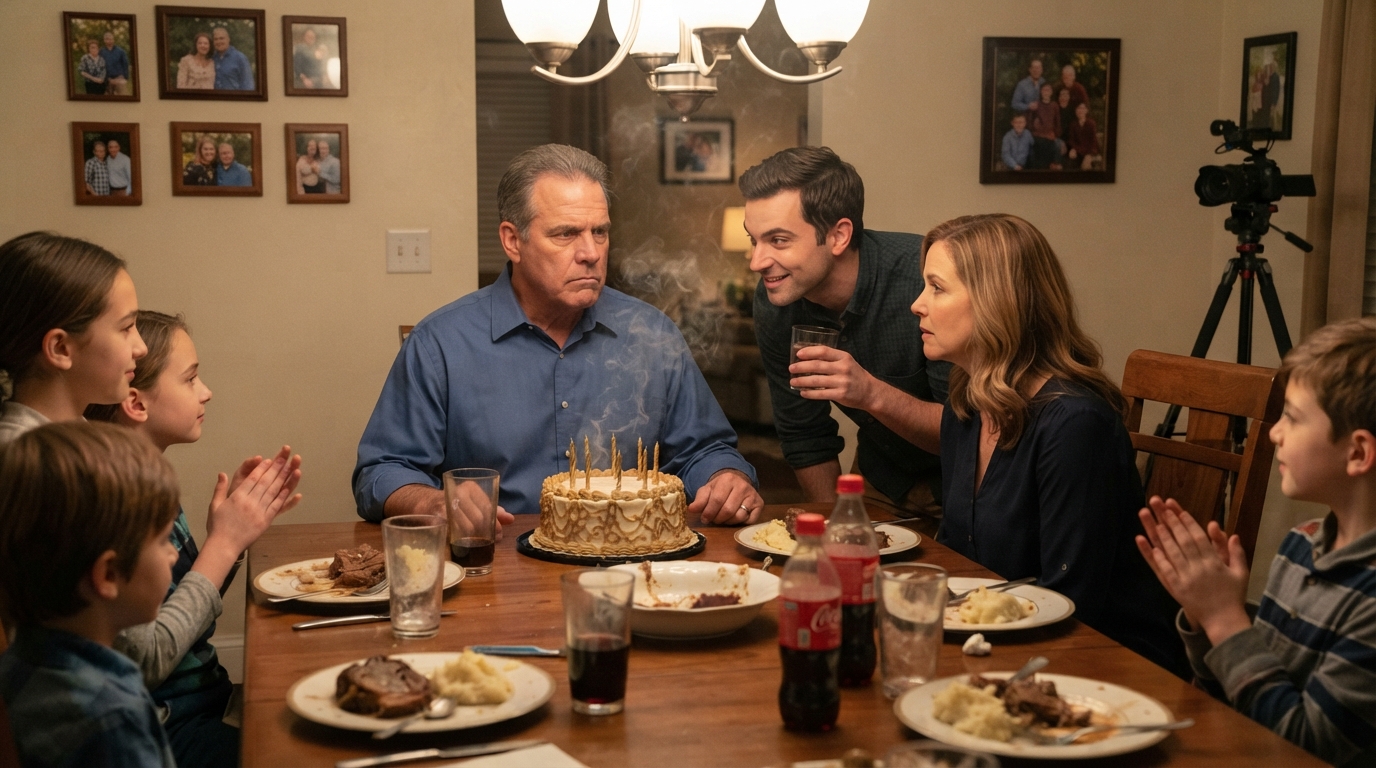
The Birthday Candle Went Dark, But My Son’s Quiet Words Kept Burning Long After Everyone Had Gone Home
Part 18 of 25

