
We took the note to Robert.
He examined it under magnification.
“The handwriting isn't Theresa's.”
“We know.”
“It's not Mercer's either.”
“Can you identify it?”
“Not yet.”
We compared it with every document from the case.
No match.
Then Daniel remembered something.
“There's another place.”
“What place?”
“Mercer's old office.”
“The investigators cleared it.”
“They cleared the main office.”
Daniel looked at me.
“There was a storage room behind the garage.”
Robert frowned.
“Why didn't you mention that before?”
“Because I forgot.”
That answer was enough to make us go quiet.
Daniel had spent years in that building.
He had seen the room.
He had simply never thought it mattered.
The investigators agreed to search it.
Inside were old filing cabinets.
Most were empty.
One was locked.
The key was found in a desk drawer.
Inside were folders arranged by year.
Daniel's name appeared repeatedly.
Not just during the gambling period.
Years earlier.
There were notes about his school.
His job.
His friends.
His debts.
His habits.
Someone had been monitoring him.
I felt anger rise.
“How long?”
Robert looked at the oldest file.
“Since he was nineteen.”
Daniel stared.
“That can't be right.”
The first note described a conversation Daniel had with Victor.
The next recorded a meeting with the old banker.
The third mentioned Theresa.
Someone had been feeding Mercer information.
Not enough to control Daniel.
Enough to make him predictable.
At the bottom of one folder was the same handwriting as the note.
Robert finally recognized it.
“Miriam.”
I stared.
“The banker's daughter?”
“No.”
He turned the page.
“Her father had a secretary.”
The secretary's name appeared in the margin.
Helen Ward.
She had worked for the banker for decades.
After his death, she had retained copies of his private correspondence.
We found her living in a neighboring state.
She agreed to speak.
Helen was ninety-two.
She remembered Theresa.
She remembered Victor.
And she remembered Mercer.
But when she heard Daniel's name, she closed her eyes.
“I was afraid you'd find me.”
“Why?”
“Because I helped start it.”
Daniel sat across from her.
“How?”
She looked at him.
“Your father asked me to watch you.”
Daniel went pale.
“My father?”
“Yes.”
“Why?”
“He knew you were angry.”
Helen explained that Daniel's father had discovered how easily young people could be manipulated by family secrets.
He feared someone would use Daniel.
So he asked Helen to watch from a distance.
She agreed.
At first, she only reported harmless information.
Where Daniel worked.
Who he trusted.
When he visited Victor.
But after Daniel's father died, Mercer obtained access to her reports.
He began paying her.
She continued sending information.
Not because she believed Mercer was right.
Because she was afraid of losing everything.
Daniel looked down.
“So you were the person behind the notes.”
“Yes.”
“Why did you write, ask the son?”
“Because Mercer wanted to know whether you would lead him to Theresa's records.”
“Did you know what he planned?”
“Not at first.”
“When did you know?”
Helen began crying.
“When he asked me where your father's papers were.”
Daniel's hands tightened.
“Did you tell him?”
“No.”
“Why?”
“Because your father had trusted me.”
It was the first clear line between protection and betrayal.
Helen had failed.
But at the final moment, she had refused to give Mercer the most important information.
She gave us something else instead.
A key.
“This belonged to your father.”
Daniel stared at it.
“What does it open?”
Helen shook her head.
“I never knew.”
Robert examined it.
The number matched a locker at the old train station.
We went there the next day.
The locker was still registered to the estate.
Inside was a single suitcase.
Daniel opened it.
There were photographs.
Letters.
And a journal.
His father's journal.
Daniel touched the cover.
“I've never seen this.”
The first pages described the original fraud.
The middle pages described Victor.
The final pages described Daniel.
His father had written about his fear that Daniel would inherit not the money but the anger.
One sentence stopped Daniel.
I cannot protect my son from every lie. I can only leave enough truth behind for him to find his way back.
Daniel closed the journal.
For a long time, he couldn't speak.
Then he whispered,
“He knew.”
“Yes.”
“He knew I'd mess up.”
“He knew you could.”
Daniel wiped his face.
“That's worse.”
“Why?”
“Because he believed I could come back.”
I put my hand on his shoulder.
“He was right.”
The journal contained one final instruction.
Give this to Daniel only if he chooses responsibility over inheritance.
We looked at one another.
The condition had been fulfilled.
Theresa's final letter.
The deed.
The trust.
The journal.
They had all been designed around the same idea.
Nobody could be forced to become better.
They could only be given the opportunity.
Daniel looked at me.
“I wish they had trusted me sooner.”
“They did.”
He shook his head.
“They hid everything.”
“They trusted your future more than your judgment.”
He considered that.
“That sounds cruel.”
“It probably was.”
Then he smiled faintly.
“But it worked.”
We returned home with the journal.
That night, Daniel sat at the kitchen table reading every page.
He didn't ask me to join him.
I didn't.
Some things belonged to him.
The next morning, he handed it back.
“I want you to keep it.”
“Why?”
“Because it's part of the family history.”
“It belongs to you.”
“I have copies.”
I placed it beside Theresa's letters.
Father.
Mother.
Son.
Three lives connected by choices that had taken decades to understand.
Daniel stood.
“I want to change something.”
“What?”
“The compensation fund.”
“How?”
“I want to add my own money.”
I looked at him.
“How much?”
“Everything I can reasonably afford.”
“You don't need to punish yourself forever.”
“I'm not.”
He shook his head.
“I want to contribute because I finally understand what the money means.”
I nodded.
“That is different.”
“Yes.”
He smiled.
“That's what I'm learning.”
Months passed.
The fund grew.
The farmhouse remained open to the family.
The house remained mine.
Daniel continued repairing it.
The roses survived his pruning.
Barely.
One spring morning, he planted a new tree beside the porch.
“What kind?”
“Maple.”
“Why?”
“My grandfather planted one near the old house.”
I looked at him.
“You remember?”
“No.”
He laughed.
“I read it in the journal.”
We stood beneath the young tree.
It was thin enough to bend in the wind.
But it stood.
Daniel touched the trunk.
“Do you think I'll ever stop feeling guilty?”
“No.”
He looked at me.
“That isn't what you expected.”
“No.”
“You shouldn't stop feeling responsible.”
He nodded.
“But guilt?”
“Guilt is useful only when it teaches you something.”
He smiled.
“Mom would say that.”
“She probably would.”
The family slowly became ordinary again.
That was the greatest victory.
No more secret meetings.
No more hidden accounts.
No more envelopes waiting behind walls.
No more fear every time someone knocked.
The legal files were archived.
The trust was secure.
The fraudulent actors had been held accountable.
The compensation fund continued.
The house remained protected.
And Daniel kept showing up.
Not because anyone required him to.
Because he wanted to.
Years later, I would still keep the photograph of Theresa and Mercer.
Not because it proved betrayal.
Because it reminded me that people are rarely one thing.
Theresa had trusted someone dangerous.
Mercer had once helped her before exploiting what she had shown him.
Martin had remained silent, then told the truth.
Jonathan had betrayed the family, then helped repair the damage.
Daniel had made terrible choices, then spent years accepting their consequences.
None of those truths canceled the others.
They simply belonged together.
One afternoon, Daniel came by with a box.
“What now?”
He opened it.
Inside were the old tools.
Theresa's hammer.
Her shears.
The measuring tape.
The same toolbox he had brought me years earlier.
“I thought these should stay here.”
“Why?”
“Because this is where the work happened.”
I smiled.
“You could keep them.”
“I have my own.”
He placed the toolbox beneath the porch.
“Then they'll stay here.”
I looked toward the house.
The repaired step.
The new tree.
The roses.
The garden.
Nothing looked like the place where our family had nearly torn itself apart.
But I knew better.
A home doesn't become safe because its walls are clean.
It becomes safe because the people inside stop hiding from one another.
That evening, Daniel and I sat on the porch.
The sun went down behind the trees.
He handed me a cup of coffee.
“Still terrible,” I said.
“You taught me.”
“I taught you nothing about coffee.”
“Then it's hereditary.”
I laughed.
For a while, we sat without speaking.
Then Daniel said,
“I used to think inheritance was what you received when someone died.”
I looked at him.
“What do you think now?”
He watched the young maple move in the wind.
“I think inheritance is what you choose not to destroy.”
I looked toward Theresa's garden.
That was the closest thing to an answer I had ever needed.
The house remained standing.
The trust remained protected.
The people who had been wronged were remembered.
The money was no longer a weapon.
And the son I had once feared losing had learned that returning home did not mean escaping the consequences.
It meant accepting them.
That was not the ending Theresa had written for us.
It was the ending she had left room for us to choose.
Click here to continue reading: PART 21: The Years That Followed Did Not Erase What Happened, but They Revealed Whether Daniel’s Promises Could Survive Ordinary Life
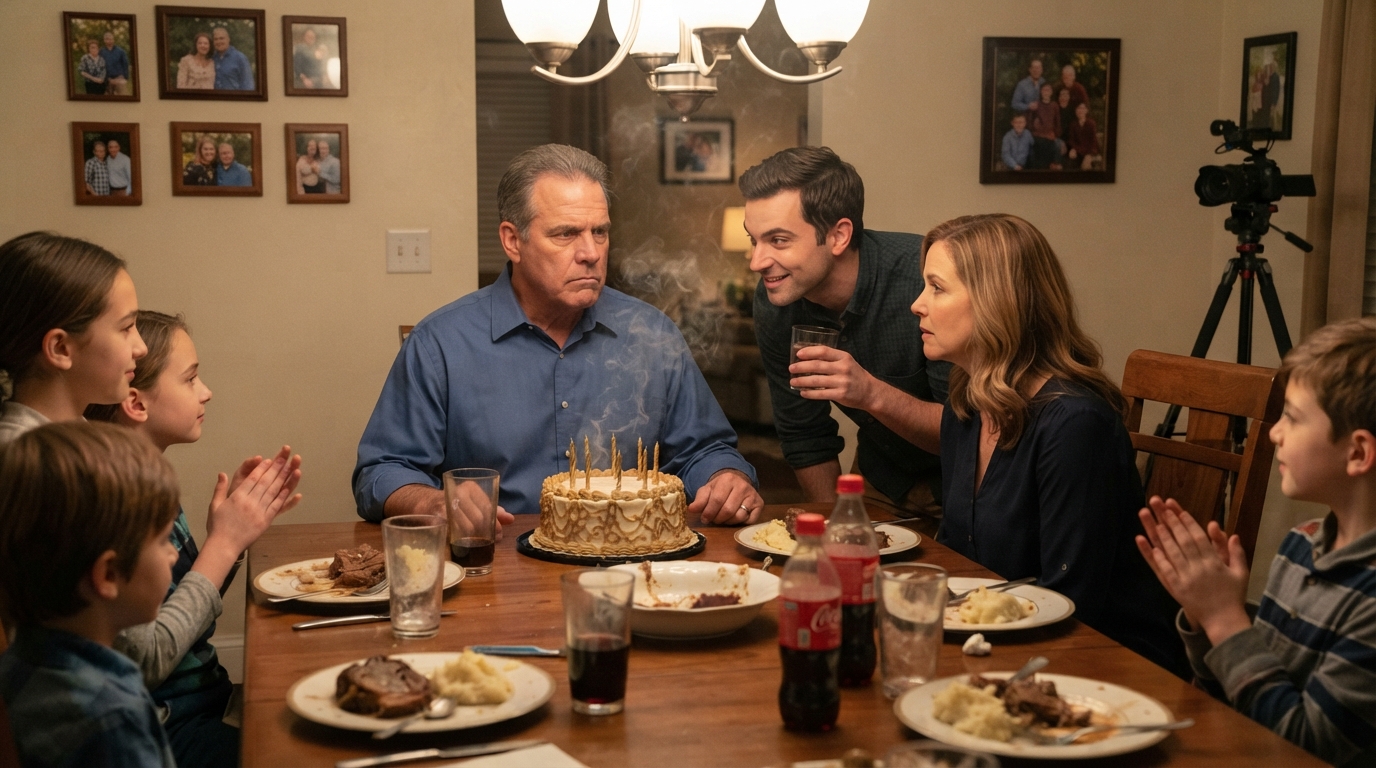
The Birthday Candle Went Dark, But My Son’s Quiet Words Kept Burning Long After Everyone Had Gone Home
Part 20 of 25

