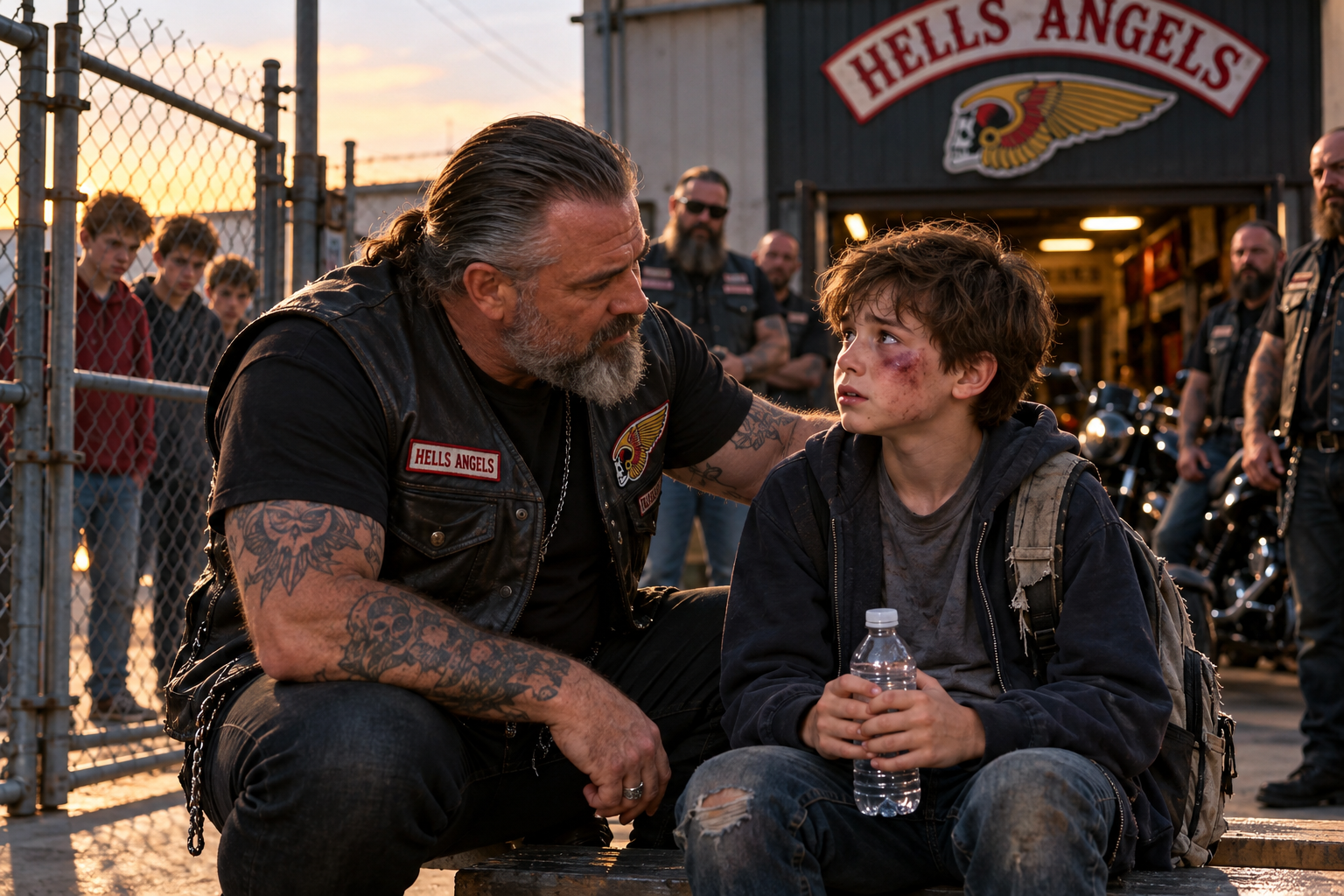
By late afternoon, the sunlight had shifted across the concrete.
The clubhouse had grown quieter.
Some of the men were still working on their motorcycles, but the usual joking had stopped.
Noah remained in the same chair.
He had finished one bottle of water and opened the second.
His backpack sat beside him.
Every so often, he checked his phone.
His mother still hadn't called back.
I sat across from him with the paper on which I'd written his school and street names.
"Let's go through what happened today, one step at a time."
He nodded.
I asked when the teenagers first approached him.
"After school."
"Where?"
"Near the corner by the bus stop."
"Did they hit you there?"
He rubbed his cheek.
"One of them shoved me."
"Then what?"
"They told me to give them my money."
I waited.
"I didn't have any."
He explained that he had stopped bringing much cash to school because the boys kept taking it.
That afternoon, they had demanded his lunch money anyway.
When he couldn't give them what they wanted, one grabbed his backpack.
Another shoved him against a wall.
Noah tried to pull away.
That's when his cheek struck the brickwork.
He told me the oldest boy had laughed.
Then they started chasing him.
I asked whether he had called for help.
He nodded.
"Some people looked."
"Did anybody stop?"
He shook his head.
I could imagine it.
A child running down a street.
Three older boys behind him.
Adults glancing over, deciding it was probably a schoolyard dispute, and returning to whatever they had been doing.
Maybe they thought the boys were friends.
Maybe they didn't want to get involved.
Maybe they assumed somebody else would step in.
There were plenty of possible explanations.
None of them changed what had happened to Noah.
"How did you know where to go?" I asked.
He glanced toward the clubhouse.
"I knew this building."
"From where?"
"I've seen the motorcycles."
He hesitated.
"My stepdad says people shouldn't come here."
I raised an eyebrow.
"What did he say about us?"
Noah looked embarrassed.
"He said we were trouble."
I almost smiled.
"Well, today you came here anyway."
He nodded.
"I didn't know where else to go."
I let that answer sit between us.
The boy had chosen a place his stepfather had warned him to avoid because every other place he could think of had failed him.
I couldn't stop thinking about that.
We had spent years watching people cross the street to avoid us.
Now a frightened child had crossed into our yard because he believed we might be the only people who would refuse to hand him back to his pursuers.
That said something about Noah.
It also said something about the adults who had made him feel he had no other option.
I asked whether his stepfather knew about the bullying.
"He knows some of it."
"How long has it been going on?"
"A few months."
I stopped writing.
"A few months?"
Noah nodded.
He said the first incidents had seemed small.
A shove in the hallway.
A joke about his clothes.
A demand for a few dollars.
Then the boys began taking things from his bag.
They hid his homework.
They knocked books out of his hands.
Sometimes they waited near his classroom.
He tried ignoring them.
He tried walking away.
He tried changing the route he took home.
Nothing worked for long.
Eventually, he told an adult at school.
I asked what happened after that.
"The school talked to them."
"And then?"
"They found out I told."
He stared at the bottle in his hands.
"The oldest one said he knew who my stepdad worked with."
That caught my attention.
I asked him to explain.
Noah said the teenager had mentioned his father's workplace and made it clear that the adults knew one another.
At first, Noah hadn't understood why that mattered.
Then his stepfather started asking questions.
Who had Noah spoken to?
What had he told the school?
Why had he made the situation bigger?
The questions had not sounded like concern.
They had sounded like accusations.
"Did your stepdad ever ask if you were hurt?" I asked.
Noah didn't answer right away.
"Not really."
He picked at the edge of the bottle label.
"He said I needed to stop getting involved in other people's business."
I felt my jaw tighten.
"What did your mother say?"
"She told him to calm down."
"Did she talk to you afterward?"
He nodded.
"She asked what happened."
"Did you tell her?"
"Some of it."
"Why only some?"
He looked toward the gate.
"I didn't want them fighting."
I understood what he meant.
Children often tried to manage the emotions of the adults around them.
They learned which subjects caused arguments.
They learned when to stay quiet.
They learned how to make a painful truth sound smaller so nobody would become angry.
Noah had been doing that for months.
He had been trying to survive the bullying while protecting his family from the consequences of knowing about it.
That was too much responsibility for a twelve-year-old.
I put the pen down.
"Noah, you aren't responsible for making the adults get along."
He stared at me.
"You didn't cause this by telling somebody what happened."
He didn't speak.
I could see he wanted to believe me.
But wanting to believe something and trusting it were different things.
I asked whether he was afraid of going home.
He nodded.
"Because of your stepdad?"
"Because he'll say I made everything worse."
"Has he hurt you?"
Noah's fingers tightened around the bottle.
For a moment, I thought he might get up and leave.
Then he shook his head.
"Not like those boys."
I didn't press him to say more.
The distinction mattered.
He had answered the question he was willing to answer.
I wasn't going to force him to give me details he wasn't ready to share.
Instead, I asked whether his mother knew he had run away from the teenagers.
"No."
"Do you think she knows where you are?"
He shook his head again.
I told him we'd keep trying to reach her.
I also explained that because he was injured and frightened, we needed help from the proper people to make sure he was safe.
He looked uneasy.
"Are they going to take me away?"
"I don't know what they'll decide. But we're going to tell them what happened and ask them to help."
He looked down at his shoes.
"I don't want to get anybody in trouble."
I felt something heavy settle in my chest.
The boy had been robbed, threatened, shoved into walls, and chased through town.
Yet he was worried about the consequences for everybody else.
"Getting help isn't the same as trying to hurt somebody," I told him.
He didn't respond.
But he stopped twisting the bottle cap.
A little later, one of the members brought him something to eat.
A sandwich.
Nothing special.
No grand gesture.
No speech about how everything would be fine.
Just food placed on the table in front of a hungry child.
Noah looked at it for several seconds.
Then he whispered, "Thank you."
He ate slowly.
I noticed that he kept one hand on his backpack while he ate, as if somebody might take it if he let go.
The torn strap had left a pale mark across his sweatshirt.
I wondered how many times he'd been forced to carry his belongings home while somebody laughed behind him.
I wondered how many mornings he'd woken up already afraid of the day ahead.
And I wondered how many adults had seen enough to suspect something was wrong without ever asking him directly.
Looking back, I think that was the part that bothered me most.
The bullying had not remained a secret because nobody could see it.
It had remained a secret because people had found ways to explain it away.
A child was quiet, so he was probably shy.
A child was angry, so he was probably difficult.
A child complained, so he was probably exaggerating.
A child ran, so he was probably guilty.
Every explanation made it easier to look away.
Noah finished half the sandwich and wrapped the rest.
"Can I save this?"
"Of course."
He put it in his backpack.
Then he asked whether he could use the restroom.
I showed him where it was.
When he returned, he seemed a little less tense.
He sat down and asked me something I hadn't expected.
"Why did you believe me?"
I leaned back.
"What makes you think I did?"
"You didn't send me outside."
I looked at the closed gate.
"No."
"You didn't tell me to apologize."
"No."
He nodded, as if he were putting those answers somewhere safe in his mind.
I took a moment before responding.
"I don't know everything that happened yet. But I can see you're hurt, and I can see you're scared. That's enough reason to listen."
He looked at the ground.
"I wish somebody at home did that."
I had no answer that could make those words less painful.
So I didn't pretend I had one.
I stayed with him.
As the afternoon moved toward evening, we tried his mother's number again.
This time, the call rang longer before going to voicemail.
Noah left a short message.
He said he was safe.
He said he needed her to call back.
He didn't mention the clubhouse.
He didn't mention Grant.
He simply asked her to contact him.
Afterward, he sat quietly.
The men around him had returned to their tasks, but I noticed that nobody had forgotten he was there.
One kept an eye on the entrance.
Another checked the street whenever a vehicle slowed near the property.
Nobody made Noah feel like a burden.
That mattered.
Children notice when adults are waiting for them to leave.
They notice the sighs, the impatient glances, and the way conversations stop when they enter a room.
Noah had probably noticed all of those things at home.
We weren't going to add them to the list.
Then his phone vibrated.
He grabbed it so quickly that he nearly knocked over the bottle.
He looked at the screen.
His face fell.
It wasn't his mother.
It was a message from an unknown number.
He read it once.
Then he read it again.
I asked whether he wanted to tell me what it said.
He held the phone out.
The message was short.
It asked where he was and told him to stop making trouble.
There was no name attached.
Noah's hands began to shake.
"Is that one of them?" I asked.
He nodded.
"Which one?"
"The oldest."
I looked at the screen.
"Does he know you're here?"
"I don't know."
"Did you tell him?"
"No."
Noah stared at the message as if the words themselves might reach through the phone and grab him.
I asked whether the teenager had contacted him like this before.
"Sometimes."
"What does he usually say?"
Noah swallowed.
"That nobody's going to believe me."
I handed the phone back.
"Save the message. Don't answer it right now."
He nodded.
I made a note of the time and what he had shown me.
I didn't know whether the message would prove important later.
But I knew it was better to preserve what had happened than to rely on anyone's memory.
Noah slipped the phone into his pocket.
For several minutes, he didn't speak.
Then he asked whether he could stay until his mother called.
"Yes."
He looked toward the gate again.
"And if my stepdad comes?"
I glanced at the closed entrance.
"We'll deal with that carefully."
He nodded.
He seemed to accept the answer, though I could tell it wasn't enough to make him feel safe.
I understood why.
The first adult who had come looking for him wasn't his mother.
It was the father of the boy he accused of hurting him.
That was not a small detail.
It changed the situation.
It meant that the family connection Noah had described wasn't simply something he feared.
It was already shaping the way people were responding to him.
And if Grant was willing to come to our gate and demand that we hand Noah over, I needed to know what he had been told, what he believed, and why he was so determined to silence the boy.
I also needed to make sure Noah wasn't left alone with the consequences.
I picked up my phone again.
This time, I began making the calls necessary to get the situation properly documented and to find someone who could assess Noah's immediate safety.
He watched me work.
I could see that he was still afraid.
But he no longer looked as though he expected us to turn him away.
That was a beginning.
Not a solution.
A beginning.
And it was more than he had believed he would find when he ran through our gate.
Click here to continue reading: PART 4: The Message on Noah’s Phone Forced Us to Face a Question Nobody Could Answer by Looking Away
The Twelve-Year-Old Who Ran Into the One Place Everyone in Town Was Afraid to Enter
Part 3 of 20