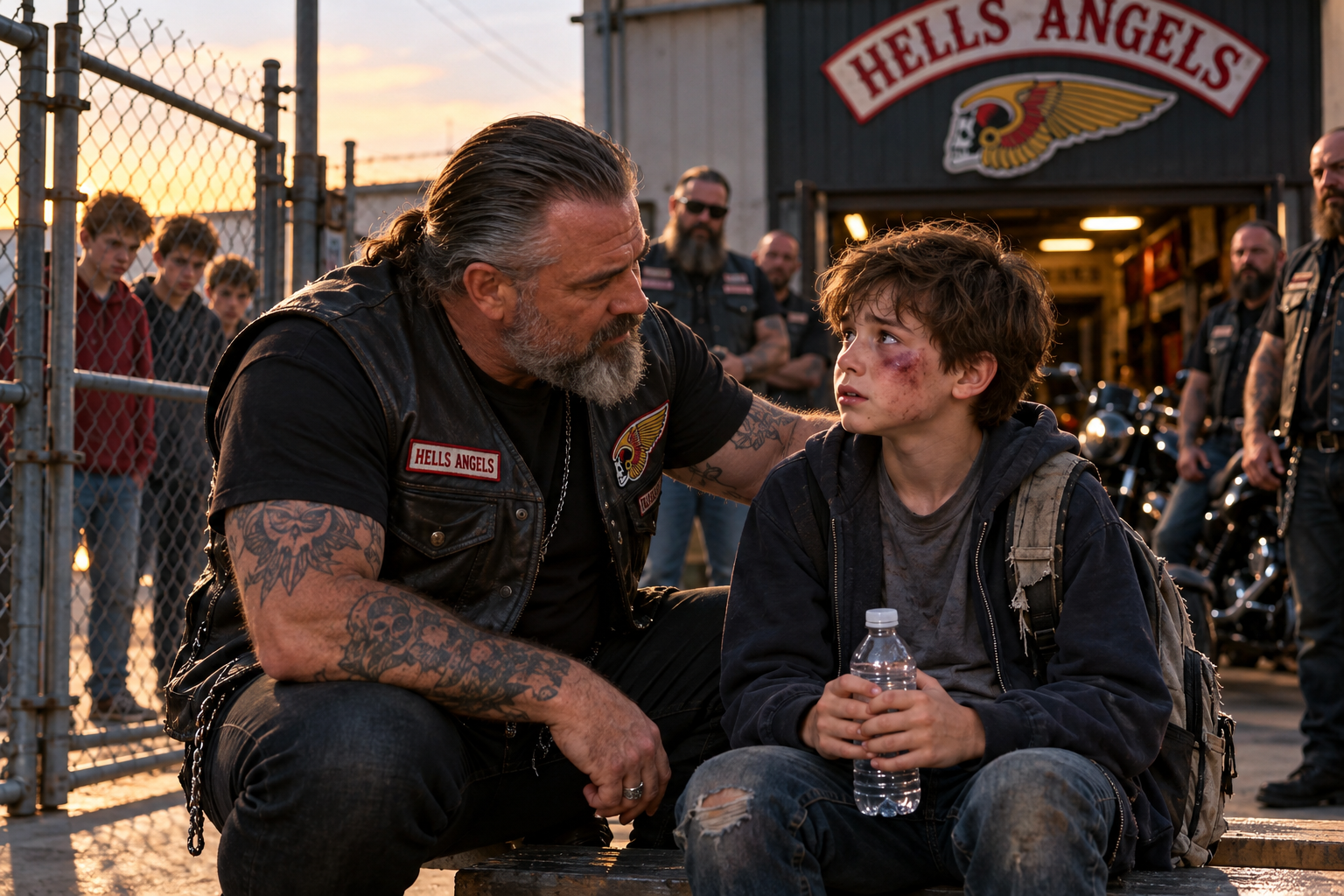
The first time Noah told me he was having a good week, he said it like he was testing the words.
We were sitting at the table on a Thursday afternoon.
He had finished his homework and was watching one of the guys polish a chrome cover.
“How was school?” I asked.
“Good.”
He looked at me.
“Actually good.”
I smiled.
“What made it good?”
“We had a group project in science. I got to choose my partner.”
“Who did you choose?”
“A kid named Marcus.”
“Is he a friend?”
“Sort of.”
“What does sort of mean?”
“It means we talk in class, but we don't hang out much.”
“That sounds like the beginning of a friendship.”
“Maybe.”
He watched the man polishing the chrome.
“Marcus asked if I wanted to work with him again next time.”
“And?”
“I said yes.”
He looked pleased with himself.
Then he added, “He doesn't know all the stuff that happened.”
“Does he need to?”
Noah thought about it.
“I don't think so.”
“Then you don't have to tell him.”
He nodded.
For a long time, Noah had believed that everyone needed to know his story before they could understand him.
Now he was learning that he could share what he wanted, when he wanted.
He could be the boy who had been bullied.
He could also be the boy who liked science, hated fractions, and made jokes about old motorcycles.
One part of his life did not have to swallow all the others.
The school counselor called his mother that evening.
She said Noah had been participating more in class and seemed less anxious about moving between rooms.
There had been no new reports involving the three boys.
The counselor wanted to keep the support plan in place while things settled.
His mother agreed.
She told me about the call the next day.
“I was relieved,” she said. “Then I caught myself thinking that maybe I should stop asking questions.”
“Why?”
“Because I don't want to keep dragging him back into it.”
“You can ask how he's doing without asking him to recount every bad thing that happened.”
She nodded.
“I need to learn the difference.”
“You're learning.”
She gave me a doubtful look.
“Some days I feel like I've made every possible mistake.”
“You're not going to fix everything in a week.”
“I know.”
“Do you?”
She laughed softly.
“I'm trying.”
I believed her.
That weekend, Noah's mother asked whether he wanted to visit a relative for lunch.
It was a family gathering that Grant's family would also attend.
She made it clear that Noah could say no.
He thought about it for two days.
Then he decided he didn't want to go.
His mother accepted the answer.
Her husband was unhappy.
He said Noah was letting the situation divide the family.
She told him that attending one lunch would not prove that the family was united, and refusing to attend would not make Noah responsible for its problems.
The argument was uncomfortable.
Noah heard some of it from the hallway.
This time, he didn't walk into the room to apologize for causing it.
He went to his bedroom.
Later, his mother came to see him.
“I'm sorry you heard that,” she said.
“Are you mad at me?”
“No.”
“Is he?”
“He's upset. But you are not responsible for making every adult happy.”
Noah looked at the wall.
“I don't want everybody to hate each other.”
“Neither do I.”
“What if they do?”
“Then the adults will have to work that out. You don't have to fix it for us.”
He was quiet.
Then he asked whether they could order pizza.
She laughed.
“Yes. We can order pizza.”
They ate in the living room that evening.
His mother let him choose the movie.
He chose an old comedy that neither of them had seen.
Halfway through, he laughed so hard he nearly spilled his drink.
She caught the cup.
He apologized automatically.
Then he stopped himself.
She looked at him.
“It's all right,” she said.
He nodded and returned to the movie.
The moment passed.
Nobody made it into a lesson.
That was how some healing happened.
Not through a speech.
Through ordinary moments that ended without punishment.
On Monday, Noah came to the clubhouse after school.
He was carrying a small paper envelope.
“What's that?” I asked.
“Something for you.”
He slid it across the table.
Inside was a photograph.
It showed the workbench where he had helped sort the bolts.
One of the guys had taken it on his phone and printed it for him.
Noah had written on the back.
*Thanks for letting me help.**
I looked at him.
“You didn't have to give me this.”
“I wanted to.”
I turned the photograph over again.
The bench was clean.
The containers were lined up.
A rag hung over the edge.
Nothing in the picture looked special.
That was what made it matter.
It showed a day when Noah had been allowed to contribute instead of being treated like a problem somebody needed to manage.
“I'm keeping this,” I told him.
“Good.”
He sat down.
“Can I ask you something?”
“You can.”
“Do you think people can change?”
I leaned back.
“Some do.”
“How do you know?”
“You watch what they do when nobody is praising them. You watch what they do when they don't get what they want. You watch whether they keep respecting a boundary after the attention moves somewhere else.”
He considered that.
“Like Grant?”
“Like anybody.”
“Do you think he changed?”
“I think he has started to understand some things. Whether that lasts is up to him.”
Noah nodded.
“And his son?”
“The same.”
He looked at the photograph.
“I don't hate him.”
“You don't have to hate somebody to decide you don't want to be around him.”
“I know.”
He was quiet for a while.
“I think I want to stop thinking about him all the time.”
“That sounds reasonable.”
“How do I do that?”
I considered my answer.
“You keep doing the things you care about. You spend time with people who treat you well. When something reminds you of what happened, you deal with it. But you don't have to make that boy the center of every day.”
Noah nodded.
“I'm going to work on my science project.”
“That's a good start.”
He opened his backpack and pulled out a folder.
The strap stayed in place.
He didn't check it.
He spread his papers across the table and began explaining a project about soil and water.
I listened while he described the experiment he wanted to conduct.
He had made a list of materials.
He had drawn a rough diagram.
He had even written down what he thought might go wrong.
“What happens if your results don't match what you expect?” I asked.
“I change the experiment.”
“Or?”
“Check whether I made a mistake.”
“Good.”
He grinned.
“Or blame the soil.”
“That would be a very scientific approach.”
He laughed.
We spent the next half hour discussing containers, drainage, and how to measure the water without making a mess.
At one point, he stopped and looked at me.
“What?”
“Nothing.”
“You keep doing that.”
“Doing what?”
“Looking like you're thinking about something.”
“I think about things.”
“Like what?”
I could have told him that I was thinking about the day he first ran through our gate.
About the way he had looked at every man in the room as if he expected us to throw him out.
About the fact that he had learned to ask for a sandwich without apologizing.
Instead, I said, “I was thinking that your project sounds good.”
He narrowed his eyes.
“You're not telling me something.”
“I'm telling you your project sounds good.”
He studied me for a moment.
Then he accepted the answer.
That was another thing I had learned from Noah.
Not every silence needed to be filled.
Sometimes people could be allowed to keep a thought to themselves.
His mother arrived just before sunset.
Noah packed his folder carefully and put it into his backpack.
She asked whether he was ready to go.
“Yeah.”
He stood, swung the bag over his shoulder, and walked toward the gate beside her.
Halfway there, he turned around.
“I'm coming back Wednesday.”
“If you want to,” I called.
“I do.”
Then he left.
I watched them reach the car.
His mother opened the door for him.
He climbed in, then leaned across to say something that made her laugh.
The car pulled away.
I went back inside and placed the photograph in my desk drawer.
I didn't put it away because I wanted to forget what had happened.
I kept it because I wanted to remember what had come afterward.
Noah had not become fearless.
He still had difficult days.
He still worried about what other people thought.
He still needed adults to listen when he said something was wrong.
But he was beginning to understand that his life belonged to him.
He could choose his friends.
He could ask for help.
He could decline a family gathering.
He could accept an apology without pretending the past had disappeared.
And he could laugh about a motorcycle without wondering whether someone would use the moment against him.
That was not a perfect ending.
It was a life opening back up.
For a boy who had once run through our gate because he believed he had nowhere else to go, I thought that was worth protecting.
*END PART 16**
Click here to continue reading: PART 17: The Morning Noah Came Back With Good News
The Twelve-Year-Old Who Ran Into the One Place Everyone in Town Was Afraid to Enter
Part 16 of 20