By the middle of the month, Noah had started talking about things that had nothing to do with school.
He told us about a science project.
He complained about a substitute teacher.
He wanted to know whether the motorcycles were faster than the cars he saw on the highway.
When one of the guys explained that speed depended on the machine, the rider, and the conditions, Noah asked whether that meant the guy's old motorcycle was slow because he was old.
The room erupted.
The man pointed a wrench at him.
“Careful, kid.”
Noah ducked behind his chair, laughing.
I hadn't seen him laugh like that when he first arrived.
Back then, every joke seemed to carry a risk.
He had been afraid that people would turn his words against him.
Now he was making jokes of his own.
That afternoon, he asked if he could stay for another hour.
His mother had given permission, but she would be working late and had arranged for another trusted adult to pick him up.
He wanted to help clean the workbench.
I told him he could help as long as he followed the safety rules.
He put on the protective glasses we gave him.
They were too large, and he kept pushing them up his nose.
One of the men found a better-fitting pair.
Noah thanked him and got to work.
He sorted bolts into containers.
He wiped the bench.
He swept the floor beneath it.
He took the job seriously, even when nobody was watching.
At one point, he dropped a container and sent bolts rolling across the concrete.
He froze.
I saw it happen.
His shoulders rose.
His hands stopped moving.
For one second, he looked like he expected somebody to shout.
Nobody did.
One of the guys grabbed a small broom.
Another got down on one knee and began gathering the bolts.
I picked up the container.
“Looks like we found a way to make the job take longer.”
Noah blinked.
Then he crouched and started helping.
“Sorry.”
“It's a container of bolts, not a priceless antique.”
He gave a small laugh.
We finished cleaning together.
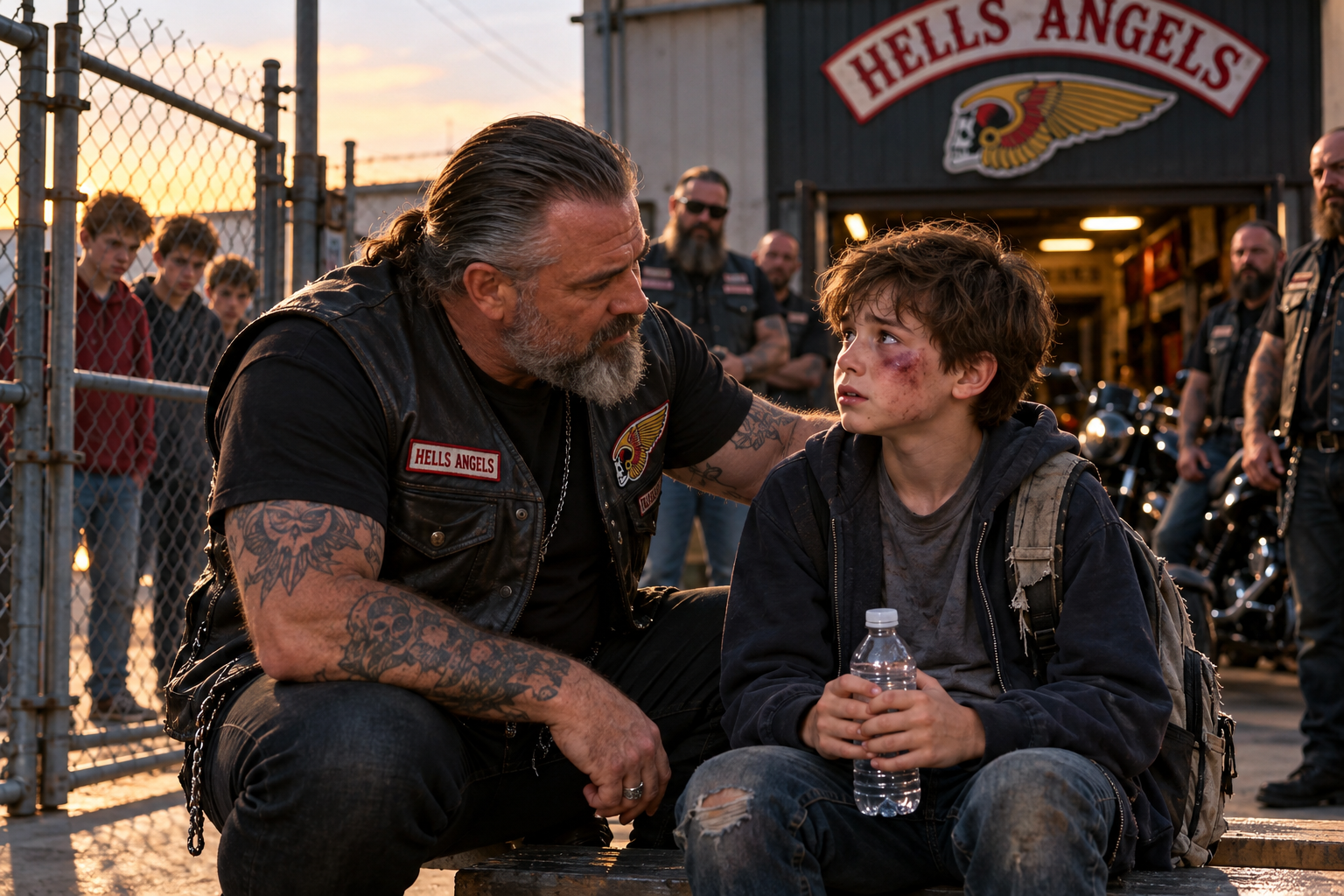
Later, he sat beside me with a bottle of water.
“Can I tell you something?”
“Of course.”
“I used to hate dropping things.”
“Why?”
“Because at home, if I spilled something or broke something, everybody got mad.”
I listened.
“Sometimes I would try to clean it up before anybody saw. Sometimes I'd hide the broken thing.”
“That sounds exhausting.”
He nodded.
“I thought if I could just do everything right, people wouldn't get mad at me.”
I looked at him.
“Did it work?”
“No.”
He answered so quickly that I almost smiled.
Instead, I said, “You can try to be careful. That's sensible. But nobody gets everything right.”
He looked down at his hands.
“Do people get mad here?”
“Sometimes.”
His face changed slightly.
I wanted him to understand the difference.
“People can get annoyed when something goes wrong. That doesn't mean they get to frighten you or make you feel worthless. If somebody here treats you badly, you can tell me.”
“Would you believe me?”
“Yes.”
He held my gaze for a moment.
Then he nodded.
I didn't promise that every disagreement would be pleasant.
I promised that he could speak.
That was the more important thing.
The following day, his mother called to say the school had gone several days without another incident.
No messages.
No comments.
No reports of the boys following him.
“Do you think it's over?” she asked.
“I think things are quieter.”
“That's not quite an answer.”
“No,” I said. “It isn't.”
She sighed.
“I keep wanting somebody to tell me we can stop worrying.”
“I understand.”
“I'm tired of checking his phone and asking how school went.”
“Then maybe you can ask him what kind of check-in helps him and what kind feels like too much.”
She was quiet.
“I hadn't thought of that.”
“He needs to know you're paying attention. He also needs room to be a boy.”
“I don't always know how to give him both.”
“You can ask him.”
That evening, she did.
Noah was at the clubhouse when she brought it up.
They sat at the table together.
“I want to make sure I help without making you feel like I'm watching you every second,” she told him. “Would you rather I ask about school when you get home, or would you rather tell me when you're ready?”
Noah thought about it.
“Can you ask me if I want to talk?”
“Yes.”
“And if I say no, can you let me eat first?”
She smiled.
“Yes.”
“And can you not ask me the same question three times?”
She glanced at me.
I looked away.
“I can try,” she said.
Noah seemed satisfied.
“Okay.”
He opened his lunch bag.
That conversation probably mattered more than a dozen speeches about safety.
She had asked him what he needed.
He had answered.
And she had listened.
A few days later, Grant came to the clubhouse again.
I was outside when he approached the gate.
He looked uncomfortable, but he wasn't angry.
“Can we talk?”
“Go ahead.”
“My son has been following the school's rules.”
“Good.”
“He says Noah won't speak to him.”
“Has Noah been asked to?”
Grant rubbed his chin.
“No.”
“Then there's no problem to solve there.”
He looked at the ground.
“I keep thinking that if they could just talk it out, things might go back to normal.”
“Normal for whom?”
He looked up.
I let the question sit.
“My son says he wants to apologize properly,” he said.
“He already apologized.”
“He says he wants Noah to understand that he means it.”
“Has he shown that by leaving him alone?”
Grant hesitated.
“Yes.”
“Then let that be the apology for now.”
He frowned.
“I don't understand.”
“Your son wants Noah to know he's sorry. Noah wants space. If your son respects that space, he's doing something useful.”
Grant was quiet for a long time.
Finally, he nodded.
“I suppose that's fair.”
“It is.”
He looked toward the road.
“I didn't handle any of this well.”
“No.”
He gave a short, uncomfortable laugh.
“You could have made that sound nicer.”
“I could have.”
He waited for me to soften the answer.
I didn't.
After a moment, he nodded again.
“I was worried about my son getting a reputation.”
“And?”
“And I forgot that another kid was already living with one.”
I looked at him carefully.
It was the closest he had come to understanding the harm.
I didn't tell him that everything was forgiven.
I didn't tell him he was a good man.
I said, “Then don't forget it again.”
He accepted that.
Before he left, he asked whether Noah was there.
“He's inside.”
“Should I say hello?”
“No.”
Grant looked surprised.
“Why not?”
“Because you came here to talk to me. Noah didn't agree to meet with you.”
He considered that, then stepped back from the gate.
“All right.”
He left without pushing.
When Noah came outside a few minutes later, I told him Grant had visited.
“Did he ask to see me?”
“Yes.”
“Did you make him leave?”
“I told him you hadn't agreed to meet.”
Noah thought about it.
“Thank you.”
“You don't have to thank me for respecting your choice.”
He nodded.
“I know.”
Then he added, “But I wanted to.”
That answer stayed with me.
The boy was beginning to understand that gratitude could be a choice rather than a debt.
Later, he asked if he could take the repaired backpack home and leave it there instead of bringing it every time he visited.
“Of course,” I said.
He ran his hand over the strap.
“I think it's strong enough now.”
“So do I.”
He placed it on his shoulders.
The stitching was still visible.
It wasn't pretty.
It didn't need to be.
The strap had been torn, then repaired, and it was holding.
I thought there was something honest about that.
Not everything had to look untouched to be useful again.
Click here to continue reading: PART 16: What Noah Chose to Remember
The Twelve-Year-Old Who Ran Into the One Place Everyone in Town Was Afraid to Enter
Part 15 of 20