I didn't sleep well that night.
Not because I expected trouble at the clubhouse.
I had spent enough years around difficult people to know that worry rarely improved a situation.
I slept badly because I kept thinking about Noah's question.
What if they said he was lying?
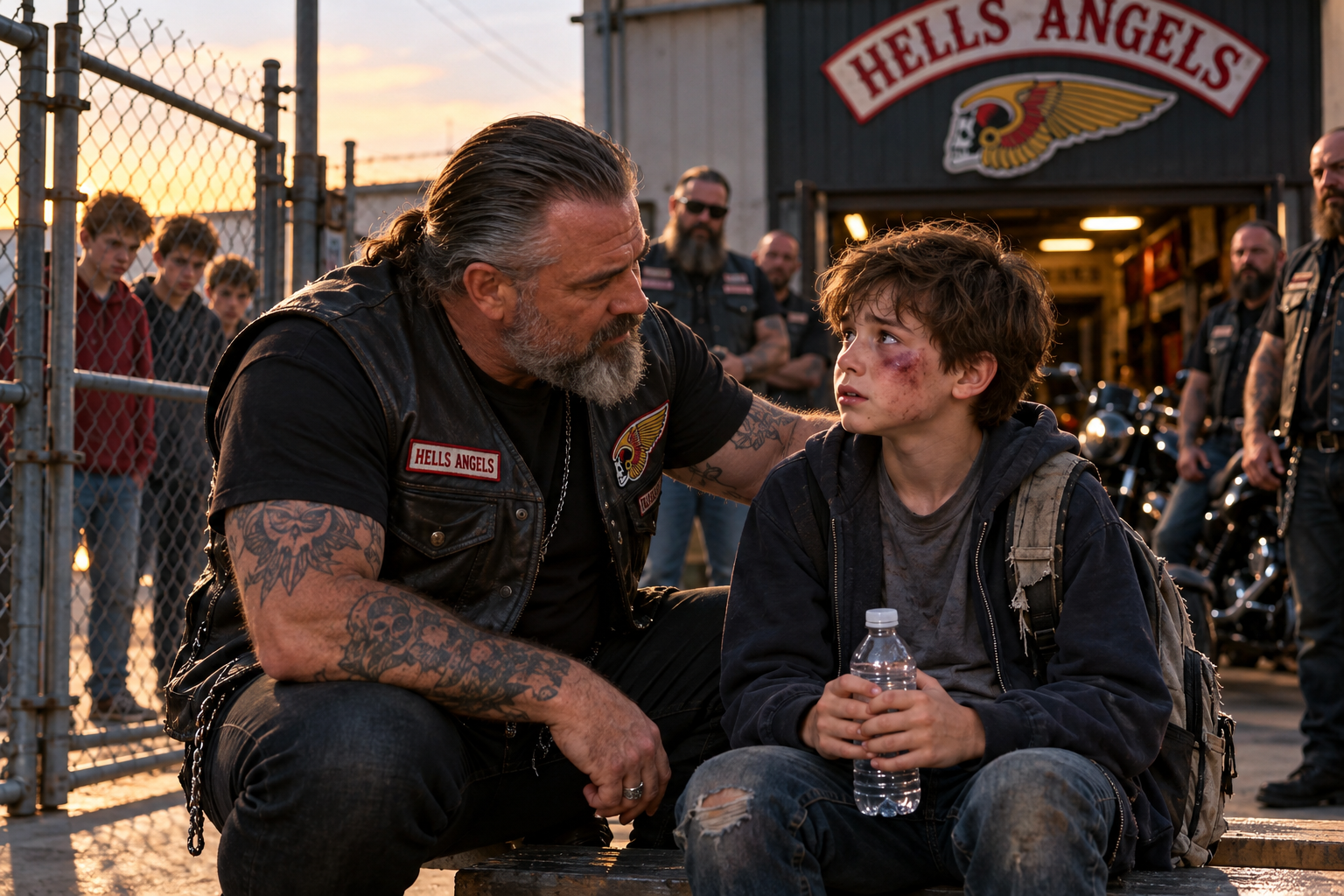
He had asked it quietly, sitting in a chair with a bottle of water between his hands.
He hadn't asked whether the boys would be punished.
He hadn't asked whether his stepfather would apologize.
He had asked whether anybody would believe him.
That was the question underneath everything.
The next morning, I arrived at the clubhouse earlier than usual.
The yard was still quiet.
A thin layer of dust covered the concrete, and the motorcycles stood where we'd left them.
I checked the entrance before going inside.
Nothing looked unusual.
No pickup truck.
No teenagers waiting outside.
No note tucked beneath the gate.
For a moment, I felt relieved.
Then I remembered that the absence of trouble didn't mean the trouble had ended.
It only meant nobody was standing in front of us at that particular moment.
I went inside and checked my phone.
There had been no message from Noah's mother.
I had also received no useful response from the calls we'd made the previous afternoon.
The situation needed proper follow-up, not assumptions.
So I continued working to reach the people who could help assess the boy's safety and determine what should happen next.
I wanted Noah's account documented.
I wanted the injuries taken seriously.
And I wanted someone qualified to speak with him without making him feel that he was being blamed for what had happened.
Those weren't unreasonable requests.
They were the minimum.
Later that morning, I received a call from a number I didn't recognize.
I answered.
A woman introduced herself as someone connected with Noah's school.
She had heard that he had been involved in an incident after dismissal and wanted to know whether we had seen him.
I explained that Noah had come to the clubhouse frightened and visibly injured.
I didn't give her a dramatic version.
I didn't need to.
I told her what I had personally seen and what Noah had told me.
I also explained that his mother had not yet returned our calls.
The woman paused.
Then she said the school had been trying to understand what had happened.
I asked whether anyone had documented Noah's earlier complaints.
She said she would need to check the records.
I told her to do that.
I didn't accuse her of ignoring the boy.
I didn't know what she had been told or what steps had already been taken.
But I made it clear that we were no longer talking about an ordinary disagreement between students.
A twelve-year-old had arrived at our property with bruises and a damaged backpack.
Three older teenagers had chased him.
The father of one of those teenagers had then arrived and demanded that we hand the boy over.
Those facts needed to be examined together.
The woman agreed to follow up.
When the call ended, I wrote down the time and the points we'd discussed.
Then I returned to the yard.
One of the members was checking a motorcycle near the garage.
He glanced up.
"Any word?"
"Not enough yet."
He nodded.
We both knew that finding the right people could take time.
We also knew that waiting without doing anything would leave Noah carrying the burden alone.
That afternoon, Noah came back to the clubhouse with an adult who had helped arrange a meeting.
He looked exhausted.
The bruising on his cheek had darkened.
His backpack was still damaged.
He held it by the remaining strap rather than wearing it over his shoulder.
I offered him a chair.
He sat down.
"Did you hear from your mom?"
He shook his head.
I kept my voice gentle.
"Has anybody explained what happens next?"
"Not really."
I nodded.
"Then we'll take it one step at a time."
He looked around the yard.
Several of the men greeted him.
One asked whether he'd eaten.
Another moved a chair out of his way.
The small gestures seemed to help.
Noah didn't smile, but his shoulders relaxed a little.
I asked whether he still had the message on his phone.
He took it out and showed me.
The message remained there.
I asked him not to delete it.
He nodded.
We made sure the relevant information was preserved so it could be reviewed by the appropriate adults.
I didn't know what conclusions anyone would draw from it.
But the words were there.
They had been sent to Noah after he escaped the people who had been chasing him.
That was worth documenting.
A few minutes later, Noah began telling me about something that had happened at school several days earlier.
One of the teenagers had taken his notebook and written insults across the front.
Another had filmed him trying to get it back.
They had shown the video to other students.
He hadn't told his mother because he thought she would ask why he hadn't simply walked away.
He hadn't told his stepfather because he already knew what the answer would be.
I listened.
When he finished, I asked whether the school had seen the video.
He said a teacher had heard about it.
He wasn't sure whether the teacher had watched it.
I wrote that down, too.
Noah watched me.
"Are you going to tell them everything?"
"I'm going to tell them what you tell me, when it's relevant to helping you."
He frowned.
"Even the embarrassing stuff?"
"Especially if it helps explain what happened."
He looked away.
I realized that he wasn't only afraid of punishment.
He was afraid of being humiliated.
He had spent months being made to feel small in front of other children.
Now he had to describe those moments to adults he barely knew.
I couldn't make that easy for him.
But I could avoid making it worse.
"You don't have to tell the story perfectly," I said. "You can take your time."
He nodded.
Then he told me something else.
The oldest teenager had once said his father could make problems disappear.
Noah didn't know what the statement meant.
At the time, he thought it was just another way of bragging.
Now, after Grant had arrived at the gate, he wasn't sure.
I asked whether the boy had explained what he meant.
"No."
"Did he say it more than once?"
Noah thought about it.
"Two times, maybe."
I wrote down the statement without assuming what it proved.
It could have been an empty threat.
It could have been a child's attempt to sound powerful.
Or it could have reflected something Noah didn't yet understand.
We would need more information before deciding.
That was important.
I didn't want to replace one person's assumptions with my own.
Noah had already suffered because adults had decided what was happening before taking the time to listen.
We weren't going to make the same mistake in the opposite direction.
Later, I asked whether he was willing to speak with someone trained to help children dealing with bullying and family conflict.
He looked nervous.
"Will they make me go home?"
I answered honestly.
"I can't promise what decisions they'll make. But I'll tell them what you've told me, and I'll make sure they understand that you're afraid."
He thought about it.
Then he nodded.
I didn't treat that nod as a complete resolution.
He was still a child.
He deserved to understand what was happening and have his concerns taken seriously.
We needed to make sure the adults involved didn't confuse cooperation with agreement or assume that his silence meant he was comfortable.
That evening, I returned to the question of Grant.
I had replayed our conversation enough times to remember almost every word.
He had arrived demanding the boy.
He had dismissed the injuries.
He had insisted Noah was creating problems for his family.
And he had shown very little interest in why a twelve-year-old would be so frightened of going home.
I wondered whether he had heard the whole story from his son.
I wondered whether he had spoken with Noah's stepfather.
I wondered whether he had come to our gate because he believed the matter could still be contained if he frightened the boy badly enough.
I didn't know.
What I did know was that his behavior had made an already difficult situation more serious.
He had turned up at the very place where Noah had sought refuge and demanded that we return him.
That was not something I was willing to dismiss.
I spoke with the members who had witnessed the confrontation.
I asked each of them to write down what they remembered.
Not what they thought Grant intended.
Not what they believed his son had done.
Only what they had seen and heard.
One man remembered Grant's exact demand.
Another remembered Noah stepping backward when the pickup arrived.
A third remembered the boy identifying Grant as the father of the teenager who had bullied him.
Their accounts differed in small ways.
That was normal.
What mattered was that several people had witnessed the same central events.
We kept the notes together.
I also made a record of the time the truck arrived and when it left, as accurately as I could remember.
Then I put the papers away.
There was nothing heroic about it.
It was simply the responsible thing to do.
The following day, I received another call.
This time, the person on the line wanted to clarify the circumstances surrounding Noah's earlier complaint.
I answered what I could.
I explained that I hadn't witnessed the bullying myself.
I had witnessed the condition Noah was in when he arrived, heard his account, seen the message on his phone, and watched Grant demand that the boy be handed over.
I kept those distinctions clear.
The person asked whether Noah had said he was afraid of his stepfather.
I confirmed that he had said he didn't want us to call him.
I also explained that I didn't know enough to determine whether the stepfather had physically harmed him.
I wasn't going to invent an allegation.
The child deserved to be believed when he described what he had experienced.
He also deserved adults who would distinguish what they knew from what they still needed to investigate.
When the call ended, I felt more tired than relieved.
Progress was happening.
But it was slow.
And every hour that passed reminded me that Noah's life didn't pause while adults exchanged information.
He still had to think about school.
He still had to wonder what would happen when his mother finally responded.
He still had to face the possibility that the boys who had hurt him would be waiting for him again.
I returned to the yard.
Noah was sitting near the garage, watching a member work on a motorcycle.
The engine was partly disassembled.
Tools lay in neat rows on a cloth.
Noah had always seemed interested in the machines.
That afternoon, he was watching without really seeing them.
I sat beside him.
"What's on your mind?"
He shrugged.
"Nothing."
I waited.
After a while, he said, "What if my mom is mad at me?"
I looked at him.
"She might be upset about the situation. But that doesn't mean you did something wrong by asking for help."
He rubbed his hands together.
"What if she says I should've gone home?"
I didn't pretend I could answer for his mother.
"Then she needs to hear why you didn't feel safe doing that."
He was quiet.
I could tell he was trying to imagine the conversation.
Maybe he hoped she would understand.
Maybe he expected her to be angry.
Maybe he was preparing himself for both.
I asked him what he wanted to happen.
He looked surprised.
Nobody had asked him that directly before.
"I want them to stop."
"The boys?"
He nodded.
"I just want to go to school and come home."
There it was.
No revenge.
No grand demand.
No desire to destroy anybody's future.
He wanted to live an ordinary life.
He wanted to walk down the street without checking over his shoulder.
He wanted to carry his backpack without worrying that somebody would rip it away.
He wanted adults to stop treating his fear as an inconvenience.
I told him those were reasonable things to want.
He stared at the motorcycle.
Then he said something I wasn't prepared for.
"I think the adults are more scared of each other than the boys are."
I turned toward him.
He kept looking at the engine.
"My stepdad doesn't want to upset Grant. Grant doesn't want his son getting in trouble. And the boys know nobody wants to make things worse."
I didn't speak.
Because the boy had just described the situation more clearly than many adults could have.
The bullying had been allowed to continue not only because teenagers had chosen to hurt someone weaker.
It had continued because the adults around them had started treating the truth as a threat to their own comfort.
I thought about Grant standing outside our fence.
I remembered the way he had spoken about his family's problems.
I remembered how little attention he had paid to Noah's injuries.
And I remembered the boy's question.
What if they say I'm lying?
I looked at Noah.
"That's why we have to make sure the facts are heard."
He nodded slowly.
For the first time, he seemed to understand that the adults who had failed him did not get to decide the entire outcome simply because they were older.
That didn't mean the situation would be easy.
It didn't mean everybody would agree.
But it meant we could take the next step without asking Noah to carry the whole burden.
Before he left that evening, I checked whether he still had the message saved.
He did.
I reminded him not to respond to any threatening messages and to show them to the adults helping him.
He nodded.
Then he picked up his damaged backpack.
At the gate, he stopped.
"Can I come back if I need to?"
I looked at him.
"Yes. If you're in danger or need help, come to a safe adult and tell them what's happening. You don't have to handle it alone."
He nodded.
Then he stepped out with the adult who had come to accompany him.
I watched until they were safely down the street.
Afterward, I returned to the garage.
The motorcycle was still waiting to be repaired.
The tools were still laid out on the cloth.
Everything looked ordinary again.
But the clubhouse didn't feel quite the same.
A boy had come through our gate because he had run out of places to turn.
And a grown man had come looking for him because he believed the boy's silence mattered more than the boy's safety.
I didn't know how the story would end.
I didn't know whether Noah's mother would finally call.
I didn't know whether Grant would reconsider his behavior or double down on it.
But I knew we had reached a point where ignoring the problem was no longer an option.
The next step had to be taken carefully.
No threats.
No retaliation.
No promises we couldn't keep.
Just the truth, documented and heard by people who had a responsibility to act.
For Noah, that was still a frightening prospect.
For the adults who had counted on him staying quiet, it might become something much more uncomfortable.
Because once a frightened child had witnesses, the story could no longer be controlled by the loudest person in the room.
And that was where things began to change.
Click here to continue reading: PART 5: Noah’s Mother Finally Responded, but the First Thing She Asked Was Whether He Had Told Anyone About Grant
The Twelve-Year-Old Who Ran Into the One Place Everyone in Town Was Afraid to Enter
Part 4 of 20