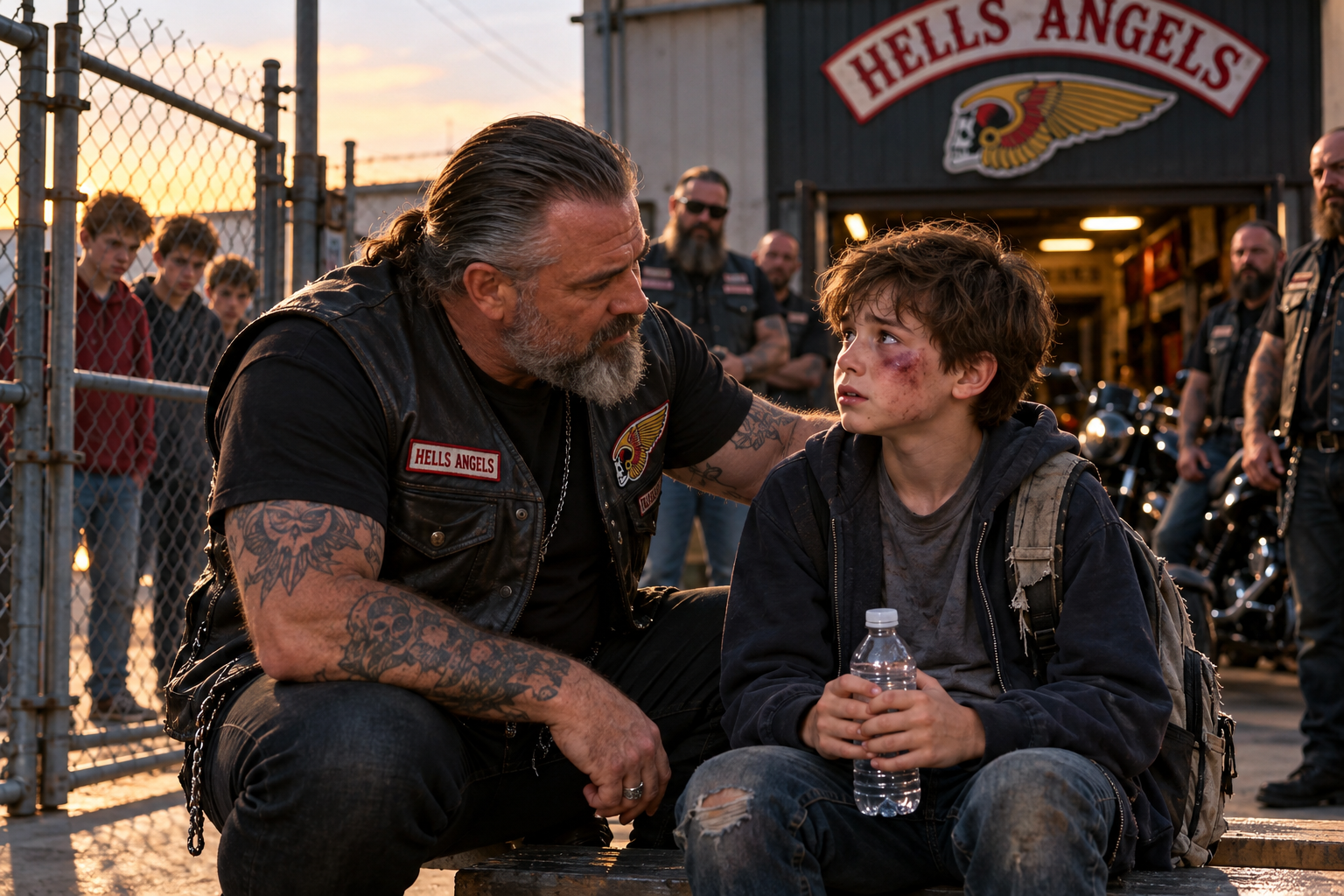
Monday morning, Noah went back to school.
I knew because his mother told me.
She called the clubhouse just after seven, while most of the guys were still drinking coffee and complaining about the weather.
“He’s getting ready,” she said.
Her voice sounded tired.
“Is he all right?”
“He says he is.”
“That isn’t quite what I asked.”
She went quiet for a moment.
“No,” she admitted. “He’s scared.”
I looked across the room at the repaired backpack sitting on the chair where Noah had left it the last time he visited.
The strap was holding.
I had checked the stitching twice.
“What does he say he’s scared of?”
“Seeing them.”
I understood.
“You tell him he doesn’t have to pretend he isn’t scared.”
“I tried.”
“And?”
“He said being scared doesn’t change the fact that he has to go.”
That sounded like Noah.
The boy had spent so long being pushed around that he seemed to believe getting through the day without crying was his responsibility.
It wasn't.
But a boy could understand that in his head long before he believed it in his heart.
“Does the school have a plan?” I asked.
“They said someone would meet him at the office.”
“Someone specific?”
“The counselor.”
“Good.”
“And they said they would keep the boys separated while they investigated.”
“Did they tell you how?”
“No.”
I rubbed my thumb along the edge of my coffee mug.
“Ask them.”
“I don't want to be the mother who calls every five minutes.”
“You're his mother. You're allowed to ask how they're keeping him safe.”
She breathed out.
“I know.”
“Then ask.”
After we hung up, I sat there thinking about how many adults had made Noah feel like protecting himself was an inconvenience.
His stepfather had wanted the matter settled quietly.
Grant had wanted the accusations to stop.
The school wanted time to investigate.
All of them had their reasons.
Noah still had to walk through the same doors.
That was the part adults sometimes forgot.
Around nine, one of the guys came over and nodded at the backpack.
“You fixing that thing again?”
“No.”
“Looks like you're thinking about it.”
“I was thinking about how a strap can hold better than some promises.”
He gave me a look.
Then he sat down beside me.
Neither of us said anything for a while.
At ten, Noah's mother called again.
“He made it inside.”
I felt my shoulders loosen.
“Good.”
“He didn't want me to walk him all the way to the office.”
“Did you let him?”
“I stopped at the front desk.”
“That sounds fair.”
“He turned around before he left me. He wanted to know if I'd be here when he got home.”
“What did you tell him?”
“That I'd be there.”
“Then make sure you are.”
“I will.”
She paused.
“There was something else.”
I waited.
“He asked me if you thought he was a coward.”
I stared at the table.
“No.”
“I told him that.”
“Tell him I said a coward wouldn't have come forward when he thought nobody would believe him.”
“I will.”
She ended the call.
I went outside and stood near the gate.
The morning was ordinary.
A truck passed on the road.
A bird landed on the fence and flew away again.
Somewhere down the block, a lawn mower started.
I had spent years around men who believed courage had to be loud.
I had seen it in a hundred forms.
Sometimes it was a man walking into a dangerous room.
Sometimes it was a man admitting he'd done wrong.
And sometimes it was a boy putting on his backpack and going back to school.
Around lunchtime, Noah's mother sent me a message.
*He made it through the morning. He hasn't seen Grant's son yet.**
I wrote back that I was glad.
A few minutes later, another message arrived.
*He says the counselor is checking on him between classes.**
That was something.
Not enough to solve everything, but something.
By the time the afternoon came around, I had nearly convinced myself that the first day might pass without another problem.
Then my phone rang.
It was Noah's mother.
“He saw them,” she said.
Her voice was tight.
“Where?”
“Outside the science room. The three of them were standing near the lockers.”
“Did they approach him?”
“No. At least, not directly.”
“What does that mean?”
“She said one of them laughed when he walked past. The oldest one didn't say anything. He just stared at Noah.”
I closed my eyes for a second.
“Did Noah report it?”
“Yes.”
“Good.”
“He says it wasn't worth reporting.”
“Why?”
“Because they didn't touch him.”
I felt the anger rise, but I kept my voice steady.
“Tell him he doesn't have to wait until someone touches him before he can ask for help.”
“I did.”
“And?”
“He said he doesn't want them to think he's afraid.”
I looked toward the clubhouse door.
“They already know he was afraid. That's not the question anymore.”
“What is?”
“Whether he's going to let their behavior decide what he does next.”
She was quiet.
Then she said, “I think he understands that.”
“I hope so.”
After we hung up, I called the school counselor.
I had no intention of asking for private details about other children.
I wanted to know whether the school was following the plan it had promised Noah and his mother.
The counselor answered after two rings.
“We're aware of the incident near the science room,” she said.
“Was it reported?”
“Yes.”
“Was Noah told what to do if it happened again?”
“Yes. He can come directly to my office or speak to the designated staff member in the hallway.”
“Good. Is somebody checking on him?”
“We are.”
I listened carefully.
She sounded professional, but professionalism didn't tell me whether Noah felt safe.
“I'm not asking you to promise that nothing uncomfortable will ever happen,” I said. “I'm asking whether he has a clear way to get help when it does.”
“He does.”
“Then please make sure he knows that.”
“I will.”
That afternoon, Noah came to the clubhouse with his mother.
He walked in holding the backpack by its repaired strap.
He didn't look frightened exactly.
He looked exhausted.
I pointed toward the chair.
“How was your day?”
“Fine.”
His mother gave him a look.
He sighed.
“Mostly fine.”
“That's a better answer.”
He sat down and put the backpack beside him.
“They laughed at me.”
“Did they say anything?”
“No.”
“Did you tell the counselor?”
“Yes.”
“Good.”
He looked at me as if he expected me to explain why that was good.
“You reported what happened. That's what you're supposed to do.”
“But it wasn't really anything.”
“It was enough to make you uncomfortable, wasn't it?”
He shrugged.
“Then it was worth reporting.”
He rubbed the repaired strap between his fingers.
“I don't want to be the kid who keeps telling on everybody.”
I pulled a chair closer.
“Let me tell you something. There's a difference between trying to get somebody in trouble and telling the truth about what they're doing.”
He listened without looking up.
“You don't get to choose whether the school gives them consequences. That's their job. Your job is to tell the truth and ask for help when you need it.”
“What if they hate me for it?”
“They might.”
His eyes lifted.
I wasn't going to lie to him.
“Some people get angry when their behavior has consequences. That doesn't mean you did something wrong.”
He sat with that for a while.
Then he nodded.
His mother reached for his hand.
“How about we get something to eat?” she asked.
He agreed.
They stayed for nearly an hour.
They talked about schoolwork, the science room, and a teacher who had mispronounced a student's name three times.
Noah laughed at that.
It was a small laugh.
But it was real.
When they left, he put the backpack on both shoulders.
The strap held.
I watched him reach the gate.
This time, he didn't look back.
I didn't need him to.
Click here to continue reading: PART 10: The Truth Doesn’t Stay Neat
The Twelve-Year-Old Who Ran Into the One Place Everyone in Town Was Afraid to Enter
Part 9 of 20