The call came just after nine the next morning.
I was standing near the workbench when my phone started vibrating against the metal surface.
Noah's mother's number appeared on the screen.
I answered immediately.
She sounded frightened.
"Is my son there?"
I told her Noah was safe and that we needed to talk about what had happened.
She let out a breath.
"Thank God."
For a moment, I thought we might finally be getting somewhere.
Then she asked another question.
"Did he tell you about Grant?"
I looked at the phone.
Not whether Noah was hurt.
Not whether he had eaten.
Not whether he was afraid to come home.
She wanted to know what he had said about Grant.
"Your son told me that Grant's boy had been bullying him," I answered. "He also told me Grant came to our gate demanding that we send Noah outside."
The line went quiet.
I could hear her breathing.
Then she said, "He shouldn't have gone there."
I set down the wrench I had been holding.
"Where should he have gone?"
She didn't answer.
"He was being chased by three teenagers," I continued. "He was hurt, frightened, and didn't believe he could safely go home. He came here because he didn't know where else to turn."
"I understand that."
I wasn't sure she did.
"Then why are we talking about where he went instead of what happened to him?"
She sighed.
It was the tired sigh of somebody who had been carrying a problem for too long and had begun to believe the problem itself was the child.
"I've been trying to keep everybody calm," she said.
I looked across the yard.
The chair Noah had used was still near the garage.
We had moved it out of the way the previous evening, but I hadn't put it back with the others.
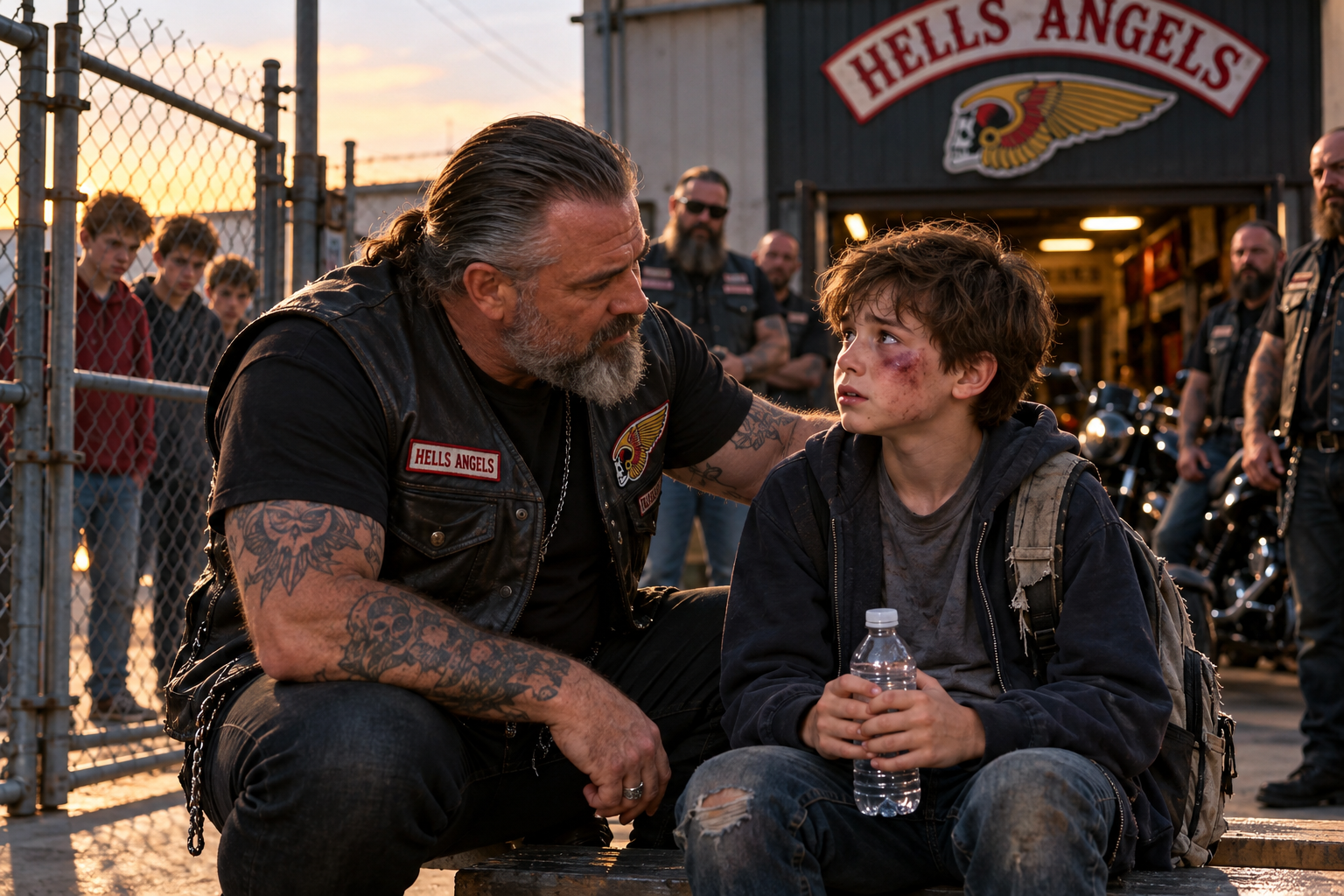
I could still picture the boy sitting there, holding his water bottle with both hands.
"Keeping everybody calm isn't the same as keeping Noah safe."
She didn't speak.
I wondered whether anybody had ever said that to her.
Maybe they had.
Maybe she had been telling herself the same thing for months, hoping that if she stayed patient enough, the trouble would eventually disappear.
But trouble rarely disappears just because the person suffering from it stops talking.
"What happened when he told you about the bullying?" I asked.
"He told me some things."
"What did you do?"
"I spoke to my husband."
"His stepfather?"
"Yes."
"What did he say?"
She paused.
"He said the boys were having problems with each other. He said Grant would speak to his son."
"And did that stop it?"
"I don't know."
That answer bothered me.
Not because she was necessarily lying.
Because she seemed to have accepted uncertainty where her son's safety required more attention.
I asked whether she had seen Noah's injuries.
She said she had noticed bruises before.
She had asked him about them.
He had told her the boys were bothering him.
She said she hadn't realized how bad things had become.
I believed that might be true.
But I also knew that not knowing everything did not mean she had no responsibility to find out more.
"Can you come here?" I asked.
She hesitated.
"Why?"
"Because Noah needs to know you're willing to listen to him. And because we need to work out a safe way forward."
She said she would have to speak with her husband first.
I closed my eyes for a moment.
"Your son is twelve years old. He shouldn't have to wait for everybody else to agree that he's allowed to ask for help."
"I didn't say he wasn't."
"No. But you haven't answered his calls, either."
She went quiet again.
Then she admitted that she had seen his missed calls the previous day.
She had been at work.
By the time she could call back, she had heard that Grant was looking for him.
She had become worried that the situation was getting out of control.
I asked what she meant by that.
She said Grant had contacted her husband.
He had complained that Noah was making accusations against his son.
He had said the school was becoming involved.
He had warned that the matter could create problems for their families.
"And what did your husband say?" I asked.
She took a long breath.
"He said we needed to settle it privately."
There it was again.
The same phrase Noah had used.
Privately.
As if a problem became less serious when the people involved agreed not to discuss it.
I told her that Noah had described being repeatedly bullied, threatened, and physically hurt.
I told her that he had shown us a message from one of the teenagers.
I told her that several adults had witnessed Grant demanding that we hand the boy over.
I made it clear that we weren't going to invent accusations or assume facts we couldn't verify.
But we weren't going to pretend the situation was harmless, either.
She began to cry.
It was quiet at first.
Then she apologized.
"I'm his mother," she said. "I should have done more."
I didn't rush to reassure her.
There was no point in pretending she hadn't made mistakes.
But I didn't want her to become so overwhelmed by guilt that she stopped listening again.
"Then start now," I said.
She wiped her face.
"Can I speak to him?"
I asked Noah whether he wanted to take the call.
He had arrived at the clubhouse earlier that morning with the adult helping us coordinate the next steps.
He was sitting near the workbench, drawing lines on a scrap of paper with a pencil.
When I told him his mother was on the phone, he stopped moving.
"Is she mad?"
"I don't know. She wants to talk to you."
He stared at the paper.
For several seconds, he didn't reach for the phone.
Then he held out his hand.
I passed it to him.
"Hi, Mom."
I couldn't hear her words clearly, but I saw Noah's expression change as she spoke.
He listened without interrupting.
Then he said, "I'm sorry."
My stomach tightened.
He was apologizing again.
His mother said something.
Noah shook his head.
"I didn't mean to make things worse."
She spoke for a while longer.
He rubbed the corner of the paper between his fingers.
Then he whispered, "I didn't make it up."
I turned away to give him privacy.
I couldn't hear the rest of their conversation.
I didn't need to.
When he handed the phone back, his eyes were wet.
His mother asked to speak to me again.
She said she wanted to come to the clubhouse, but she was afraid her husband would become angry.
I asked whether she could meet Noah somewhere safe with another trusted adult present.
She agreed to discuss that arrangement with the person helping us coordinate the situation.
We didn't make promises about what would happen afterward.
We didn't assume that one emotional phone call had fixed everything.
We simply agreed that Noah needed to be heard and that his safety had to come first.
After the call, Noah sat quietly.
I pulled the chair closer.
"What did she say?"
"She said she's sorry."
I nodded.
"How do you feel about that?"
He shrugged.
"I don't know."
That was honest.
A child could love his mother and still be hurt by her.
He could want her to protect him and still be afraid of disappointing her.
He could accept an apology without suddenly trusting that things would change.
I told him he didn't have to decide how he felt right away.
He looked down at his drawing.
Then he said, "She asked if I could just stay away from those boys."
I waited.
"Like I can control where they go."
He looked up at me.
"They come to me."
I had no answer that could make the situation easier.
So I told him what I knew.
The adults helping us were working to document what had happened.
The school had been contacted.
The message on his phone had been preserved.
And nobody should expect him to solve the problem by making himself invisible.
He nodded.
Then he folded the paper he'd been drawing on and placed it in his backpack.
A few minutes later, one of the members brought over a small repair kit.
He had noticed the torn strap.
"Want me to see if I can fix that?"
Noah looked surprised.
"You can?"
The man shrugged.
"I've fixed worse things."
For the first time that morning, Noah smiled.
It wasn't a big smile.
But it was real.
He handed over the backpack.
The member examined the damaged stitching and began looking for a stronger strap attachment.
Noah watched him work.
I watched Noah.
It struck me that the boy had spent so much time worrying about the people who wanted him to apologize that he had forgotten there were adults who could help him without asking him to earn it.
The repair wasn't going to solve the bullying.
It wasn't going to change his home situation.
But it meant he wouldn't have to carry his books in a bag that was falling apart.
Sometimes, a small practical kindness was the only honest thing you could offer.
By noon, Noah's backpack was sitting on the workbench with the strap secured.
The member handed it back.
"Should hold for a while."
Noah slipped it over his shoulder.
He adjusted the strap carefully.
"Thanks."
The man nodded and returned to his motorcycle.
Noah stood there for a moment, testing the weight of the bag.
Then he looked toward me.
"Do you think Mom will come?"
"I think she wants to."
"That's not what I asked."
He had a point.
I couldn't promise that she would show up.
I couldn't promise that his stepfather would cooperate.
I couldn't promise that Grant would stop trying to influence the situation.
"I don't know," I admitted. "But we'll keep working on a safe way for you to talk to her."
Noah nodded.
He seemed disappointed, but he didn't look betrayed.
Maybe that was progress, too.
I had stopped giving him answers I couldn't guarantee.
And for a boy who had heard too many empty assurances, honesty might have been more useful than comfort.
That afternoon, the school contacted us again.
They wanted to arrange a meeting to discuss Noah's earlier reports and the incident after dismissal.
I agreed to help coordinate the information we had, provided Noah's needs remained central and the adults involved handled the matter appropriately.
We would not be asking the boy to face the teenagers alone.
We would not treat his account as a family disagreement that could be settled by telling him to apologize.
And we would not let the fact that the adults knew one another replace an honest examination of what had happened.
Before the call ended, I asked whether the school had reviewed Noah's earlier complaint.
The person on the line said they were checking.
I wrote that down.
Then I looked at the repaired backpack resting beside Noah's chair.
The strap had been stitched back into place.
It was a small thing.
But it reminded me that damage could be acknowledged and repaired without blaming the person who had been carrying it.
I wished the adults in Noah's life understood that.
Click here to continue reading: PART 6: When Grant Tried to Turn a School Meeting Into a Private Settlement, Noah Finally Explained What the Threats Had Cost Him
The Twelve-Year-Old Who Ran Into the One Place Everyone in Town Was Afraid to Enter
Part 5 of 20