
Lily's house smelled like fresh paint for nearly six months.
She complained about it constantly.
“I can taste the walls.”
“You're being dramatic.”
“They smell terrible.”
“You'll survive.”
She smiled.
She had always complained loudly about things she secretly loved.
The house suited her.
It wasn't large.
It wasn't impressive.
But it was hers.
She chose every curtain.
Every chair.
Every shelf.
Even the ridiculous yellow lamp in the hallway that looked like it belonged in a children's room.
“You like it,” she told me.
“I tolerate it.”
“You're lying.”
“Yes.”
Her tomato plants grew slowly.
Then suddenly.
By August, the backyard was green.
She sent me photographs.
Every morning.
Sometimes before sunrise.
“Look.”
“It's the same tomato as yesterday.”
“No. It's bigger.”
I played along.
“It is.”
The garden became part of her routine.
So did Daniel.
They were still together.
They argued.
They apologized.
They learned.
They didn't rush toward marriage.
That pleased me.
I had learned that promises made under pressure rarely survive pressure.
One Sunday, Derek came by to fix a broken gate.
He stood in the backyard tightening a screw.
“You've built a nice life here.”
I nodded.
“Lily did.”
He looked toward the house.
“She seems happy.”
“She is.”
He smiled.
“I used to think happiness was something you earned by getting everything right.”
“And now?”
“Now I think it's what happens when you stop making excuses.”
I looked at him.
He continued working.
“I've thought a lot about that first year after the divorce.”
“I imagine.”
“I was angry.”
“At whom?”
“Everyone.”
“Why?”
“Because I had consequences.”
I said nothing.
He looked at me.
“Then I realized consequences weren't punishment. They were information.”
I raised an eyebrow.
“Information?”
“They showed me exactly what my choices had done.”
I nodded.
“That is a useful way to see them.”
He finished the gate.
Then he stood.
“I wanted to ask you something.”
“What?”
“Would you come to dinner sometime?”
“With whom?”
“Me and my wife.”
I smiled.
“That is unexpected.”
“I know.”
“Why?”
“She wants to meet you.”
I laughed.
“She already knows about me.”
“She knows the story.”
“That's different.”
“Yes.”
I considered it.
“All right.”
The dinner happened two weeks later.
His wife, Claire, was warm and straightforward.
She didn't treat me like a fragile person.
I appreciated that.
At one point, she asked whether she could tell me something.
“Of course.”
“Derek has told me what happened.”
I nodded.
“I don't want to hear you say you're sorry for him.”
I smiled.
“I wasn't going to.”
She laughed.
“Good.”
“He needs to carry his own history.”
“Yes.”
“And you?”
“I carry mine.”
That seemed to satisfy her.
After dinner, Derek walked me to my car.
“I didn't know what would happen tonight.”
“Neither did I.”
“Did you enjoy it?”
“Yes.”
He smiled.
“Me too.”
I reached for the car door.
Then I stopped.
“Derek.”
“Yes?”
“I want you to understand something.”
“All right.”
“I don't need you to become a good man because of me.”
He looked confused.
“You need to become one because you want to.”
He nodded slowly.
“I know.”
“Good.”
I got into the car.
He closed the door.
On the drive home, I realized something.
For years, I had imagined closure as a final conversation.
A sentence.
An apology.
A moment where the past would finally release me.
But closure had not arrived that way.
It had arrived quietly.
It was the day I stopped checking the mailbox for another problem.
The day I stopped comparing signatures.
The day I stopped wondering where the money went.
The day I stopped asking whether Derek regretted what he had done.
I didn't need his regret to validate my pain.
I knew what happened.
That was enough.
Winter came.
Lily's tomatoes died back.
She was devastated.
“It looks horrible.”
“It is winter.”
“I know.”
“Plants die.”
“That doesn't make it better.”
“No.”
She stood in the garden.
“Do they come back?”
“If you plant again.”
She looked at me.
“You always say that.”
“Because it keeps being true.”
She smiled.
The next spring, she planted again.
This time she used stakes.
She read about pruning.
She even kept a gardening notebook.
“I'm becoming you,” she said.
“Careful.”
She laughed.
One afternoon, Emily came over.
She had news.
“I met someone.”
I smiled.
“You're smiling too much.”
“Stop.”
“What is his name?”
“Michael.”
“Good?”
“So far.”
“Does he know about Derek?”
“Yes.”
“What did he say?”
“He said every person has a past.”
“That sounds sensible.”
“He also said he doesn't want to know every detail.”
“That sounds wiser.”
Emily laughed.
Then she looked at me.
“I'm happy.”
“I know.”
“And I'm not scared.”
“That is even better.”
She leaned against me.
“I used to think starting over meant pretending the first life never happened.”
“And now?”
“Now I think it means taking what you learned with you.”
I kissed her forehead.
“That sounds right.”
Michael eventually met all of us.
Derek knew.
There was no jealousy.
No competition.
No attempt to make Lily choose.
Michael understood that Emily's past was part of her history, not a threat to their future.
That was another small miracle.
One evening, the whole family gathered at Lily's house.
Emily.
Michael.
Derek.
Claire.
Daniel.
Me.
Lily had cooked.
Badly.
We ate anyway.
At the end of dinner, she brought out a cake.
It was lopsided.
“Don't laugh.”
“I won't.”
Everyone laughed.
She cut the first slice.
Then she stopped.
“I want to say something.”
We waited.
“I used to think family meant everyone staying together.”
She looked at her mother.
“Then I learned that isn't true.”
She looked at Derek.
“Family can change shape.”
Then she looked at me.
“And sometimes changing shape is how people learn how to love each other better.”
Nobody spoke.
I felt Emily squeeze my hand.
Lily smiled.
“Okay. That's enough seriousness. Eat cake.”
Everyone laughed.
Later, I stood alone in her backyard.
The tomato plants were young.
The leaves moved gently in the breeze.
I touched one.
It was warm from the afternoon sun.
I thought about the old kitchen.
The piggy bank.
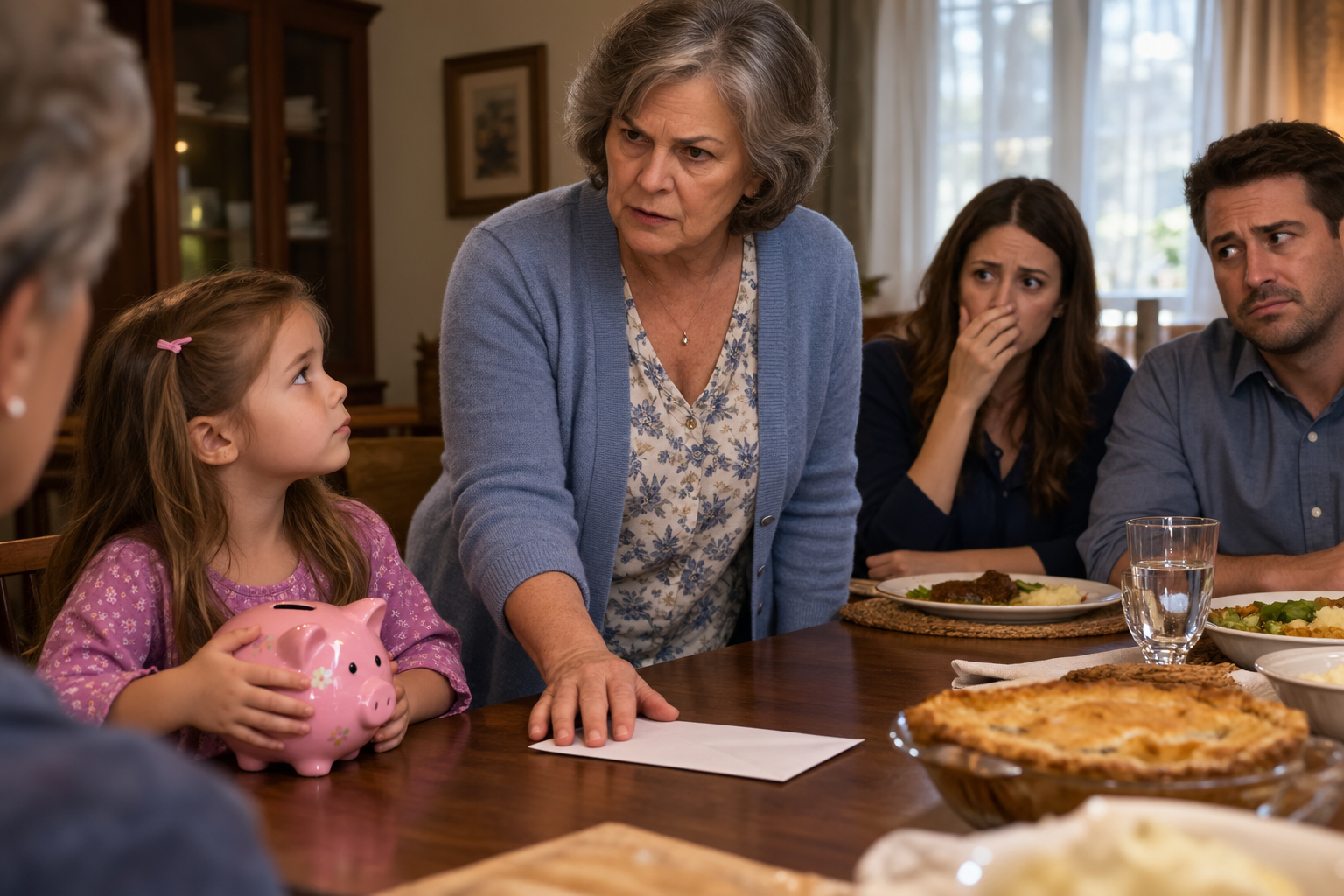
The forged forms.
The envelope.
The number $1,960.
Once, those things had felt like the center of my world.
Now they were simply the beginning of a lesson that had outgrown them.
I heard footsteps behind me.
It was Lily.
“You okay?”
“Yes.”
“What are you thinking?”
“That you grew up.”
She smiled.
“Finally.”
“Don't rush it.”
“I won't.”
We stood together.
Then she said, “I think Dad finally understands.”
I looked at her.
“Understands what?”
“That family isn't ownership.”
I nodded.
“Yes.”
“And neither is love.”
“No.”
She smiled.
“Good.”
She slipped her arm through mine.
We walked back toward the house.
Neither of us looked behind.
Click here to continue reading: PART 15: The Old File Box Was Finally Opened Again, and Lily’s Decision About Its Contents Showed Me How Completely the Past Had Changed
A Six-Year-Old Asked One Innocent Question About My Worth, and Before Dinner Was Over, I Realized Someone Had Been Keeping Count
Part 14 of 20

