I returned to the room with more questions than answers.
Matthew was sitting in the same chair.
He had folded his hands on the table.
The paper cup stood beside him, nearly empty.
I sat down without moving the photograph.
For a while, neither of us spoke.
Then I asked whether he wanted to hear about the search.
He looked at me.
"What search?"
I felt my stomach tighten.
"The search for you. After you disappeared."
He lowered his eyes.
I realized that I had assumed he knew what happened after he was gone.
That assumption might have been wrong.
I told him about the people who searched the beach.
I told him about the questions asked at the resort.
I told him that we had waited for news, hoping someone would find him.
I kept my words simple.
I didn't describe every night I had spent awake or every time I had imagined hearing his footsteps outside his room.
Those were my memories.
He didn't need to carry all of them at once.
When I finished, he stared at the table.
"Did you think I was dead?"
I took a breath.
"Yes."
The word felt cruel, even though it was true.
"I was told the sea had taken you. After a while, I believed that was what had happened."
He looked at the photograph.
"Did you stop looking?"
I thought about the question before answering.
I had stopped making some of the calls.
I had stopped expecting a new development every week.
I had learned how to live without waiting for the telephone to ring.
But I had never stopped looking for him in the world around me.
Every child with dark hair made me look twice.
Every family photograph reminded me of what was missing from mine.
Every visit to the beach brought back the same afternoon.
"I stopped expecting an answer," I said. "I never stopped wondering where you were."
Matthew seemed to think about that.
I wanted to know whether it helped him.
I didn't ask.
He reached for the photograph and drew it closer.
His eyes rested on Robert.
I watched him carefully.
There was something about that picture that neither of us could explain.
It showed an ordinary afternoon.
A little boy.
A familiar man.
Nothing more.
Yet I could no longer look at it without remembering Robert standing apart from the search.
I had always defended that memory.
I had told myself that people reacted to emergencies in different ways.
I had told myself that shock could make someone quiet.
I had told myself that Robert had been trying to help.
Perhaps those things were possible.
But I had used them to avoid asking whether his behavior had made sense.
That was the part I could no longer ignore.
I turned toward Matthew.
"Do you remember the beach?"
He remained quiet.
I waited.
He eventually shook his head, though I could not tell whether he meant that he remembered nothing or did not want to discuss it.
I didn't press him.
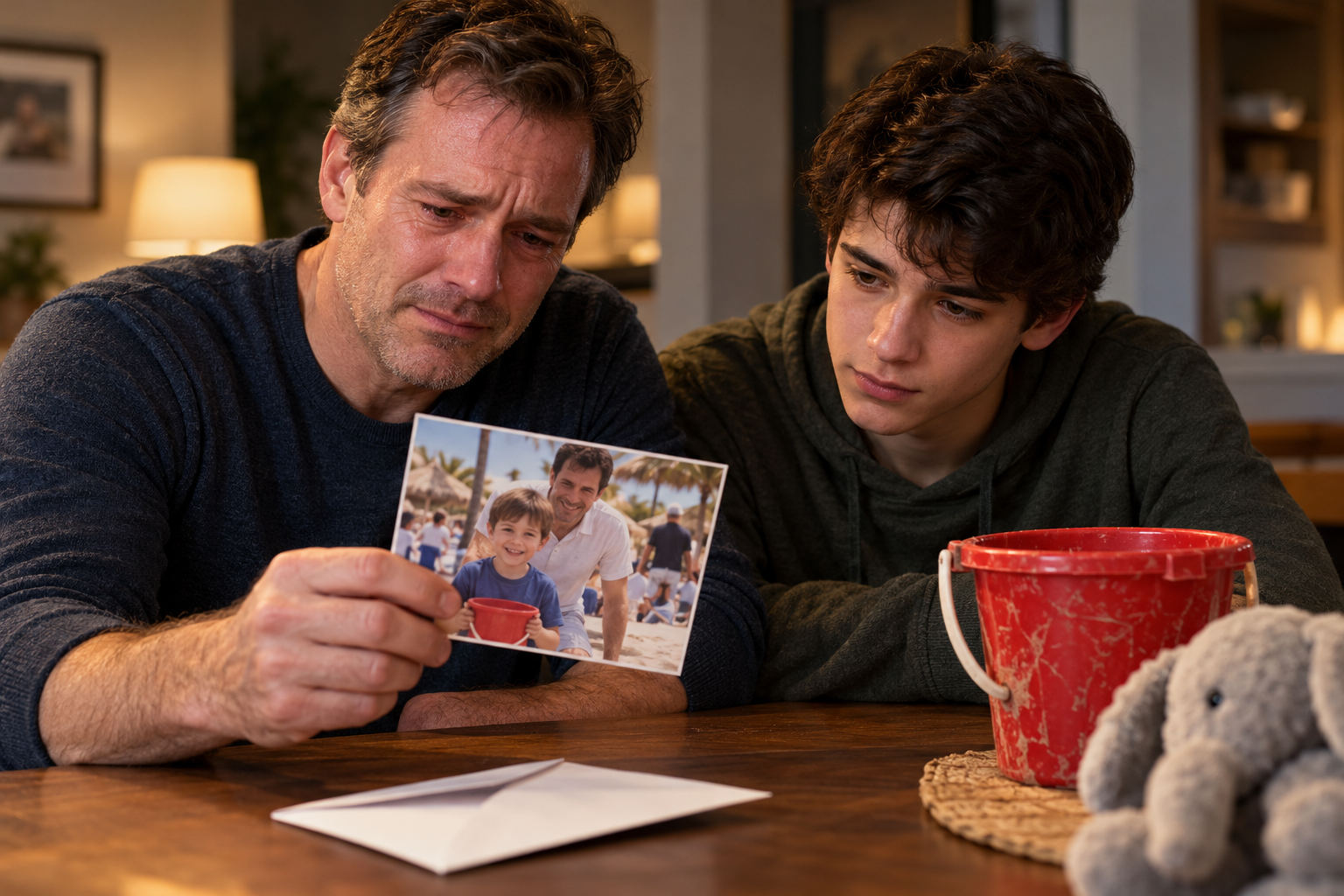
Instead, I told him about the red bucket.
I described the small scratches along its side.
I told him how he used to fill it with shells and stones, then empty everything out when he found something he liked better.
I remembered one afternoon when he had insisted that a flat gray stone was a piece of treasure.
I had asked what made it special.
He told me that I wouldn't understand.
At the time, I had laughed.
Now I could barely speak about it.
Matthew listened without interrupting.
When I finished, he asked whether I still had the bucket.
"Yes."
"Where is it?"
"At home."
He nodded.
I wondered whether he wanted to see it.
I wanted to bring it to him immediately.
But I didn't know whether the object would comfort him or make the distance between us feel even larger.
I decided not to offer it as though it could solve anything.
It was only a bucket.
It had mattered because a little boy had loved it.
I needed to learn what mattered to the young man sitting in front of me.
Ramirez returned later with another folder.
She placed it on the table but did not open it immediately.
She explained that the case had raised questions that required careful examination.
I asked whether the information pointed toward Robert.
She said that his role in the events remained important to the investigation.
That was all she would say at that moment.
I felt anger move through me.
For eleven years, Robert had occupied a place in my life that should have belonged to memories of Matthew.
He had been the man who listened when I couldn't speak.
The man who visited when my house felt unbearable.
The man whose account I had accepted because I could not face the possibility that he might have failed my son.
I had treated his presence as proof of his goodness.
I had never asked whether he had been helping me understand what happened or helping me stop asking questions.
That distinction frightened me.
I looked at the photograph.
Robert's hands rested near Matthew's shoulders.
I remembered the ease with which he had said he would watch him.
I remembered how little I had questioned that promise.
A father should be able to trust someone with his child.
I still believed that.
But I had learned that trust was not the same as certainty.
I looked at Ramirez.
"Have you spoken to Robert?"
She told me that the relevant information was being reviewed.
I understood that she was not going to give me details she could not confirm.
I disliked the restraint.
I also knew that I needed it.
I could not build a new understanding of my son's disappearance on guesses.
Matthew had been listening.
He looked from Ramirez to me.
"Is he the reason I'm here?"
The room went still.
Ramirez did not answer for me.
I was grateful for that.
I turned toward my son.
"I don't know everything yet."
He looked down.
"But I know I have questions about him that I should have asked a long time ago."
Matthew's expression did not change.
I wished I could tell whether he understood.
I wished I could tell whether he was waiting for me to say something else.
I decided not to pretend that I knew more than I did.
"I won't tell you I understand what happened until I do."
He nodded slowly.
It was not forgiveness.
It was not trust.
It was simply an acknowledgment that he had heard me.
I held on to that.
Ramirez explained that we could continue talking when Matthew felt ready.
I asked whether he would be allowed to contact me.
She said that the arrangements would need to be clarified.
I hated the word arrangements.
It made our reunion sound like a problem to be managed.
But I knew that a single meeting could not settle eleven years.
I stood and put the photograph back into my jacket.
Matthew watched me.
"I'll keep it safe," I told him.
He looked at the place where it had been.
Then he nodded.
I left the room with Ramirez to discuss what would happen next.
I did not feel relieved.
I felt as though I had finally reached the beginning of something I should have understood years earlier.
The ocean had been the explanation.
Robert had been the person who gave it to me.
And I had been the man who chose to believe it.
Click here to continue reading: PART 7: The Red Bucket Was Still Waiting at Home, but I Could No Longer Pretend the Past Was as Simple as I Had Been Told
For Eleven Years, I Believed the Sea Had Taken Everything From Me, Until One Photograph Made Me Question the Man I Trusted
Part 6 of 20