
I had thought recognition would come first.
I expected to look at Matthew and know, without hesitation, that he was my son.
Instead, I sat across from a seventeen-year-old boy and tried to understand how much of the child I remembered could still be found in him.
His face was unfamiliar.
His voice, when he finally spoke, would be unfamiliar too.
Even the way he sat in the chair belonged to someone who had grown up without me.
That was the first thing I had to accept.
I had not been there for the years that made him who he was.
I could not fill those years by remembering the boy he had been.
I could only sit with the person in front of me.
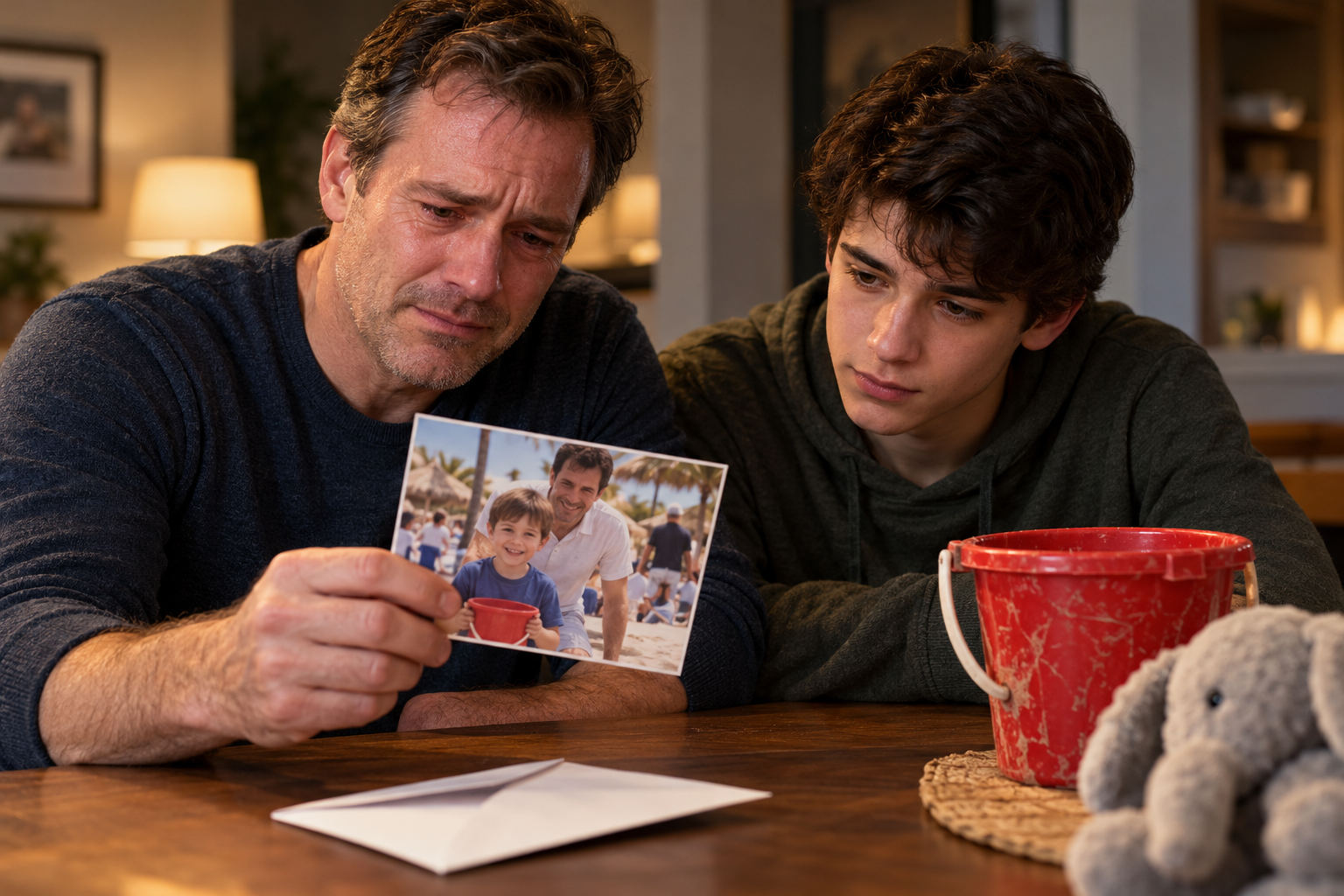
The photograph lay between us.
He looked at it for a long time.
I wondered whether he remembered the day it had been taken.
I wondered whether he remembered the red bucket.
I wondered whether he remembered me.
I was afraid to ask.
Ramirez remained nearby, quiet enough that I almost forgot she was there.
She had brought us into the same room, but she could not tell us how to bridge eleven years.
That part belonged to us.
I cleared my throat.
"I've kept that photograph for a long time."
The boy looked at me.
I continued before I lost my nerve.
"You were six when it was taken."
He glanced down again.
I watched his fingers move against the edge of the table.
I recognized the nervous gesture, but I could not tell whether it meant anything now.
I wanted to tell him about the red bucket.
I wanted to describe how he used to collect shells and insist that I examine every one.
I wanted to remind him that he had once been frightened by a harmless crab and then spent the next hour trying to catch it.
Those memories belonged to me.
I had no idea whether they belonged to him.
So I did not use them to demand anything.
I simply waited.
The boy asked me whether I had known he was alive.
The question struck harder than I expected.
"No."
I answered too quickly, then forced myself to say it again.
"No. I didn't know."
He studied my face.
I could not tell whether he believed me.
I wanted to explain the search.
I wanted to tell him how many times I had walked the shoreline, how many nights I had stayed awake, how many years I had spent thinking that I had failed him.
But I did not want to turn the conversation into a defense of myself.
He had lost eleven years too.
Whatever had happened, he had been the child.
I had been the father.
I could not ask him to carry my guilt before I understood what he had endured.
"I looked for you," I said.
He lowered his eyes.
I wondered what those words meant to him.
They were simple.
They were true.
They were also far too small to explain the years between us.
I wanted to say more, but nothing I could think of seemed adequate.
Ramirez asked whether we needed a moment.
The boy shook his head.
I nodded.
Neither of us wanted to be alone with our thoughts yet.
The photograph remained on the table.
I turned it slightly so that he could see the whole image.
Matthew stood in front.
Robert stood behind him.
The boy's gaze settled on Robert.
I noticed it immediately.
He was not looking at the children in the background.
He was not studying the building.
He was focused on the man whose presence had once seemed so ordinary to me.
I felt the old discomfort return.
I remembered Robert standing near the pool while everyone else searched.
I remembered his answers.
I remembered the way he had spoken about the sea as though the explanation had already been settled.
I had spent years pushing those memories away because I did not know what to do with them.
Now they were sitting between my son and me.
I pointed to Robert.
"Do you know him?"
The boy did not answer immediately.
He looked at the photograph again.
Then he looked at me.
I could see that he was deciding whether to speak.
I wanted to reassure him.
I wanted to promise that whatever he told me, I would believe him.
But I could not make that promise honestly.
Not because I doubted my son.
Because I did not yet know what he had been told, what he remembered, or what might have happened during the years I had lost.
I could promise to listen.
That was all.
"You can tell me whatever you remember."
The boy's expression tightened.
He looked away from the photograph.
I waited for him to speak.
Nothing came.
For a moment, I thought I had asked too much.
Then Ramirez said that we did not have to answer every question at once.
The boy seemed relieved.
I felt ashamed that I had been so focused on my need for answers that I had almost forgotten his need for time.
I leaned back in the chair.
The room was quiet.
I could hear a faint sound from somewhere beyond the door, followed by footsteps moving down the corridor.
Ordinary sounds.
The world had continued while mine had stopped.
I had always known that in theory.
Sitting beside my son, I finally felt it.
He had grown older while I remained trapped in the afternoon he disappeared.
He had learned things I could not imagine.
He had experienced days when I was not there to help him.
He had become a young man without knowing whether I was searching for him or had given up.
I could not change any of that.
I could not return to the beach and make a different choice.
I could not take Matthew by the hand and walk away from Robert.
All I could do was stay in the room.
So I stayed.
After a while, the boy looked at me again.
He asked whether I had kept anything else from his childhood.
The question caught me off guard.
"Yes."
I thought about the red bucket.
I thought about the stuffed elephant with the folded ear.
I thought about the drawings that had remained on the refrigerator long after I could bear to look at them.
"I kept some of your things."
He listened without speaking.
I did not tell him everything.
I did not want to overwhelm him with a list of objects that had become sacred to me simply because they were all I had left.
But I told him about the bucket.
I described the scratches on its side and the way he used to carry it around even when there was nothing inside.
For the first time, something changed in his expression.
It was not quite a smile.
It was closer to recognition, though I could not be certain.
I held on to that small change without asking it to become anything more.
Then he looked at the photograph again.
His eyes returned to Robert.
The silence grew heavier.
I felt the questions building between us.
Why had Robert been there?
What had he known?
Why had I never noticed the things that seemed so clear now?
And what had happened to my son after that afternoon on the beach?
I had spent eleven years believing the ocean was the answer.
Now I had to consider that it might only have been the explanation I had been given.
I looked at Ramirez.
She was watching us carefully.
I asked whether she believed Robert had told the truth about the disappearance.
She did not answer immediately.
Instead, she said that the photograph had become important because of information that had emerged during the renewed examination of the case.
I asked what information.
She told me that there were details we still needed to discuss.
I felt my patience begin to fray again.
I had spent eleven years waiting for someone to explain what had happened.
Now that my son was sitting in front of me, I could not bear another delay.
But I looked at him and stopped myself.
He had been brought into this room for a reason.
He had agreed to meet me, or at least had allowed the meeting to happen.
I did not know what that had cost him.
I would not turn his first conversation with me into an interrogation.
I looked back at the boy.
"I'm not going to force you to talk."
He watched me.
"But I need you to know something. I never stopped being your father."
The words sounded inadequate as soon as I said them.
I had been his father in name, in memory, and in the photographs I kept.
I had not been there when he needed someone to answer his questions.
I had not been there to see him grow up.
Still, the words were true.
I hoped he could understand that without feeling obligated to forgive me for anything.
He looked down at his hands.
I did not reach for him.
I let the silence remain.
After a while, Ramirez suggested that we take a short break.
The boy stood.
I stood too.
For a second, we faced each other with only a small distance between us.
I wanted to hug him.
I wanted to hold him the way I had when he was little, before I understood how quickly a life could change.
But he did not move toward me.
So I did not move toward him.
He glanced at the photograph one last time before turning away.
I picked it up carefully.
The paper felt warm from my hands.
For eleven years, I had carried that image as proof of what I had lost.
Now it had become something else.
A reminder that the story I had believed was incomplete.
And that the man I had trusted might have known more than he had ever admitted.
Click here to continue reading: PART 5: I Wanted to Hold My Son, but the Photograph Between Us Reminded Me That Eleven Missing Years Could Not Be Returned
For Eleven Years, I Believed the Sea Had Taken Everything From Me, Until One Photograph Made Me Question the Man I Trusted
Part 4 of 20

One Comment on “PART 4 – The Boy Across the Table Had Grown Up Without Me, and the Photograph Between Us Raised Questions Neither of Us Could Answer”