I arrived early.
I had barely slept the night before.
Every time I closed my eyes, I imagined different versions of the conversation waiting for me.
Perhaps they had found something connected to Matthew.
Perhaps someone had come forward after all these years.
Perhaps Ramirez had discovered a mistake in the original investigation.
I tried not to build too much hope around any of those possibilities.
Hope had become dangerous to me.
It could make an ordinary sentence feel like a promise.
It could turn a stranger's hesitation into a sign that everything might be different.
And when nothing changed, I was the one who had to live with the disappointment.
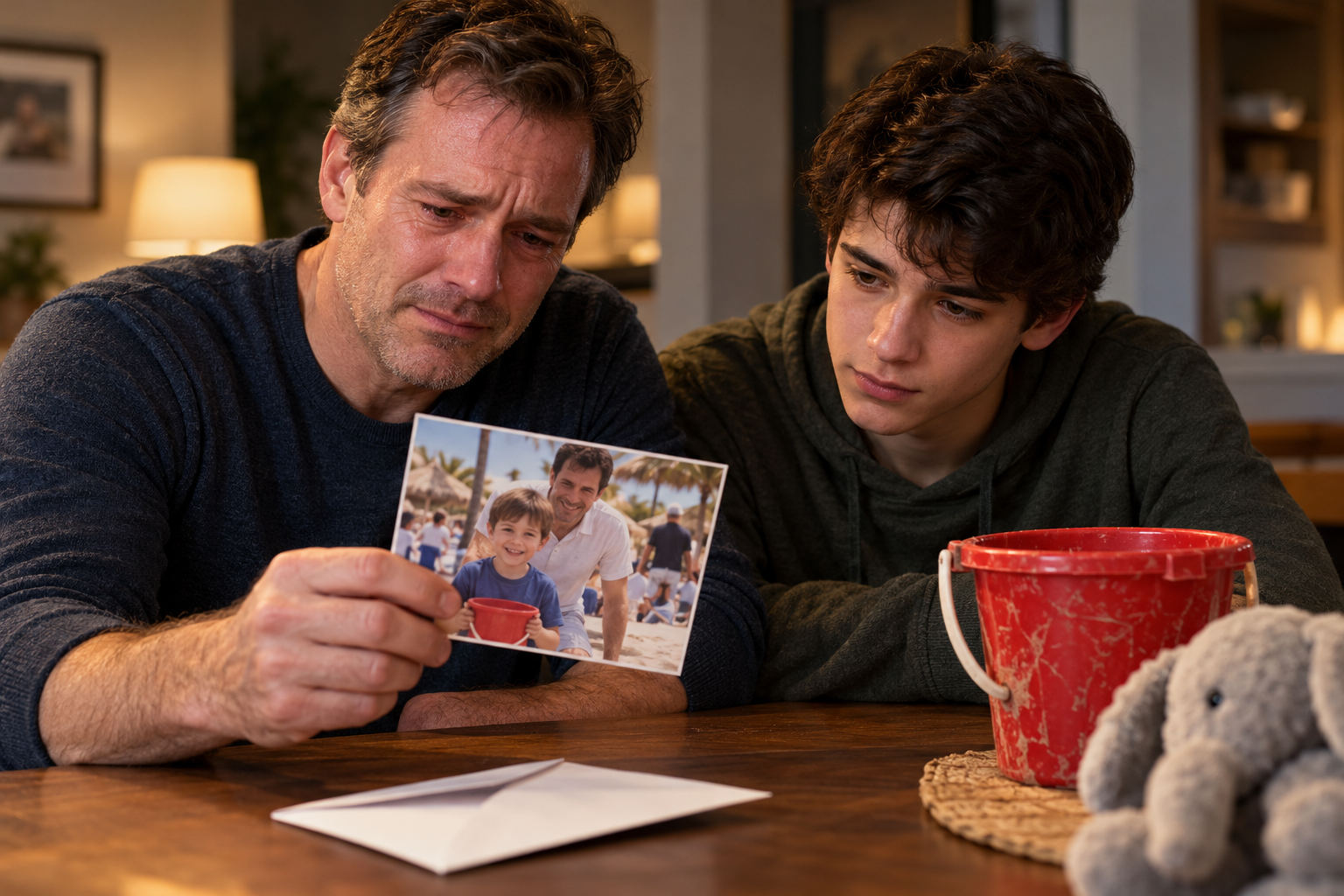
I carried Matthew's photograph in my jacket pocket.
I had considered leaving it at home.
Then I decided that if I was going to speak about him, I wanted something real in front of me.
Not a case number.
Not a report.
My son.
The building was quieter than I expected.
A receptionist checked my name and directed me to a waiting area.
I sat down with the photograph resting between my hands.
The paper had softened along the edges.
I had taken it out so many times over the years that I could recognize every mark on it.
There was a faint crease near the bottom.
I remembered making it by accident when I had first carried the photograph in my wallet.
I had been afraid of damaging it.
I had damaged it anyway.
That seemed fitting.
Ramirez appeared a few minutes later.
She introduced herself in person and asked me to follow her.
She didn't speak much as we walked.
I watched her face, trying to understand what she was preparing to tell me.
She seemed serious.
Not cold.
Not impatient.
Serious in a way that made me feel as though the conversation had already started without me.
We entered a small room.
There was a table, several chairs, and a folder placed neatly in front of one of them.
Ramirez asked me to sit.
I remained standing for another moment.
"Is this about Matthew?"
She nodded.
I sat down.
For eleven years, I had imagined hearing his name spoken by someone who had found a new clue.
I had imagined the relief that might come with knowing the search had not ended completely.
I had also imagined hearing that there was nothing left to investigate.
I had never imagined the feeling I experienced when Ramirez opened the folder.
She began by asking me to describe the day Matthew disappeared.
I had answered that question so many times that I could have repeated the story without thinking.
I told her about the beach.
I told her about the children's club.
I told her that Robert had been watching Matthew while I dealt with the excursion arrangements.
I told her that I had returned and found the situation in chaos.
Ramirez listened without interrupting.
When I finished, she asked me to explain what Robert had done after the disappearance.
I described finding him near the pool.
I described how he had seemed strangely removed from the panic around him.
Then I repeated what I had told myself for years.
I said I believed he had been in shock.
Ramirez looked down at the folder.
"Did you ever question him about that?"
"Many times."
"And did his answers remain the same?"
I thought about it.
"No. Not exactly."
She waited.
I explained that Robert's account had shifted in small ways.
Sometimes he said Matthew had been close to the club entrance.
Sometimes he spoke about the children playing nearby.
Sometimes he emphasized the noise and confusion.
I had never been able to identify one clear contradiction.
I had only remembered the discomfort of hearing different versions of the same afternoon.
Ramirez wrote something down.
I felt embarrassed.
It seemed absurd that I had spent eleven years carrying those doubts without doing anything useful with them.
But I also knew why I had done it.
I had been trying to survive.
When you lose a child, even the smallest possibility of blame can become unbearable.
If I had questioned Robert too closely, I might have had to question every decision I had made that day.
I might have had to admit that I had trusted someone without paying enough attention.
I might have had to accept that my own judgment had failed me.
It was easier to believe that the sea had taken Matthew.
The ocean could not answer questions.
It could not look me in the eye.
It could not change its story.
Ramirez closed the folder.
She told me that some information had recently come to light.
I asked what kind of information.
She said she wanted to establish a few things first.
I hated that answer.
I had waited eleven years.
I did not want another careful conversation in which every important detail was held just beyond my reach.
"Please tell me what you've found."
She looked at me for a long moment.
Then she asked me about the photograph I had brought.
I took it out and placed it on the table.
She examined it without touching the paper.
I told her where it had been taken.
I told her that Matthew had been attending the children's club that day.
I pointed to the small figure in the foreground.
Then I pointed to Robert standing behind him.
Ramirez leaned closer.
"Is that Robert?"
"Yes."
"How long had you known him?"
"Years."
"Did you trust him?"
The question irritated me.
It sounded too simple for everything I had lost.
"Of course I trusted him."
She didn't react.
I looked down at the photograph.
Then I felt the shame of my own answer.
I had trusted him.
That was precisely why the memory hurt.
Ramirez asked whether I had ever noticed anything unusual about Robert's behavior before Matthew disappeared.
I said no.
Then I corrected myself.
There had been moments when Robert seemed more interested in knowing where I would be than in making plans with me.
He sometimes asked about my work schedule.
He occasionally wanted to know whether I would be away for a weekend.
At the time, I had taken those questions as ordinary conversation.
Friends asked about one another's plans.
There had never been a reason to suspect anything else.
Ramirez asked whether I had discussed those moments with anyone.
I said I had not.
She made another note.
I began to feel that we were walking around the center of something without entering it.
"What does this have to do with Matthew?"
Ramirez folded her hands on the table.
She told me that the new information had forced the people involved to reconsider parts of the original case.
I asked whether they believed Matthew had survived.
She did not answer immediately.
My hands began to shake.
I pressed them together beneath the table.
"Is my son alive?"
Ramirez looked directly at me.
"I need you to understand that we are still working through what we know."
That was not an answer.
I stood up.
"I didn't come here to hear that you have questions."
She remained seated.
"I understand."
"No, you don't."
My voice was louder than I intended.
I apologized, then sat down again.
I hated losing control in front of someone who was trying to help me.
But the possibility that Matthew might still be alive had changed everything.
For eleven years, I had forced myself to accept that my son was gone.
Now someone had opened the door to another possibility, and I was terrified of what it might cost me to believe it.
Ramirez took a breath.
She said there was a person connected to the new information whom I needed to see.
I asked who it was.
She told me that before I met him, I should look at the photograph again.
I didn't understand.
I picked it up.
She asked me to focus on Robert.
I examined the picture, searching for some detail I had overlooked.
Robert was standing behind Matthew.
His expression seemed ordinary.
His posture seemed ordinary.
There was nothing in the image that proved he had done anything wrong.
I told Ramirez that I didn't know what she wanted me to see.
She asked me to remember the moments after I returned to the beach.
I remembered the shouting.
The people moving toward the water.
The questions being asked.
And Robert standing near the pool.
He had not been looking for Matthew.
He had been watching everyone else.
I lowered the photograph.
"Why are you asking me about him?"
Ramirez did not look away.
"Because his actions that day matter more than we understood at the time."
I felt cold.
I wanted to argue.
I wanted to tell her that Robert had been there for me after the disappearance, that he had helped me through the worst months of my life, that he had never given me a reason to think he was capable of hurting my son.
But the words wouldn't come.
I remembered his changing answers.
I remembered the way he had stood apart from the search.
I remembered how quickly he had accepted the explanation that Matthew had been lost to the sea.
For the first time in eleven years, I allowed myself to consider that my trust might have been misplaced.
It was not proof.
It was worse than proof.
It was a question I could no longer push away.
Ramirez gathered the papers in front of her.
She said she was ready to take me to the next room.
I asked whether I would meet the person she had mentioned.
"Yes."
"Does he know who I am?"
She paused.
Then she said that he knew enough to understand why I had been called.
I followed her to the door.
My legs felt weak.
I had spent eleven years preparing myself for the possibility that Matthew was gone forever.
I had not prepared myself for the possibility that he had been somewhere in the world, growing older without me.
I could not decide which thought frightened me more.
Ramirez opened the door.
I looked into the room beyond it.
Someone was waiting there.
Click here to continue reading: PART 3: The Photograph Showed Robert Beside My Little Boy, and Suddenly the Quiet Man Near the Pool Looked Like Someone I Had Never Known
For Eleven Years, I Believed the Sea Had Taken Everything From Me, Until One Photograph Made Me Question the Man I Trusted
Part 2 of 20