The hardest thing I ever did was bury a child I had never found.
For eleven years, I told myself I had accepted it.
I had learned how to answer people when they asked about my son.
I had learned how to look at photographs without breaking down in front of strangers.
I had even learned how to laugh again, sometimes.
But there was one thing I had never learned.
How to stop waiting for Matthew to come home.
He had been six years old when he disappeared.
Six.
Old enough to run ahead of me on a beach, but young enough to believe that every adult who promised to protect him would keep that promise.
I had been one of those adults.
His father.
The man who was supposed to know where he was every second of every day.
Instead, I spent eleven years wondering whether my last memory of him had been the last memory I would ever have.
People told me the ocean had taken him.
They said it gently at first.
Later, they said it as though repeating the words might finally make me understand.
The sea had been rough that afternoon.
The beach had been crowded.
There had been shouting, confusion, and people running in every direction.
And somewhere in all of it, my little boy had vanished.
No body was recovered.
No explanation ever made sense to me.
Still, everyone eventually accepted the same conclusion.
Everyone except me.
I didn't know that until much later.
For years, I had thought my inability to move on was simply a father's refusal to face reality.
I blamed myself for every question I couldn't answer.
I blamed myself for every minute I couldn't account for.
And I blamed myself most of all for trusting a man who had looked me in the eye and told me that my son was safe.
His name was Robert.
He had been my friend long before Matthew disappeared.
We had known each other for years, long enough that I rarely questioned his intentions.
Robert was the kind of man people liked quickly.
He spoke calmly.
He remembered little details about others.
He knew how to make a bad situation seem manageable.
When Matthew was born, Robert had been one of the first people to visit us.
He brought a small stuffed elephant and made a joke about how the boy would probably grow up to be taller than both of us.
I remembered that elephant.
It had been gray, with one ear folded over.
Matthew carried it everywhere until the stitching came loose.
Robert had laughed when I tried to repair it with a needle and thread.
He said I was making the thing look worse.
I told him to buy the next one himself if he thought he could do better.
Those were ordinary memories.
That was what made everything afterward so difficult.
It was hard to look back at a friendship that had once felt harmless and wonder whether I had ever really known the person standing beside me.
Before the disappearance, Matthew had been an easy child to love.
He woke early.
He asked questions about things I had never thought to explain.
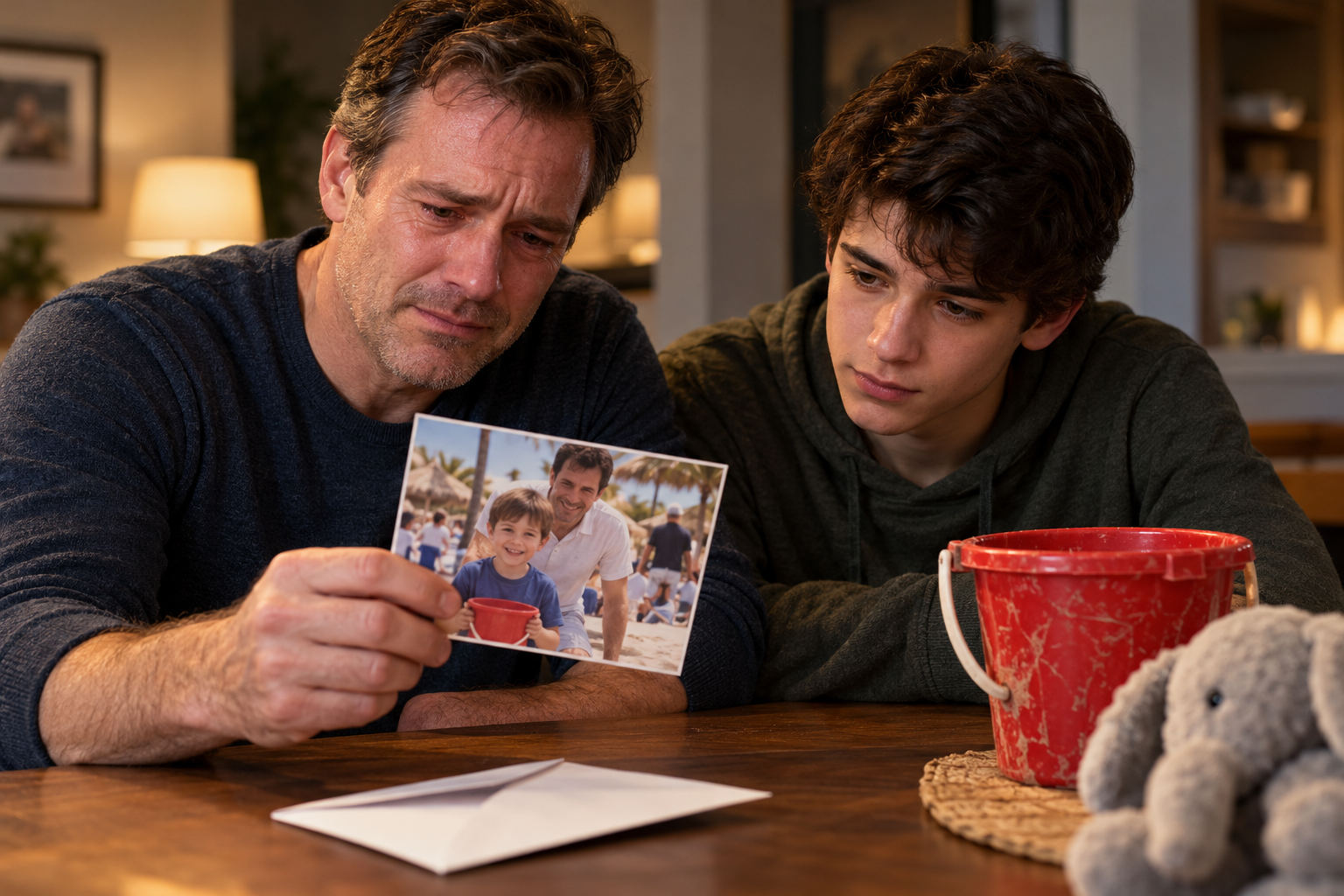
He collected shells, bottle caps, and smooth stones, keeping them in a red plastic bucket that he insisted was treasure.
Most of the things he collected were worthless.
To him, they were not.
He could spend half an hour examining a shell that I would have stepped over without noticing.
Sometimes he asked me to guess what he had found.
I was almost always wrong.
He laughed every time.
I missed that laugh more than I could explain.
After he disappeared, the house became a place where every ordinary object seemed to accuse me.
His shoes remained beside the door.
His drawings stayed on the refrigerator.
The red bucket sat near the back entrance for months because I could not bring myself to put it away.
My wife and I had tried to handle our grief together.
We had tried to give each other room to be angry, frightened, and exhausted.
But grief did not make us better at understanding each other.
It made every conversation harder.
Some days, we spoke about Matthew as though he might return that evening.
Other days, we avoided saying his name altogether.
There was no right way to live with what had happened.
There was only the way we managed to get through the next morning.
Eventually, the years began to separate us.
I won't pretend that our marriage fell apart because of one thing.
It didn't.
There were too many sleepless nights, too many arguments about questions nobody could answer, and too many silences that lasted longer than they should have.
We both wanted someone to blame.
Neither of us knew how to admit that we were blaming ourselves.
When the marriage finally ended, I signed the papers without arguing.
I had already lost the future I thought I would have with my son.
By then, I had stopped believing I could save anything else.
I kept a few photographs.
I kept the red bucket.
And I kept the memory of the afternoon when everything changed.
People often asked whether I remembered the exact moment I realized Matthew was missing.
I did.
I remembered the warmth of the sand.
I remembered the sound of children calling to one another.
I remembered checking the time because I had promised Matthew we would get something to eat afterward.
And I remembered Robert.
That was the part I rarely discussed.
He had been responsible for keeping an eye on Matthew while I dealt with an excursion arrangement nearby.
It was not supposed to be complicated.
Matthew was at the children's club, surrounded by other children and adults.
Robert was there with him.
I had known Robert long enough to trust him without hesitation.
I had no reason, at the time, to believe I was making a mistake.
Before I left, I asked whether he was comfortable watching Matthew for a little while.
He assured me that everything was under control.
I believed him.
I walked away.
That small decision followed me for eleven years.
When I returned, the atmosphere had changed.
People were moving quickly.
Someone was calling for help.
A woman was speaking to a staff member near the pool.
I searched for Matthew first, because I assumed he had wandered away from the children's club.
Then I searched for Robert.
I found him near the pool.
He was standing apart from the confusion.
He wasn't running along the beach.
He wasn't calling Matthew's name.
He wasn't searching the surrounding area with the frantic desperation I expected from someone who had been watching my child.
He was simply standing there.
Looking at the people around him.
At the time, I told myself he was in shock.
I wanted to believe that.
When he finally spoke to me, he said Matthew had disappeared during the commotion.
He said everything had happened quickly.
He said the sea was dangerous that afternoon.
The words came one after another, each one offering an explanation that sounded reasonable until I tried to fit it together with what I had seen.
I asked him where Matthew had gone.
Robert couldn't tell me.
I asked him when he had last seen my son.
His answer changed slightly each time I asked.
Not enough to make me accuse him of lying.
Enough to make me remember the conversation years later.
I was desperate then.
I wanted information more than I wanted to be right.
So I listened.
I accepted what he told me because I couldn't bear the thought that there might be something worse than losing Matthew.
The search continued for days.
People checked the shoreline.
Authorities questioned witnesses.
Staff members were asked to explain what had happened.
Every new possibility gave me a little hope, and every empty answer took some of it away.
I walked along the beach until my legs hurt.
I looked at every child who resembled Matthew from a distance.
Sometimes I called his name even when I knew I had no reason to believe he could hear me.
At night, I replayed the afternoon in my head.
I tried to remember whether he had seemed frightened.
Whether he had been carrying his red bucket.
Whether he had said anything to me before I left.
I searched my memory so many times that I began to distrust it.
The official explanations became more certain as the days passed.
The family explanations became simpler.
People began speaking about Matthew in the past tense.
I hated them for it.
Then I hated myself for hating them.
They were trying to help me survive something they could not understand.
Eventually, the search ended.
There was no discovery that could give me certainty.
There was no final moment in which I could hold my son one last time and say goodbye.
There was only an absence.
I returned home without him.
The red bucket was still where he had left it.
I picked it up and carried it to his room.
Then I put it down beside his bed and sat on the floor.
I stayed there until the light outside the window disappeared.
For a long time, I could not make myself leave that room.
I thought that if I kept everything as it was, I would somehow be preserving a place for him to return to.
It was a foolish belief.
I knew that even then.
But it was the only belief I had left.
Robert continued to visit in the weeks that followed.
He brought food sometimes.
He asked whether I needed anything.
He sat with me when I didn't want to talk.
I appreciated his presence because I had very few people who could bear to sit beside me in silence.
Looking back, I find that difficult to admit.
I trusted him more because I was broken.
I mistook his willingness to stay for proof that he had nothing to hide.
When I asked him again about that afternoon, he always returned to the same basic explanation.
Matthew had been there.
Then he wasn't.
The sea had been dangerous.
Everyone had tried to help.
Robert said he had done what he could.
I wanted to believe him.
I needed someone to tell me that I hadn't handed my son over to the wrong person.
So I believed him.
Eleven years passed.
I moved to a smaller place.
I changed jobs.
I stopped attending gatherings where people might ask about Matthew.
I learned to keep my answers short.
If someone asked whether I had children, I would pause before responding.
Sometimes I said yes.
Sometimes I said I had lost my son.
Sometimes I said nothing at all.
The truth depended on how much I could bear that day.
I still kept his photographs.
One showed him standing beside a small table at the children's club.
His hair was untidy.
His shirt was slightly too large.
He was looking away from the camera, distracted by something outside the frame.
Robert stood behind him.
His hands rested near Matthew's shoulders.
Both of them were smiling.
I had seen that photograph hundreds of times.
For years, I had looked at it as evidence of a life that no longer existed.
I had never considered that it might contain something I had failed to notice.
That changed eleven years after my son vanished.
It began with a phone call.
I almost ignored it because I didn't recognize the number.
I was tired that evening, and I had grown used to calls that brought nothing but questions about the past.
But something made me answer.
The woman on the other end introduced herself as Ramirez.
She spoke carefully.
She asked me to confirm my identity.
Then she asked whether I was Matthew's father.
I stood up so quickly that my chair scraped against the floor.
"Why are you asking me about my son?"
There was a pause.
She told me that she needed to speak with me in person.
I asked whether something had happened.
She didn't answer directly.
Instead, she said there was information about the case that I needed to hear.
I asked her whether they had found him.
The silence that followed was short.
It felt endless.
She told me that she wanted me to come in as soon as possible.
I asked again whether they had found my son.
This time, her voice changed.
She said she believed I needed to prepare myself for what I was about to learn.
I didn't ask any more questions.
I wrote down the address she gave me.
Then I looked at Matthew's photograph on the shelf.
He was still six years old in that picture.
Still smiling.
Still waiting for me to come back.
I took the photograph with me.
Click here to continue reading: PART 2: The Woman Who Called Me Had Answers Nobody Had Given Me, but One Familiar Name Turned My Hope Into Something I Feared
For Eleven Years, I Believed the Sea Had Taken Everything From Me, Until One Photograph Made Me Question the Man I Trusted
Part 1 of 20