The next call came the following morning.
It was Ramirez.
She asked whether I could meet with her again.
I said yes.
I did not ask whether Matthew would be there.
I was beginning to understand that every conversation did not have to lead directly to him.
Some questions needed to be answered separately.
I arrived at the building shortly before noon.
Ramirez met me near the entrance and led me to the meeting room.
The folder was already on the table.
I sat down and waited for her to speak.
She explained that the renewed examination of the case had raised questions about the account given after Matthew disappeared.
I asked what those questions were.
She said she wanted to compare my recollections with the information already recorded.
I felt disappointed.
I had hoped for something more definite.
Then I remembered how many details I had failed to examine carefully over the years.
I agreed to go through the account again.
Ramirez asked me to describe the moments before I left Matthew at the children's club.
I told her that I had been dealing with the excursion arrangements.
I had wanted to make sure everything was organized before we went.
Matthew had been occupied with the other children.
Robert was there.
I had asked him to keep an eye on my son.
He had agreed.
I had walked away believing that nothing could go wrong in the short time I would be gone.
Ramirez asked whether I had noticed anyone else paying particular attention to Matthew.
I said I couldn't remember anyone specific.
She asked whether Robert had seemed concerned about anything before I left.
I told her that he had appeared relaxed.
He had spoken confidently.
He had given me no reason to hesitate.
Ramirez wrote down my answers.
Then she asked me to describe the moment I returned.
I told her that the beach had become chaotic.
People were moving around.
Some were calling out.
Others were looking toward the water.
I had started searching immediately.
I had expected Robert to be beside the children's club.
Instead, I found him near the pool.
Ramirez asked what he had been doing.
I told her that he was standing still, watching the activity around him.
I could not remember whether he had been speaking to anyone.
I could not remember exactly where he had been looking when I first noticed him.
I remembered only that he had not seemed to be searching.
I had thought he was in shock.
That was the explanation I had accepted.
Ramirez asked whether Robert had come to me before I found him.
I said he had not.
She asked whether he had called out to me.
I could not remember hearing him call my name.
I felt a cold sensation move through my chest.
Those details had always been there.
I had never considered that they might matter.
I had spent years focusing on the fact that Matthew had disappeared.
I had paid less attention to the behavior of the person responsible for watching him.
That was a difficult truth to admit.
Ramirez did not tell me what the details meant.
She asked me to continue.
I described the questions I had asked Robert afterward.
I told her that he had spoken about the confusion and the danger near the water.
I told her that he had said everything happened quickly.
I admitted that I could not remember every word.
Ramirez asked whether I had written down his account at the time.
I said I had not.
I had been too overwhelmed to keep a careful record of every conversation.
I had relied on memory.
I had relied on Robert.
I had relied on the conclusion that everyone else seemed willing to accept.
The ocean had become the explanation because there had been no body and no answer.
Over time, the explanation had hardened into something I rarely questioned.
Ramirez asked whether I had ever considered that Robert might have known something he had not told me.
I looked down at my hands.
"Not in a way I was willing to admit."
She waited.
I told her that I had sometimes wondered why he seemed so calm.
I had wondered why he had not searched more visibly.
I had wondered why his account never quite settled in my mind.
But every time those questions arose, I found a reason to dismiss them.
He was my friend.
He had been grieving too.
He had helped me afterward.
Those facts had seemed to outweigh my doubts.
I understood now that they did not answer the questions.
They only made it harder for me to ask them.
Ramirez closed the folder.
She told me that she would continue examining the available information.
I asked whether she believed Robert had lied.
She said she could not make that determination based only on my recollections.
I felt the disappointment again.
I wanted a clear answer.
I wanted someone to tell me that my suspicions were justified or that I could put them away.
Instead, I had to live with uncertainty.
Ramirez said that my willingness to describe what I remembered, without filling in the gaps, was important.
I thanked her.
The words felt strange.
I had spent years thinking that a father should have been able to protect his child.
Now I was being asked to help reconstruct the moments when I had failed to do so.
I did not know whether that would ever lead to a complete explanation.
But I could stop pretending that my memories were more certain than they were.
Before I left, I asked whether Matthew was doing all right.
Ramirez told me that he had been given space to decide how much contact he wanted.
I asked whether he had said anything about our meetings.
She could not tell me everything he had shared.
I accepted that.
I did not need to know every thought my son had in order to care about him.
I only needed to keep showing up when he was willing to see me.
On the way home, I stopped at a small shop and bought a simple notebook.
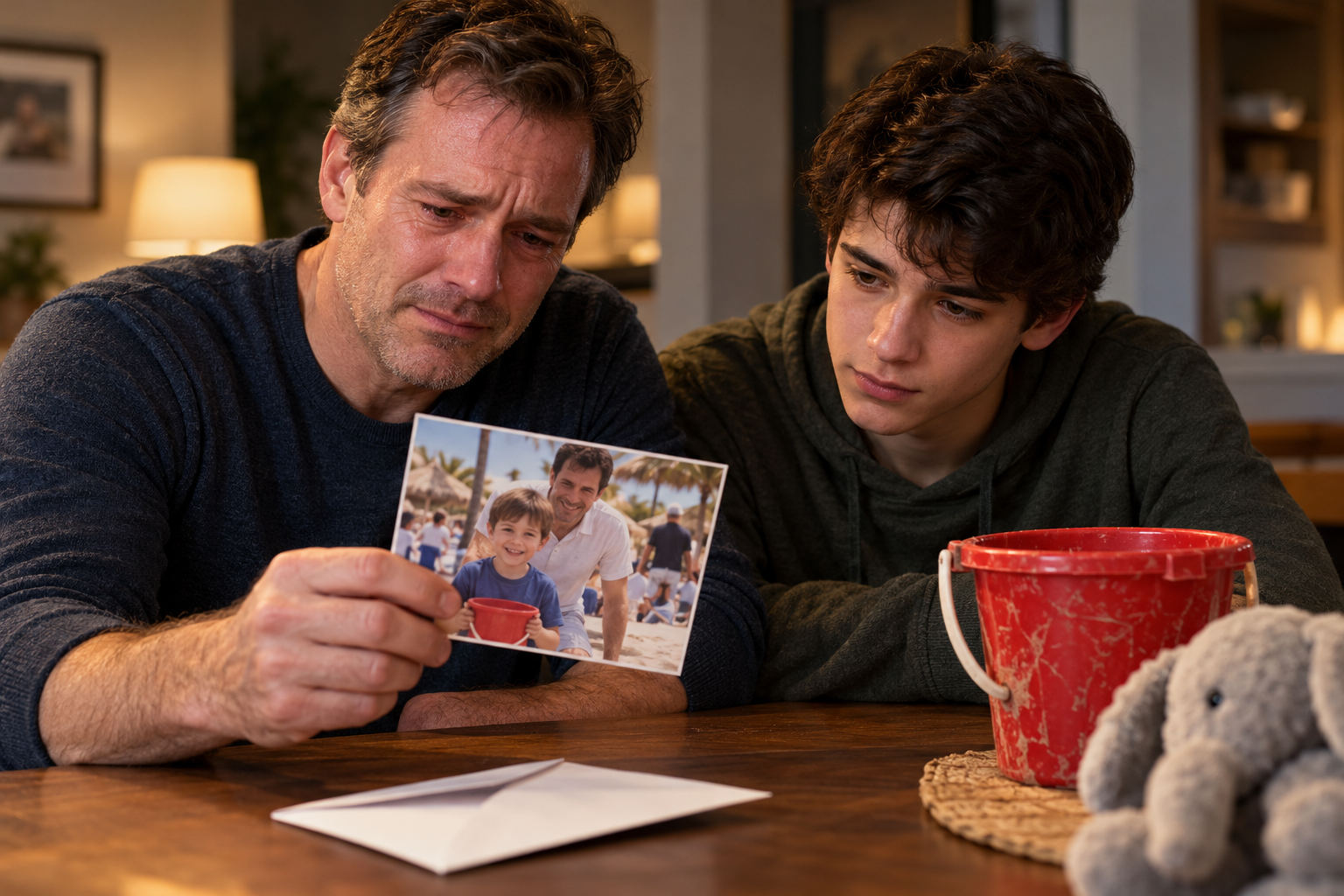
I took it back to the kitchen and placed it beside the red bucket.
Then I opened it to the first page.
I wrote down what I remembered about the afternoon at the beach.
I wrote down what Robert had told me, marking the places where I could not remember his exact words.
I wrote down the moment I found him near the pool.
I wrote down the questions I had asked him since Matthew returned.
I did not write what I thought those things proved.
I did not want another explanation to become a substitute for the truth.
When I finished, I read the page again.
It was not much.
It did not solve the case.
It did not explain where Matthew had been for eleven years.
But it was the first time I had put the memories down without trying to make them fit a conclusion.
I closed the notebook.
Then I looked at the red bucket.
I thought about bringing it to Matthew at our next meeting.
I decided to ask him first.
That small decision mattered.
For eleven years, I had made choices about my son's memory without being able to ask him what he wanted.
Now I had the chance to listen.
I would not waste it by assuming that my love gave me the right to decide everything for him.
That evening, I placed the notebook in the drawer beside the photograph.
I left the bucket where it was.
I did not know what the next meeting would bring.
I did not know what Ramirez would discover.
I did not know whether Robert would ever give me an answer that made sense.
But I knew that I could no longer accept the old explanation simply because it had allowed me to keep living.
My son had returned.
The questions had returned with him.
And this time, I was going to let them remain unanswered until I had a reason to believe the answers.
Click here to continue reading: PART 13: I Had Started Writing Down What I Remembered, and the More Honest I Became About the Past, the Less I Could Trust My Old Conclusions
For Eleven Years, I Believed the Sea Had Taken Everything From Me, Until One Photograph Made Me Question the Man I Trusted
Part 12 of 20