The notebook stayed in the kitchen drawer for two days.
I took it out each morning and read the first page.
Then I put it away again.
I had written down what I remembered about the beach, but I still felt as though something was missing.
Not another detail.
A reason.
I wanted to understand why I had accepted Robert's explanation so easily when parts of his behavior had never made sense to me.
I knew the answer was not simple.
I had been frightened.
I had been grieving.
I had wanted someone I trusted to tell me that there was nothing else I could have done.
Robert had given me that comfort.
I had accepted it because I needed it.
That was the truth I found hardest to face.
On the third morning, Ramirez called.
She asked whether I could come in for another conversation.
I agreed.
Before leaving, I took the notebook from the drawer and slipped it into my jacket.
I did not take the photograph.
I wanted to keep the conversation focused on what I remembered rather than on what the picture made me feel.
Ramirez met me at the entrance.
She led me to the same room and offered me a seat.
I opened the notebook.
She looked at the pages I had written.
I explained that I had tried to separate what I could remember from what I had assumed.
She said that was useful.
Then she asked me to tell her about the days immediately after Matthew disappeared.
I described the search.
I described the calls I made.
I described the way I kept returning to the beach, even after people began telling me that there was little more anyone could do.
I told her that Robert had visited me during that period.
He had brought food.
He had asked whether I had eaten.
He had sat with me when I couldn't speak.
Those memories still felt real.
I did not want to pretend they meant nothing simply because I was questioning him now.
Ramirez asked whether Robert had ever told me not to pursue a particular lead.
I thought carefully.
I could not remember a specific occasion when he had directly stopped me from following information.
He had encouraged me to rest.
He had said the search teams had done what they could.
He had reminded me that the ocean was dangerous.
But I could not say that he had prevented me from doing anything.
I wrote that down.
I was beginning to understand how easily suspicion could become its own kind of certainty.
I did not want to make that mistake.
Ramirez asked whether I had noticed any changes in Robert's behavior over the years.
I said that our friendship had gradually become less close.
We still spoke.
He still checked on me occasionally.
But I had become less interested in spending time with people who reminded me of the life I had lost.
I had assumed the distance was my fault.
I had been withdrawing from almost everyone.
I could not say that Robert's behavior had caused it.
I wrote that down too.
The notebook was becoming a record of what I could not prove as much as what I remembered.
That was uncomfortable.
It was also necessary.
When the meeting ended, I asked whether there was anything new about Matthew's disappearance.
Ramirez told me that the questions remained under examination.
I thanked her and left.
Outside, I stood for a moment with the notebook in my hand.
I wanted to call Matthew.
I wanted to tell him that I was trying to understand what had happened.
Then I remembered that he had not asked me to report every step of the process.
He deserved room to live his life without becoming responsible for my investigation.
I put the notebook away and drove home.
That evening, I received a message from Ramirez saying that Matthew was willing to meet again.
I read it twice.
Then I replied that I would be available whenever he was ready.
The meeting was arranged for the following afternoon.
I spent the evening thinking about what I wanted to say.
I decided I would not begin with Robert.
I would not begin with the investigation.
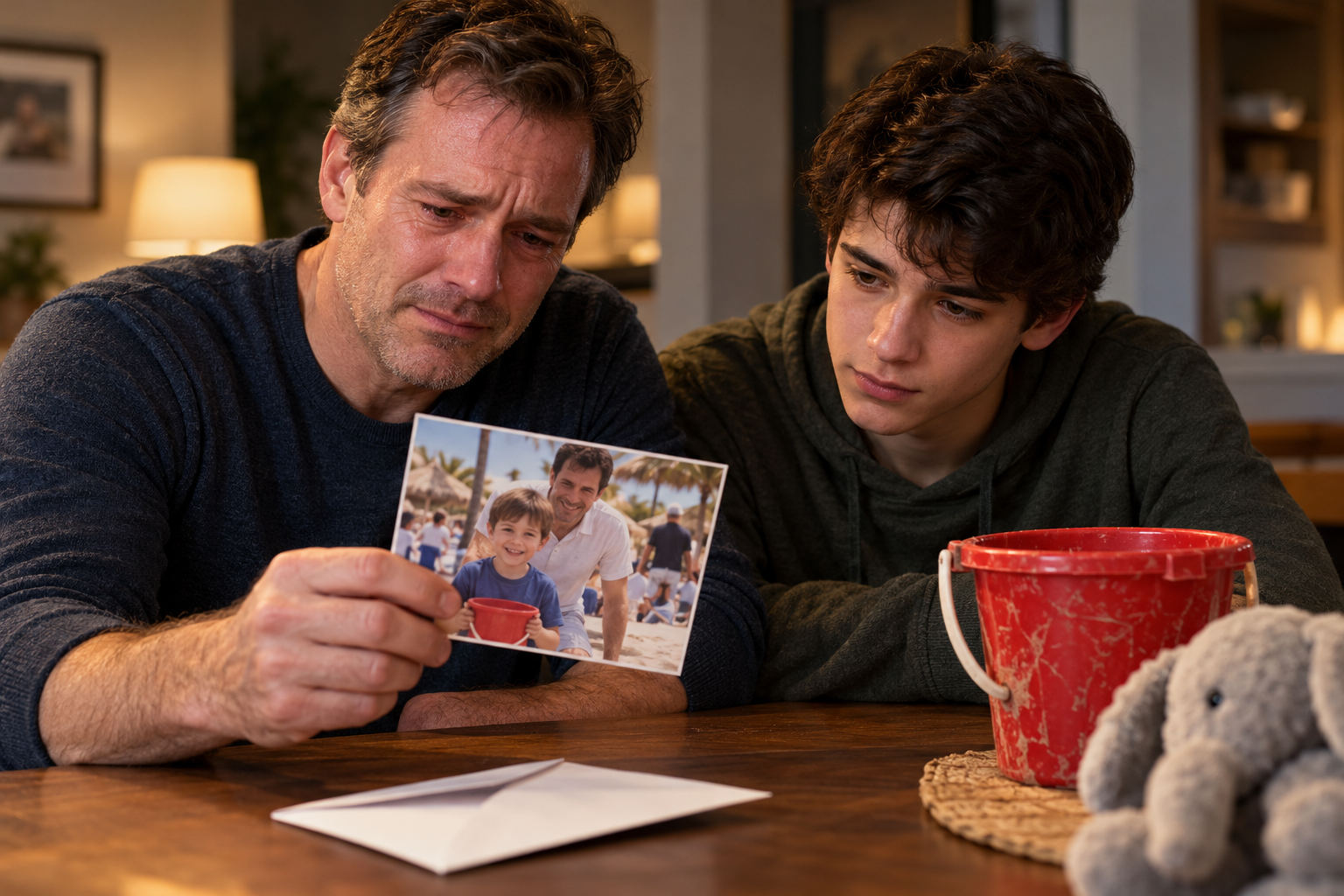
I would ask Matthew whether he wanted to see the red bucket.
If he said no, I would leave it at home.
The next day, I carried the bucket to the building in a plain bag.
I felt ridiculous walking through the entrance with it.
I was a grown man carrying an old piece of plastic as if it were something valuable.
To me, it was.
Matthew entered the room a few minutes later.
His eyes went to the bag beside my chair.
I asked whether he wanted to see what was inside.
He nodded.
I took out the bucket and placed it on the table.
For a moment, neither of us spoke.
He picked it up.
His fingers moved along the scratched side.
I watched his face, trying not to turn his reaction into something it might not be.
"It's smaller than I thought."
I smiled.
"It always seemed big when you carried it."
He looked at the bucket again.
Then he turned it over.
There was a faded mark on the bottom where I had once written his name.
He rubbed it with his thumb.
I remembered doing that with a permanent marker because he had kept leaving the bucket in different places.
I had been afraid someone would mistake it for a discarded toy.
The mark was almost gone now.
Matthew studied it.
I wanted to tell him how many times I had imagined him carrying it along the beach.
Instead, I let him examine it without interruption.
After a while, he put it back on the table.
"Thanks for keeping it."
The words were quiet.
I nodded because I could not trust myself to answer immediately.
We sat together for a little longer.
Then he asked whether I had learned anything new.
I told him that I had been speaking with Ramirez.
I explained that I was writing down what I remembered about the day he disappeared.
He asked whether I was still talking to Robert.
I said that we had spoken on the telephone.
Matthew's expression became difficult to read.
I told him that I had asked Robert about the afternoon at the beach.
I told him that I was not satisfied with the answers I had received.
Matthew looked at the bucket.
I did not ask him to explain his reaction.
Instead, I said that I would not make accusations without knowing what had happened.
"But I'm not going to ignore the questions anymore."
He looked up at me.
For a moment, I thought he might say something about the past.
He didn't.
He simply nodded.
That was enough.
When our meeting ended, I packed the bucket carefully.
Matthew watched me.
I asked whether he wanted me to bring it again.
He said he would think about it.
I told him that was fine.
On the way home, I realized that I had felt no need to take the bucket out of the bag again.
For once, I had allowed an object to be what it was.
A thing my son had once loved.
Not evidence.
Not a promise.
Not a way to force the past into the present.
I put it back in its place at home.
Then I opened the notebook.
I wrote down what Matthew had said about the bucket.
I did not write down what I hoped it meant.
I was learning that the truth required more patience than I had expected.
Click here to continue reading: PART 14: My Son Could Remember the Bucket Without Remembering the Life I Missed, and I Had to Learn Not to Turn Every Small Moment Into Proof
For Eleven Years, I Believed the Sea Had Taken Everything From Me, Until One Photograph Made Me Question the Man I Trusted
Part 13 of 20