
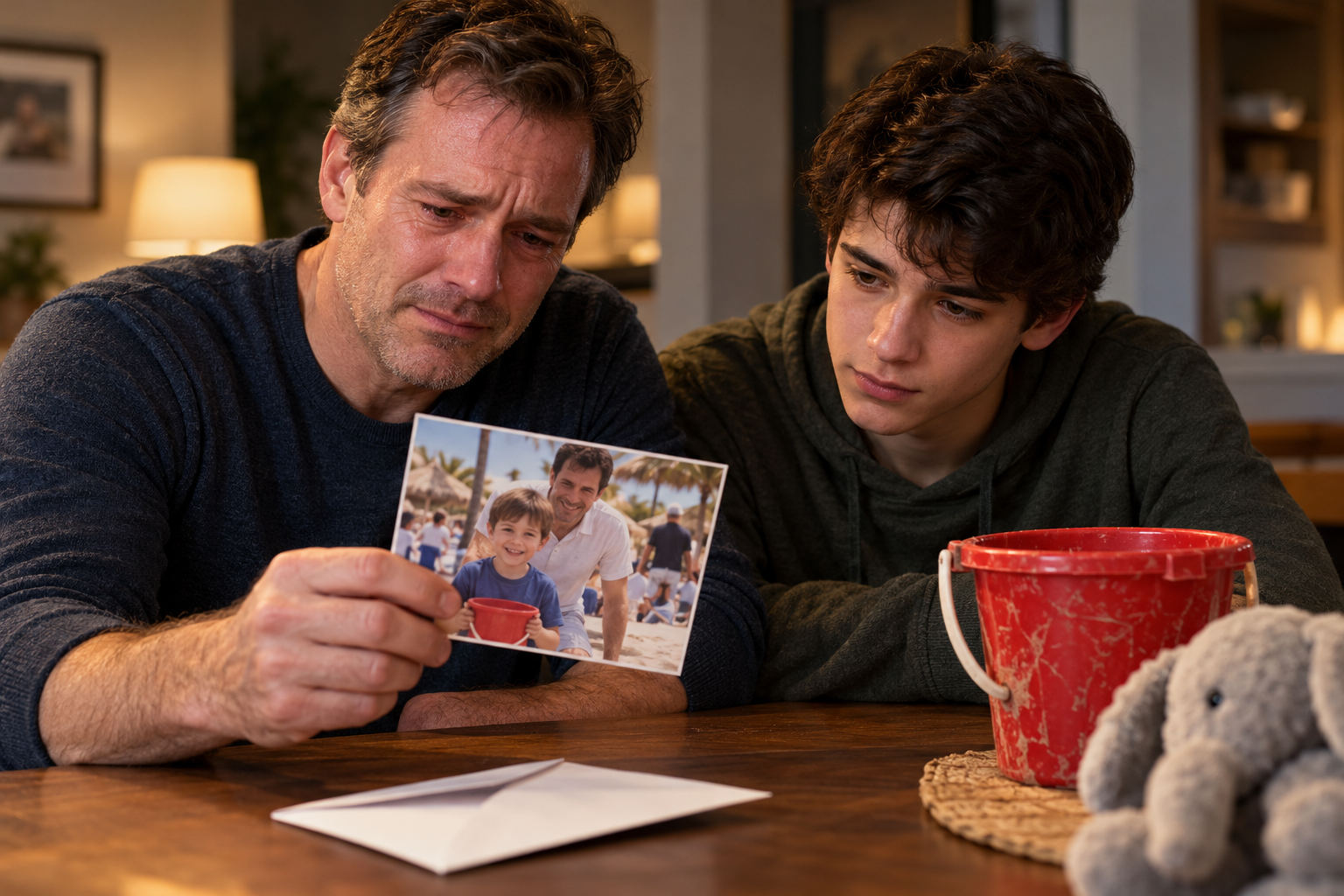
I kept thinking about Matthew's hands on the red bucket.
He had examined the faded name on the bottom as though he were looking at something that belonged to another person.
Perhaps, in a way, he was.
The child who had carried that bucket was someone he could not fully remember.
The father who had kept it was someone he barely knew.
We were both trying to connect two lives that had been separated for eleven years.
I had spent so much time imagining that reunion would restore what we had lost.
Now I understood that nothing could restore it.
We could only begin again.
A few days after our meeting, I received another call from Ramirez.
She asked whether I could come in to discuss some of the details I had provided.
I agreed.
This time, I left the notebook at home.
I wanted to see whether I could answer questions without relying on the words I had written down.
Ramirez asked me about Robert's account of the afternoon.
I told her what I remembered.
She asked whether I had ever heard Robert describe the moments before Matthew disappeared in detail.
I said that he had spoken about the confusion, but I could not recall a complete account that covered every part of the afternoon.
I had never demanded one.
I had been too focused on finding my son.
After the search ended, I had accepted that there might be no answer.
Ramirez asked whether Robert had ever offered a different explanation later.
I could not remember him changing the basic story.
What I remembered were small differences in the way he described the events.
Those differences had bothered me, but I had never written them down.
I told her that I did not want to exaggerate my memory.
I could not quote Robert word for word.
I could only describe the impression his answers had left with me.
Ramirez thanked me.
She explained that she wanted to understand the sequence of events without assuming that every uncertainty pointed to wrongdoing.
I appreciated that.
I had spent too many years turning uncertainty into whatever explanation I needed at the time.
I did not want to replace one untested belief with another.
When I left, I drove to a quiet place and sat in my car.
I thought about the difference between suspicion and knowledge.
Suspicion had become unavoidable.
Knowledge was still out of reach.
I could not force it to appear by worrying harder.
I could not get it from the photograph.
I could not get it from the red bucket.
And I could not get it from Matthew simply because he had returned.
My son was not a witness I could question until I felt satisfied.
He was a young man who had already lost eleven years of his life with me.
I needed to remember that.
The following week, Matthew agreed to meet for a short time.
He asked whether we could talk somewhere other than the room we had been using.
I was surprised, but I agreed.
We met in a quiet public place.
I arrived first and chose a table away from the busiest part of the room.
When Matthew arrived, I stood.
He sat down and looked around.
I asked whether the place was all right.
He said it was.
We ordered drinks.
The conversation began awkwardly.
I asked whether he had been sleeping well.
He said his sleep was irregular.
I told him mine had been poor for years.
Then I regretted saying it.
I had not meant to make our lives sound equal.
My sleepless nights had been part of my grief.
His experiences belonged to him.
I didn't know enough about those years to compare them.
So I changed the subject.
I asked what he wanted to do after our meeting.
He said he hadn't decided.
I told him that he didn't need to make plans around me.
He looked at me briefly.
We sat quietly until he asked whether I still had the photograph.
I told him that I did.
He asked whether I looked at it often.
"Yes."
He seemed to consider that.
Then he asked whether I looked at Robert in the picture.
I was surprised by the question.
"Sometimes."
"What do you see?"
I thought about the answer.
I could have told him that I saw a man who might have known more than he had admitted.
I could have told him that I saw a friend whose behavior had begun to trouble me.
But I did not want to describe a suspicion as if it were a fact.
"I see someone I trusted," I said. "And someone I have questions about."
Matthew looked down at his drink.
I waited.
He did not ask anything else.
I wanted to know why he had asked.
I wanted to know whether the photograph meant something to him that it did not mean to me.
But I let the question remain unanswered.
We talked about other things.
He asked what kind of work I did.
I told him.
He asked whether I still lived in the same area.
I explained that I had moved years earlier.
He listened while I described the house.
I did not tell him that I had once imagined bringing him home to it.
I did not know whether he would ever want to see the place.
When our drinks were finished, I asked whether he wanted to meet again.
He said yes.
I tried not to show how much that answer meant to me.
We stood outside for a moment before separating.
I wanted to hug him.
I still didn't know whether he wanted that from me.
So I asked.
"Would it be all right if I hugged you?"
He hesitated.
Then he nodded.
I put my arms around him carefully.
He remained stiff for a moment.
Then he rested one hand against my back.
It lasted only a few seconds.
When we stepped apart, I did not ask whether it had felt strange to him.
I knew it had.
It had felt strange to me too.
But it had also felt real.
I watched him walk away.
For the first time since his return, I felt that we had shared something that belonged to neither the investigation nor the past.
It was a small moment between a father and a son.
I could not make it larger than it was.
I did not need to.
That evening, I opened the drawer where I kept the photograph and notebook.
I took out the picture.
I looked at Matthew first.
Then I looked at Robert.
I no longer tried to decide what the image proved.
It showed a moment before everything changed.
That was all I knew for certain.
I put it away.
The next time I saw Matthew, I would bring no objects and ask no questions about the case unless he wanted to discuss them.
I wanted him to know that he could spend time with me without becoming part of an investigation.
For eleven years, I had wanted answers.
Now I was beginning to understand that I also needed a relationship with the person those answers concerned.
Click here to continue reading: PART 15: I Had Finally Begun to Know the Young Man My Son Had Become, but the Questions About Robert Still Waited for Me at Home
For Eleven Years, I Believed the Sea Had Taken Everything From Me, Until One Photograph Made Me Question the Man I Trusted
Part 14 of 20

One Comment on “PART 14 – My Son Could Remember the Bucket Without Remembering the Life I Missed, and I Had to Learn Not to Turn Every Small Moment Into Proof”