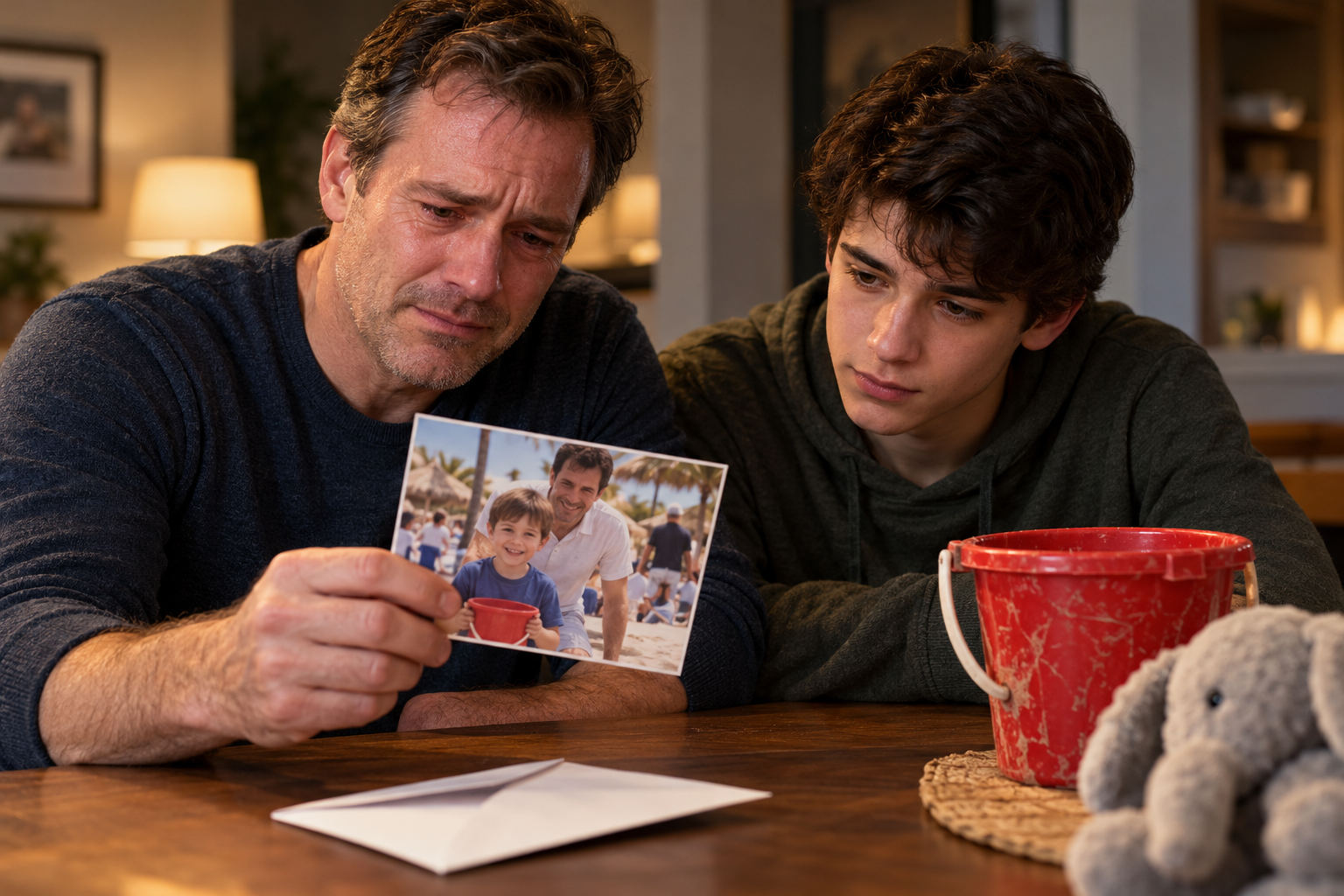
I looked at the photograph again.
The image had not changed.
Matthew stood in front of the children's club.
His red bucket was beside him.
Robert stood just behind him, close enough to appear responsible for keeping him safe.
I remembered that afternoon clearly now.
I remembered the way Matthew had smiled when I told him I would be back soon.
I remembered Robert's easy confidence.
He had made the whole arrangement seem so simple.
For eleven years, I had treated that memory as the last ordinary moment before my life fell apart.
Now I could not stop examining it.
Robert had been smiling.
Matthew had been smiling.
Nothing in the photograph showed what would happen later.
That was what made it so difficult to look at.
Ramirez stood beside the table, giving me time to think.
I tried to organize the memories in my head.
The beach.
The children's club.
The shouting.
The search.
And Robert near the pool.
I had never forgotten where he was standing.
I had only forgotten to ask myself why.
At the time, I had assumed he was overwhelmed by the sudden disappearance.
I had believed that shock could make a person stand still while everyone else moved.
Perhaps it could.
But the longer I considered the scene, the less certain I became.
He had not called out to me.
He had not rushed toward the shoreline.
He had not asked whether anyone had seen Matthew.
He had watched the commotion.
I lowered the photograph.
"Where is my son?"
Ramirez studied my face.
"Robert?"
I shook my head.
"Matthew. I'm asking about Matthew."
She understood.
I could see that she did.
She told me he was in the adjoining room.
For a moment, I couldn't move.
The words seemed too ordinary for what they meant.
My son was in the next room.
Not beneath the sea.
Not lost somewhere beyond the reach of the search teams.
Not a six-year-old boy frozen forever in the photographs I kept at home.
He was close enough for me to walk to him.
I pushed back my chair.
"Take me to him."
Ramirez stepped toward the door but stopped before opening it.
She said there were details I needed to understand first.
I stared at her.
I had spent eleven years waiting for information that might never come.
I had answered questions.
I had attended meetings.
I had listened to people explain why nothing more could be done.
I had learned to live around an empty place that nobody could fill.
And now I was being asked to wait again.
"I've waited long enough."
My voice cracked on the last word.
I tried to steady it.
"I can't sit here while my son is somewhere on the other side of that door."
Ramirez nodded slowly.
She did not argue with me.
She opened the door.
A boy sat in the next room.
He looked up when we entered.
He was seventeen years old.
His hair was dark.
He was taller than I expected, though I could not have explained what I had expected after eleven years.
For a second, I saw only a stranger.
Then I noticed the way he held himself.
Something about the shape of his face pulled at a memory I had tried not to disturb.
I stood still.
The boy looked at me.
Neither of us spoke.
I had imagined this moment in a hundred different ways.
In some versions, Matthew ran toward me.
In others, I fell to my knees and held him so tightly that he complained.
Sometimes I imagined him asking why I had taken so long to find him.
I had prepared answers to questions he might never ask.
But I had never imagined standing in a room with him and being unable to say his name.
Ramirez moved to one side.
She gave us space.
The boy's eyes shifted briefly toward her, then returned to me.
He looked uncertain.
I couldn't blame him.
As far as he knew, I was a man who had suddenly appeared in his life with a story he had not yet heard.
I wanted to cross the room.
I wanted to reach for him.
I was afraid that if I moved too quickly, I would frighten him.
So I remained where I was.
I looked at his face and tried to find the little boy I remembered.
There were traces of him.
The shape of his eyes.
Something familiar around his mouth.
But eleven years had passed.
I had missed the years when his voice changed, when he grew taller, when his face became his own.
I had missed everything a father usually took for granted.
I felt the weight of those lost years before I felt anything else.
Then the boy shifted in his chair.
He looked down at his hands.
And I recognized the way he rubbed his thumb against the side of his index finger when he was nervous.
Matthew had done that as a child.
He used to do it when he was about to ask for something he thought I might refuse.
The small gesture almost brought me to my knees.
I took one step forward.
The boy watched me carefully.
I stopped again.
I did not know what he had been told about his childhood.
I did not know what he remembered.
I did not know whether he had spent eleven years believing that I had abandoned him.
There were too many questions, and every one of them seemed capable of hurting him.
I wanted to ask where he had been.
I wanted to ask who had raised him.
I wanted to ask whether he had ever thought about me.
Instead, I looked at Ramirez.
She gave a slight nod, as if reminding me that the boy needed time.
I understood.
I had waited eleven years.
I could give him a few seconds.
The boy raised his eyes again.
I tried to smile.
It felt strange on my face.
He did not smile back, but he did not look away either.
That was enough to keep me standing.
I moved toward the chair opposite him.
I sat down slowly, leaving the space between us untouched.
The photograph was still in my hand.
I had carried it into the building because I wanted someone to remember Matthew as he had been.
Now I was sitting across from the person he had become.
I placed the photograph on the table.
The boy looked at it.
His expression changed.
It was slight, but I saw it.
His eyes stayed on the picture longer than I expected.
He looked at the child standing in front of the club.
Then he looked at Robert.
I watched his face.
He seemed to be searching for something.
I wanted to ask whether he recognized the scene.
But I held back.
Ramirez remained near the door.
She told me that we could take our time.
I nodded without looking at her.
I could not take my eyes off the boy.
There was so much I needed to know.
There was so much I was afraid to hear.
The ocean had taken eleven years from us, or so I had believed.
I had spent those years imagining a grave without a body.
Now the person I had mourned was sitting across from me, old enough to have lived a life I knew nothing about.
I wanted to reach across the table.
I wanted to say that I was sorry.
I wanted to tell him that I had never stopped looking for him in my own mind, even after everyone else had accepted that he was gone.
But I did not know whether those words would comfort him.
I did not know whether he would believe them.
For the first time since the phone call, I understood that finding my son was not the same as getting him back.
The boy looked at the photograph once more.
Then he lifted his head.
I waited.
Click here to continue reading: PART 4: The Boy Across the Table Had Grown Up Without Me, and the Photograph Between Us Raised Questions Neither of Us Could Answer
For Eleven Years, I Believed the Sea Had Taken Everything From Me, Until One Photograph Made Me Question the Man I Trusted
Part 3 of 20