I left the building that afternoon with Matthew still on my mind.
I had wanted answers.
Instead, I had been given a living person who carried more questions than I could bear to ask.
I sat in my car for several minutes before turning the key.
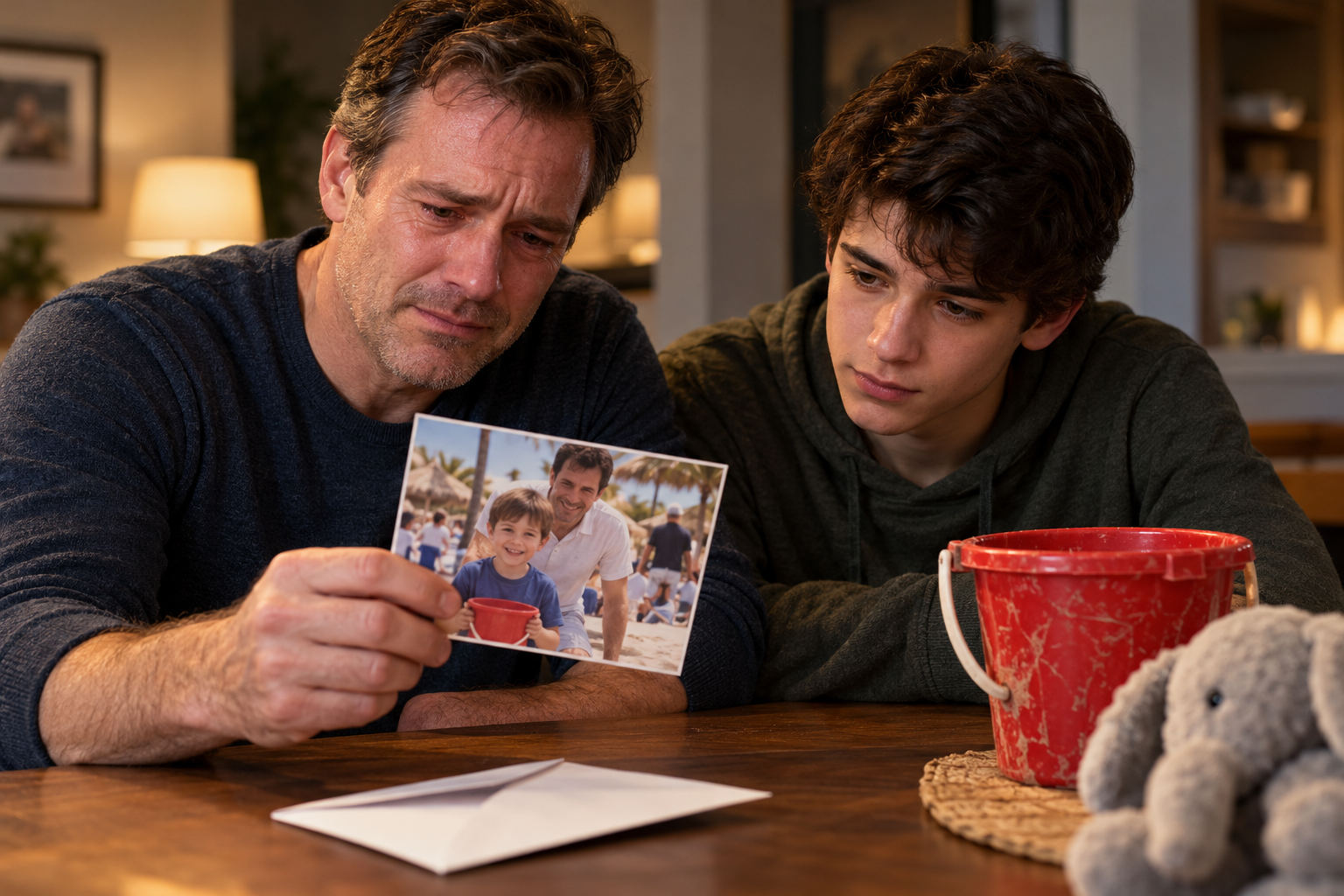
The photograph was in my jacket pocket.
I took it out and laid it on the passenger seat.
Robert stood behind Matthew, looking like the friend I had trusted for years.
I wondered how many times I had looked at that picture without seeing anything beyond what I wanted it to mean.
I had used it to remember my son.
I had also used it to preserve the belief that the afternoon had been an accident no one could have prevented.
Now I wasn't sure what the picture meant.
I drove home slowly.
The roads were familiar.
The houses along the way looked exactly as they had that morning.
Nothing in the world had changed to match what I felt inside.
When I reached home, I left the photograph on the table.
Then I went to the place where I kept Matthew's things.
The red bucket was still there.
Its plastic had faded slightly.
One side had a scratch that ran from the rim toward the bottom.
I remembered how he had once complained that the scratch made it look old.
He had been six.
He had thought old things could always be replaced.
I picked up the bucket.
It was lighter than I remembered.
I ran my fingers over the rim and tried to picture Matthew carrying it along the beach.
I could see him clearly for a moment.
Then the image faded, replaced by the seventeen-year-old boy sitting across from me.
I put the bucket down.
I did not know whether Matthew would want it.
I did not know whether he would want anything from the life he had lost.
I had to stop deciding what he needed before I had even asked him.
That evening, I called Ramirez.
I wanted to know when I could see Matthew again.
She explained that the next meeting would depend on the arrangements being made.
I asked whether he had said anything about me after I left.
She told me she could not share every detail of their conversations.
I understood.
I still hated not knowing.
After the call, I sat at the kitchen table.
The photograph lay in front of me.
I turned it over.
There was nothing written on the back.
I had checked many times over the years, but I checked again anyway.
The blank paper seemed to hold every question I had avoided.
I thought about the moment I returned to the beach.
I remembered how quickly I had searched for Matthew.
I remembered asking people whether they had seen him.
I remembered the feeling of looking at every face and finding none that belonged to my son.
Then I remembered Robert.
He had been near the pool.
He had not been shouting.
He had not been searching.
I had told myself that he was in shock.
I had repeated that explanation so often that it had become part of the memory itself.
But a memory and an explanation were not the same thing.
I could remember where Robert stood.
I could remember what he said.
I could remember how his answers changed.
I could not honestly say that I knew why.
For years, I had treated that uncertainty as a reason to stop asking questions.
Now it felt like the reason I should have kept asking.
I called Robert that night.
I nearly hung up before he answered.
When his voice came through the phone, I felt the old familiarity.
He sounded like the same man who had visited my house after Matthew disappeared.
The same man who had offered to help when I could barely manage ordinary tasks.
For a moment, I wanted to speak to him as though nothing had changed.
Then I remembered my son sitting in the next room.
I remembered the photograph.
I asked Robert whether he had heard anything about Matthew.
There was a pause.
He asked what I meant.
I told him that new information had come to light.
I did not explain more than that.
Robert asked whether someone had contacted me.
I said yes.
He wanted to know who.
I told him that I was not ready to discuss the details.
The silence on the other end lasted longer than I expected.
Then he asked whether I was all right.
It was the kind of question he had asked me for eleven years.
Once, I would have heard concern in it.
Now I wondered what else it might mean.
"I'm managing," I said.
He asked whether I wanted him to come over.
I looked at the red bucket.
"No."
The answer came more quickly than I expected.
Robert did not argue.
He asked me to call if I needed anything.
I said I would.
Then I ended the call.
I sat still for a long time.
I did not know whether Robert had been frightened by what I said.
I did not know whether he understood how much my life had changed that day.
I only knew that I no longer wanted him in my house.
That was a small decision.
It was also the first decision I had made about him without trying to protect his feelings.
I went to bed late.
I did not sleep much.
Every time I closed my eyes, I saw Matthew sitting across from me.
I remembered his question about whether I had kept looking.
I remembered how carefully he had watched my face when I answered.
I wondered whether he had spent years asking himself similar questions.
Had his father looked for him?
Had his father forgotten him?
Had his father believed the ocean had taken him?
I had answers to those questions.
But I could not assume that telling him the answers once would make him believe them.
The next morning, I returned to the building.
I had not been told to come that day.
I simply needed to ask whether Matthew wanted to see me again.
Ramirez met me at the entrance.
She explained that she would check whether he was available.
I waited in the same small room where I had first sat with him.
The chairs were still in the same places.
The tissues remained beside the papers.
I found myself staring at the empty chair opposite me.
When Matthew entered, I stood.
He looked surprised to see me.
I told him that I had come to ask whether he wanted to meet again.
He considered the question.
Then he nodded.
We sat down.
I did not take the photograph out.
I wanted him to see that I could sit with him without turning every conversation toward the past.
We talked about ordinary things for a little while.
I asked whether he had slept.
He said he had.
I asked whether he wanted something to eat.
He shook his head.
I told him that I had kept the red bucket.
He looked at me for a moment.
Then he asked whether it was still in good condition.
I almost laughed.
"Not exactly."
He looked away, and I thought I saw the beginning of a smile.
It disappeared quickly.
But I had seen it.
For the first time, I understood that our reunion would not happen in one grand moment.
It would happen in small exchanges.
In questions that did not require painful answers.
In the patience to let a conversation end before either of us was ready to say more.
I could not give Matthew back his childhood.
I could not make eleven years disappear.
I could only offer him the chance to know me again.
And I could stop allowing Robert's version of the past to stand in the way of that.
Click here to continue reading: PART 8: When I Finally Stopped Protecting My Old Memories of Robert, I Realized How Much I Still Needed to Learn About My Son
For Eleven Years, I Believed the Sea Had Taken Everything From Me, Until One Photograph Made Me Question the Man I Trusted
Part 7 of 20